Location
Mount Vernon, WA 98274

Location
Mount Vernon, WA 98274

From energy-harvesting wristbands to palmable projectors, the latest wave of micro gadgets is redefining convenience and connectivity. These ultra-portable tools marry cutting-edge materials science with practical design, promising to streamline our routines and spark new ways to interact with the world.
The world of personal technology is undergoing a quiet revolution. As devices shrink in size, they expand in capability, delivering power and intelligence in forms small enough to slip into a pocket, clip onto a keychain, or adhere to a shirt sleeve. This shift is not just about novelty; it’s about reimagining our relationship with tools, making smart functions more accessible and ubiquitous. Recent breakthroughs in micro-battery chemistry, flexible electronics, and energy harvesting have ignited a race to pack more performance into ever-smaller packages. For everyday users, that means on-demand projectors that fit in the palm, wearable sensors that harvest body heat, and foldable keyboards that slip inside a notebook.
At the heart of these innovations are new materials. Solid-state microbatteries, measuring only a few millimeters across, now deliver energy densities once reserved for larger cells. By replacing liquid electrolytes with solid films, engineers have achieved improved safety and longevity in a package slim enough to embed in a ring or a smart sticker. Meanwhile, flexible solar films-thin as a postage stamp-convert ambient light into electricity, powering low-draw electronics like environmental sensors or health patches without ever needing a plug. Combined, these advances open doorways to gadget designs that run indefinitely on ambient energy or can be recharged in seconds.
Consider the rise of portable projectors no larger than a matchbox. Leveraging microlens arrays and ultra-efficient laser light sources, these pint-sized beamers now cast bright, sharp images onto walls or tabletops from a distance of several feet. Creatives on the go use them to share presentations during impromptu meetings, while home entertainment enthusiasts pack them for movie nights in the backyard. Unlike their bulkier predecessors, they slip into side pockets and draw minimal power from a microbattery or a retractable USB cable. Their compact form has inspired accessory ecosystems-from foldable projection screens that collapse to postcard size to pocketable tripod mounts that double as phone stands.
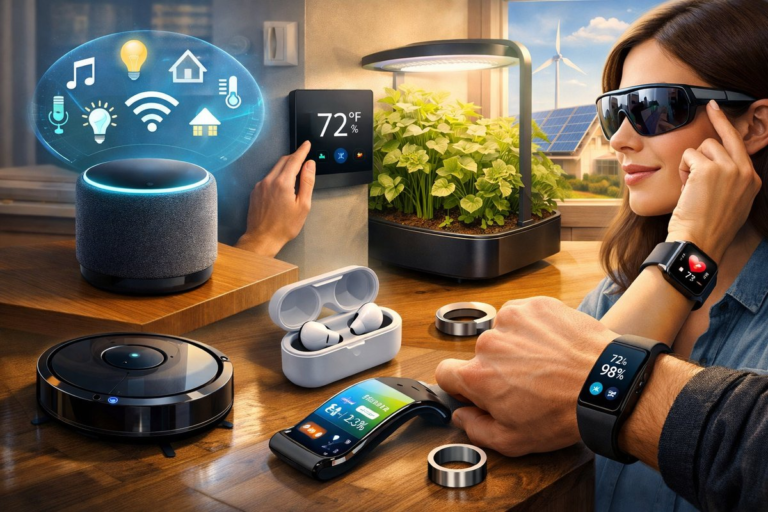
Wearable health monitors are undergoing a similar shrink-and-smarten trend. Ultra-thin sensor patches can adhere to skin like a Band-Aid, tracking biometric data such as hydration levels, sweat composition, and even blood oxygenation. By harvesting kinetic energy from motion or heat from the wearer’s body, they can report data continuously for days without needing a recharge. Smart rings, leveraging the same microbatteries at their core, measure sleep patterns, heart rate variability, and gesture inputs while remaining virtually weightless. These devices pair seamlessly with companion apps, offering real-time alerts and personalized recommendations that once required full-sized wristbands or chest straps.
Connectivity itself is getting pocket-sized. Mesh-networking nodes now fit into modular keychain fobs, forming self-healing data highways for remote sensors or ad-hoc communications in disaster zones. Tiny USB-C hubs carry HDMI, Ethernet, and multiple USB ports in a package no bigger than a car key. For travelers, a credit-card-thin Wi-Fi hotspot can keep several devices online without the bulk of a traditional router. Each slice of extra functionality-lightweight encryption chips, nano-SIM trays, multi-band radios-finds a place in these compact shells, turning a single dongle into a Swiss Army knife of connectivity.
Augmented reality is also slipping into our pockets. Clip-on AR glasses, with micro-OLED displays embedded into lightweight frames, enable heads-up notifications and context-aware prompts. Instead of a headset that weighs a pound or costs thousands, these micro-augmented spectacles handle navigation cues, language translation, and simple task reminders while you keep both hands free. Some models project turn-by-turn directions onto the lenses, while others overlay workout metrics on your field of vision during runs. The combination of low-power display chips and energy-harvesting temples means hours of use before a top-up, all in a frame that looks like regular eyewear.
Then there’s the category of micro robotics. Tiny drones, no larger than a postage stamp with rotor blades the width of a paperclip, can dart through narrow passages to inspect machinery or search for survivors in collapsed structures. On the manufacturing floor, insect-inspired robots scuttle along pipelines, delivering real-time thermal imaging or air-quality readings without requiring humans to crawl into confined spaces. Powered by miniature rechargeable cells and guided by onboard AI modules, these bots operate autonomously or via remote controls. Their small size and unobtrusive profiles make them ideal for covert environmental monitoring or precision tasks in sensitive settings.
Even classic desktop items are getting a micro makeover. Portable thermal printers, small enough to fit in a jacket pocket, can print stickers, labels, or receipts wherever you go. They pair with smartphones using low-latency Bluetooth chips and draw power from tiny polymer batteries. Miniature mechanical keyboards collapse to half their size with folding hinges and magnetic keys, offering tactile typing experiences on the move. And for audiophiles, wireless earbuds now pack active noise cancellation, spatial audio processing, and multi-device pairing into buds that barely extend beyond the earlobe.
Of course, the march toward micro-form factors raises questions about sustainability and e-waste. When a device is so small that components are embedded in custom microchips or laminated into film, recycling and repairability become more complex. Designers are exploring biodegradable substrates and modular architectures that allow individual modules-battery, sensor, or radio-to be swapped out without replacing the entire unit. Extended warranties and take-back programs are emerging, but consumers must remain aware of proper disposal channels for tiny electronics.
Privacy and security also take on new dimensions when devices are both discreet and pervasive. Wearable sensors on a lanyard or invisible insole could collect sensitive data around the clock. Manufacturers are embedding hardware-level encryption and secure-element chips to guard against unauthorized access, but users should still confirm data-handling policies and disable always-on features when privacy is a concern. In enterprise settings, IT teams are developing micro-device registration frameworks to ensure that only approved gadgets can join corporate networks.
Looking ahead, the next frontier may lie at the nanoscale. Researchers are exploring inkjet-printed circuits on biodegradable films, creating single-use sensors that dissolve after environmental monitoring or medical diagnostics. Brain-machine interfaces could shrink to the size of a pea, offering noninvasive neural feedback through clusters of electrodes densely packed into flexible patches. And ambient energy harvesting may mature to the point where devices run perpetually on sources as subtle as room light, tiny temperature differentials, or radio frequencies filling the air.
These tiny tools are not just science-fiction curiosities; they are entering labs, offices, and pockets today. Their power-to-size ratios, once constrained by chemistry and physics, are leaping forward thanks to interdisciplinary advances in materials, microfabrication, and AI-driven design optimization. As they proliferate, our collective challenge will be to wield them responsibly-balancing privacy, ecological impact, and long-term support with the conveniences they promise.
Whether you’re a digital nomad seeking a palmable projector for impromptu presentations, a fitness enthusiast wearing a paper-thin health patch, or a tinkerer experimenting with foldable input devices, this era of micro form factors offers solutions that fit wherever you go. Tiny tech is more than a trend; it’s a design philosophy that puts capabilities in the hands of every user, no matter how small the device. And as miniaturization continues, the line between object and ecosystem will blur, enabling new modes of interaction that feel natural, seamless, and delightfully compact.
Curious readers and early adopters can start by exploring the current crop of micro gadgets and experimenting with how these tools integrate into everyday life. From charging a solar harvester on a window sill to projecting a display onto any flat surface, the possibilities are limited only by imagination. The next time you reach for something in your pocket or clip a device to your bag, consider not just its size, but the big impact it carries within its tiny frame.