Location
Mount Vernon, WA 98274

Location
Mount Vernon, WA 98274
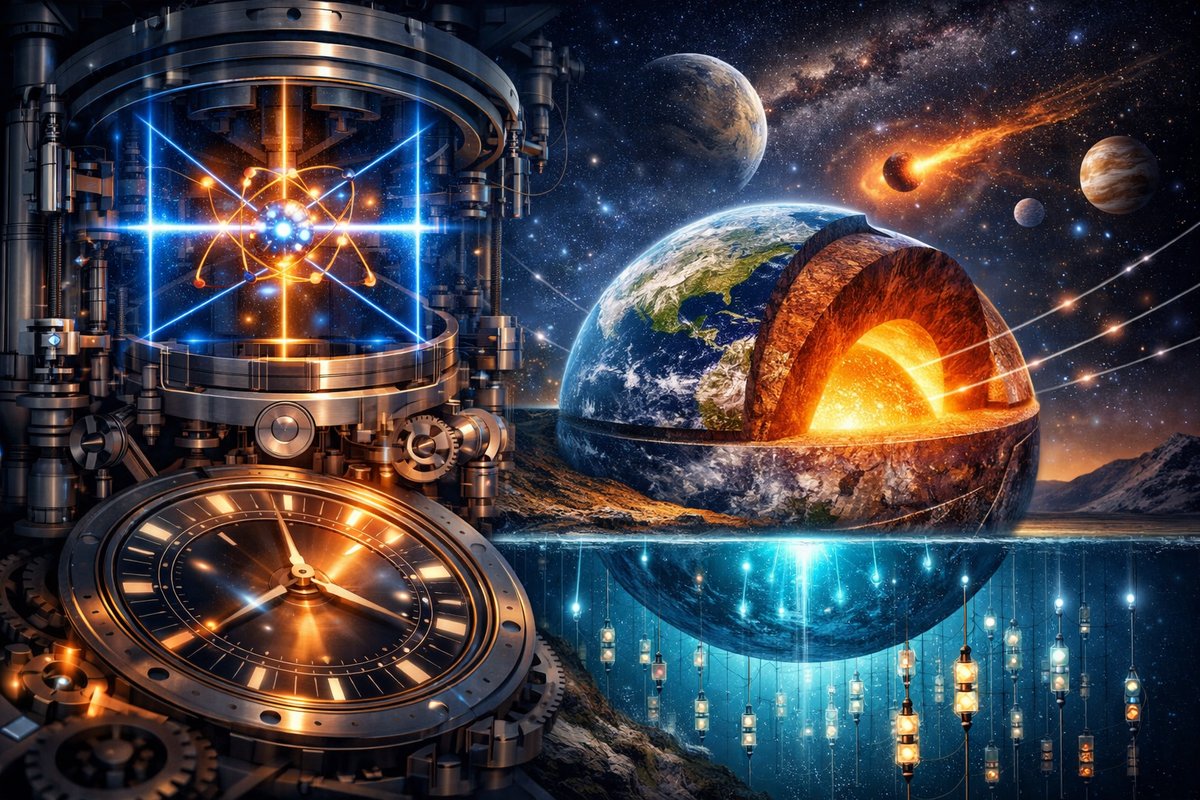
From next-generation optical lattice clocks that lose less than a second over the age of the universe to neutrino telescopes mapping Earth's hidden layers, an international effort is pushing the limits of how we measure time and matter. This article examines the breakthroughs redefining our cosmic timeline and the tantalizing mysteries they reveal.
The human urge to measure and understand the flow of time has driven remarkable advances in both technology and theory. This year, an international consortium unveiled an optical lattice clock whose precision outstrips its predecessors by orders of magnitude, losing less than one second over the entire history of the universe. At the same moment, underground detectors at the South Pole and the Mediterranean Sea captured neutrinos streaming through our planet, offering a never-before-seen view of Earth’s innermost structure. These twin triumphs in chronometry and particle detection are weaving a new tapestry of reality, one where time, matter, and mystery are inseparable.
In Braunschweig, researchers at Germany’s national metrology institute demonstrated the latest generation of optical lattice clocks using strontium atoms suspended in laser light. By isolating atoms from nearly every source of environmental interference, the clock’s ticks are defined by the wavelength of light absorbed and emitted with staggering regularity. This leap forward promises improved synchronization for global navigation, more accurate astrophysical observations, and stringent tests of fundamental physics. As clocks become precise enough to detect tiny variations in Earth’s gravitational field, they could one day map subterranean density anomalies or even monitor sea level changes in real time.
Beyond these laboratory marvels, engineers have miniaturized atomic clock technology to the scale of a smartphone chip. Chip-scale atomic clocks harness the same principles that govern large optical systems but in packages that consume only a few watts of power. These devices could revolutionize telecommunications, secure time stamping for financial transactions, and ensure synchronization for autonomous vehicles operating in GPS-denied environments. As they integrate into everyday gadgets, the boundary between personal electronics and professional timekeeping will blur, granting each of us an unprecedented awareness of the relentless march of moments.
While precise clocks probe the dimension of time, neutrino observatories are illuminating the nature of the matter through which those moments pass. At the IceCube facility beneath the Antarctic ice, scientists have charted the pathways of ghost-like neutrinos born in cosmic explosions. Some of these particles pass directly through the Earth, interacting so rarely that vast detectors are needed to catch a single collision. Yet every captured neutrino carries information about its passage through different layers of rock and metal, enabling what researchers call neutrino tomography. For the first time, we can peer into the planet’s core to study its density, composition, and thermal currents in a way that complements seismic studies.
Meanwhile, the KM3NeT detector in the Mediterranean Sea is capturing neutrinos arriving from deep space. By triangulating data from multiple detectors, physicists are beginning to trace neutrinos back to their sources: colliding neutron stars, supernova remnants, and perhaps even the supermassive black hole at the center of our galaxy. These observations enrich our understanding of high-energy processes and help calibrate models of cosmic ray production. Combining neutrino data with gravitational wave signals promises a multi-messenger era in astronomy, where time-stamped arrivals of different particle species reveal the intricate choreography of the universe’s most violent events.
Gravitational wave observatories like LIGO and Virgo have also entered a new phase of sensitivity. Their latest observing run detected subtle lensing of gravitational waves as they bend around massive galaxy clusters, effectively turning distant black hole mergers into natural probes of dark matter distribution. This use of spacetime ripples as a cosmic microscope showcases the interplay between time, gravity, and elusive matter that neither emits nor absorbs light. Each chirp and ringdown from a merging binary opens a window on the distribution of unseen mass in the cosmos, hinting at the identity of dark matter and the true landscape of the universe.
Quantum sensors are emerging as versatile tools for exploring both time and matter. Taking advantage of wave-particle duality, these devices use ultracold atoms or superconducting circuits to detect minute changes in electric and magnetic fields. Portable quantum gravimeters can monitor groundwater levels, volcanic activity, and tectonic shifts by measuring slight variations in local gravity. Atomic interferometers built into compact modules may soon fit into backpacks, empowering geologists and engineers with precision once reserved for national laboratories. As quantum technologies mature, they will generate terabytes of data linking microscopic interactions to macroscopic phenomena.
The cosmic microwave background (CMB) remains a treasure trove of mysteries tied to the origin of time and matter. Recent balloon-borne experiments have measured the CMB’s polarization with unprecedented accuracy, searching for the faint imprints of gravitational waves from the earliest moments after the Big Bang. Although no definitive signal has been found yet, the absence of certain polarization patterns is already constraining inflationary models of the universe. Meanwhile, unexpected anomalies in the CMB’s temperature distribution continue to puzzle theorists, suggesting possible influences from primordial black holes or interacting dark sectors. Each new data point refines our cosmic calendar and informs our theories of matter’s genesis.
These technical milestones are more than feats of engineering; they speak to a deeper human quest. Time and matter are the scaffolding of our experience, shaping memory, identity, and endurance. The ticking of a clock can mark a lifetime or a comet’s approach, while the passage of particles through a detector can tell a story billions of years in the making. Engaging with these phenomena encourages us to reflect on our place in a universe where every second and every atom carries profound significance.
In everyday life, this research fuels innovations that touch us all. Precise timing underpins secure communications and financial networks, ensuring that transactions settle without ambiguity. Matter-wave sensors guide autonomous vehicles through urban canyons where GPS falters. New materials born from quantum research promise more efficient energy storage and greener electronics. As these tools weave into the fabric of society, they bring abstract concepts of time dilation and particle exchange into our homes, our offices, and even our pockets.
The next frontier lies in testing the constancy of fundamental constants themselves. Scientists hope to compare time measured in different gravitational potentials to see if the fine-structure constant or the proton-to-electron mass ratio shifts over cosmic distances or epochs. Any detected variation would upend the bedrock of physics and open doors to new theories of gravity and quantum mechanics. International collaborations are designing space missions to place optical clocks in orbit and compare them with terrestrial counterparts, effectively creating a planet-wide gravitational map encoded in time.
Challenges loom as these instruments reach ever-greater sensitivity. Shielding from environmental noise, managing massive data streams, and ensuring international coordination all demand robust infrastructure and open sharing of methods. Researchers emphasize ethical considerations in deploying quantum sensors for surveillance or military use. Ensuring the benefits of these breakthroughs are distributed equitably will require dialog among scientists, policymakers, and the public. The story of time and matter is not just a scientific narrative but a social one, shaping the future of technology and governance.
Looking forward, the marriage of big data, artificial intelligence, and these next-generation instruments promises discoveries we can scarcely imagine. Machine learning algorithms are already combing through petabytes of neutrino and gravitational wave data, identifying patterns that human analysts might miss. AI-guided telescopes can autonomously pivot to transient events, capturing the earliest photons from distant explosions. Such systems blur the line between observer and actor, raising questions about agency and interpretation in scientific discovery.
At its core, the pursuit of precise timekeeping and matter mapping is a testament to curiosity and collaboration. From university labs to polar ice caps, from fiber-optic networks to deep-sea observatories, researchers are uniting on a shared mission: to chart the contours of reality with ever-finer brushstrokes. Their work reminds us that the cosmos is both external and internal, measured by instruments and felt in our awareness of change and permanence. In chasing the threads that bind time, matter, and mystery, we reaffirm our capacity to explore, to question, and to marvel at the grand tapestry of existence.