Location
Mount Vernon, WA 98274

Location
Mount Vernon, WA 98274
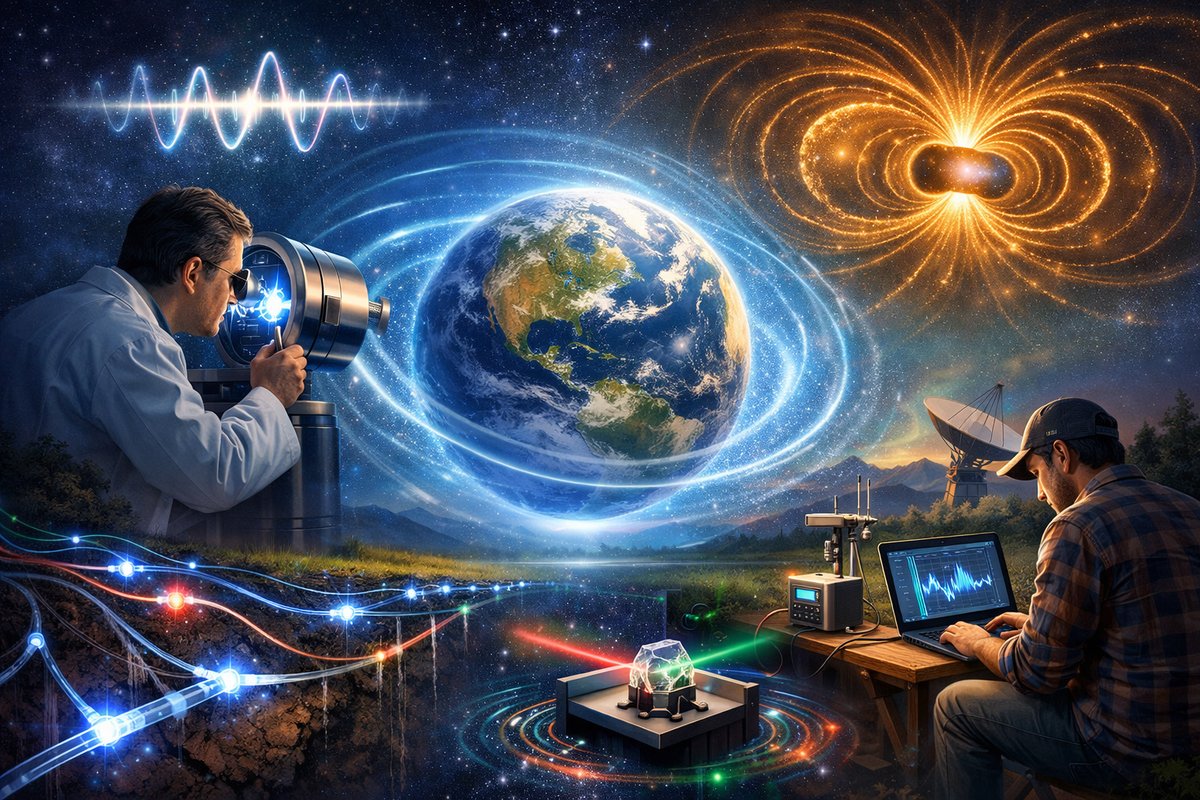
Scientists and citizen networks are tuning into Earth's hidden symphony, harnessing gravity sensors, fiber-optic arrays, and backyard magnetometers to decode natural forces once thought imperceptible. These emergent tools reveal fleeting gravity waves, shifting magnetic eddies, and quantum-scale vibrations that knit together our planet's invisible dynamics.
Across deserts, coastlines, and rooftop gardens, a quiet revolution is unfolding. No longer confined to ivory-tower labs, the tools of geophysics and quantum sensing are slipping into the hands of explorers with DIY toolkits and open-source code. This democratization of natural-forces research is exposing a web of subtle signals-gravity waves drifting through the stratosphere, magnetic vortices dancing beneath the ocean surface, and emergent patterns in flocks, schools, and microbial mats.
A new generation of microcontroller development boards paired with high-sensitivity accelerometers is chasing atmospheric gravity waves. Launched on tethered weather balloons, these instruments capture vertical oscillations in air density that ripple out from thunderstorms and jet-stream instabilities. By logging data at sub-second intervals and linking via LoRa or similar radio protocols, citizen teams map a hidden choreography of upward and downward winds. These gravity undulations, while imperceptible at ground level, shape storm formation and influence aircraft turbulence miles above.
Meanwhile, fiber-optic distributed acoustic sensing (DAS) is turning subsea cables and highway guardrails into vast sensor networks. The technology shines laser pulses down strands of glass fiber, then measures backscattered light to detect minute vibrations. Deployments along coastal cables have revealed internal waves sloshing through the deep ocean. On land, urban planners are exploring how roadway vibrations correlate with traffic flow and even distant seismic tremors.
But it’s Earth’s magnetic field that offers perhaps the most poetic illustration of hidden forces. A cadre of backyard physicists has cobbled together digital magnetometer modules, GPS dongles, and open-source data platforms. Stations dotted across rural counties record nanotesla-level fluctuations-magnetic eddies spawned by solar storms, undersea currents, and even the ebb and flow of a storm system’s rainfall. When converged into a public database, these readings help forecast space weather impacts on power grids and radio communications.
At the quantum scale, trembling diamond crystals known as nitrogen-vacancy centers are emerging as ultra-sensitive magnetometers. Laser excitation and microwave fields coax electron spins in these tiny defects, which respond to minute field changes. Room-temperature experiments are already mapping weak currents in biological tissues, suggesting future applications in medical imaging.
The rising chorus of sensors has revealed unexpected patterns. In one collaborative effort, atmospheric gravity-wave maps were overlaid with magnetometer readings from the same region. Researchers detected how stratospheric wave packets modulate the ionospheric currents, creating transient magnetic pulses at mid-latitudes. These findings refine our understanding of how weather and space weather interlock.
Emergent systems in biology also mirror these physical forces. Drone-based photogrammetry is tracking flocking starlings and schooling fish, then applying algorithms borrowed from fluid dynamics. The result: virtual vortices resembling those in laboratory wind tunnels and ocean gyres. Microbial mats in hypersaline pools generate centimeter-scale convection cells that mimic large-scale ocean overturn, linking biology to planet-scale physics.
Bridging these scales requires not only advanced instruments but also accessible software. Cloud-based repositories now host signal-processing pipelines that handle vast time series of magnetic, acoustic, and acceleration data. Citizen contributors can upload raw files and run standardized analyses-spectrograms, coherence matrices, wavelet transforms-within minutes. Interactive dashboards plot the arrival times of gravity-wave fronts alongside geomagnetic indices and sea-surface temperature anomalies, fostering multidisciplinary insights.
The environmental stakes are high. Precise gravity measurements can track groundwater depletion in semi-arid regions. Magnetometer networks can pinpoint pipeline corrosion zones before leaks occur. Underwater acoustic sensing aids marine protected areas by detecting boat noise, vessel traffic, and even illegal fishing. These applications speak to a broader value of open-source, community-driven science: helping societies anticipate and adapt to natural hazards.
Yet challenges remain. Data quality varies widely across homemade rigs. Calibration against professional-grade instruments is essential, but access can be limited. Power constraints in remote locations demand solar-charged battery packs. And data security must balance transparency with respect for local privacy: seismic data can inadvertently expose covert activities, while magnetometer logs reveal radio-frequency transmissions from nearby installations.
To tackle these hurdles, consortia are emerging. University labs supply calibration pods that can be shipped to citizen groups. Mobile apps guide on-site calibration routines for magnetometers, accelerometers, and barometers. Blockchain-style ledgers track data provenance, ensuring each reading is verifiable without compromising individual identities.
Perhaps most exciting is the prospect of quantum-networked sensors. Researchers are exploring entangled photon pairs sent through fiber links hundreds of kilometers long. When gravity waves stretch and squeeze the fiber, correlated shifts in photon arrival times betray the wave’s signature. Such quantum networks, combined with classical sensors, could pinpoint gravitational anomalies with unprecedented resolution.
As these technologies proliferate, one thing becomes clear: nature’s forces are not static backdrops but dynamic, interwoven narratives. Gravity, magnetism, acoustic waves, and biological patterns all feed into a single tapestry of interactions. By blending professional expertise with grassroots enthusiasm, we stand on the brink of decoding Earth’s invisible rhythms in full.
Whether you’re a school teacher launching a balloon from the playground, a weekend kayaker deploying an underwater acoustic log, or a retired physicist arraying magnetometers in your backyard, the tools of discovery are within reach. In embracing this collective curiosity, we don’t just gather data-we craft new stories about our planet’s living, breathing essence.