Location
Mount Vernon, WA 98274

Location
Mount Vernon, WA 98274
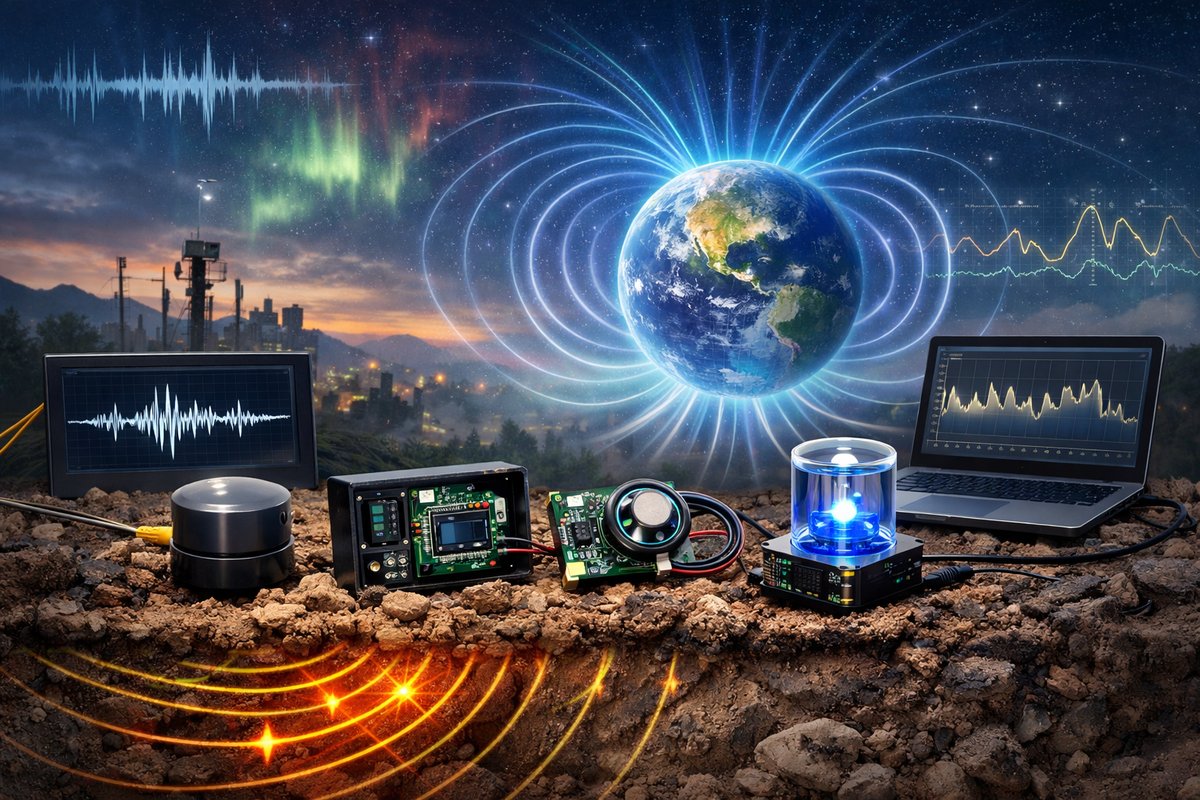
A new wave of citizen-driven sensor networks is capturing Earth's faintest whispers-tiny tremors, geomagnetic flickers, and subtle air pressure ripples once lost in noise. By weaving together low-cost geophones, magnetometer boards, barometric sensors, and pocket quantum devices, enthusiasts and researchers are unmasking hidden patterns that could reshape our view of natural forces.
Earth is alive with subtle signals-microquakes trembling beneath our feet, geomagnetic ripples swirling through the atmosphere, and faint pressure waves riding on ocean breezes. These silent phenomena are often drowned out by human bustle and conventional instrumentation limits. Now, a grassroots revolution of low-cost sensors is revealing the planet’s hidden rhythms in unprecedented detail. Enthusiasts and professionals alike are deploying DIY geophones, magnetometer breakout boards, barometric pressure kits, and even table-top quantum sensors in backyards, basements, and co-working labs around the globe. Their combined data streams are painting a vivid portrait of natural forces at scales both microscopic and planetary.
Distributed Microseism Detection
Tiny tremors-microseisms-continuously ripple through Earth’s crust and ocean floors. Historically, only high-end seismic stations could register events below magnitude 2. But recent projects like the collaborative Earth Echo Initiative have shown that low-cost geophone sensor kits, costing under one hundred dollars each, can detect these faint quivers. Volunteers install simple geophones in their basements or gardens, connecting them to single-board computers. When a local tremor or distant passing storm generates ground vibrations, the geophone transduces mechanical motion into electrical signals. Software on the computer timestamps, filters, and uploads data to a central server.
Within weeks, participants see real-time seismic maps revealing tremor clusters beneath major fault lines and surprisingly strong microseisms near busy coastal shipping lanes. Researchers have already spotted precursory wave patterns hours before small landslides in mountainous regions and used aggregated data to refine early-warning thresholds. As the network grows, every city street corner and rural homestead becomes part of a living seismograph.
Mapping the Invisible Magnetic Landscape
Earth’s magnetic field continually shifts, influenced by solar storms, molten metal flows in the core, and even passing freight trains. High-quality magnetometers cost thousands, but compact three-axis magnetometer breakout boards connectable to common microcontrollers now retail for under fifty dollars. Early adopters are using these boards mounted on weather-proof enclosures to log geomagnetic intensity fluctuations with milligauss precision.
Citizen scientists armed with magnetometer nodes have traced local magnetic anomalies caused by buried pipelines, old mine shafts, and massive steel bridges. During a recent solar storm, hundreds of these amateur stations worldwide captured sudden spikes in field strength, providing density and coverage far exceeding sparse professional observatories. Data fused across the network helped utilities anticipate minor transformer faults triggered by the storm’s geomagnetically induced currents.
Tuning into Atmospheric Gravity Waves
Above the ocean and across mountain ranges, atmospheric gravity waves-ripples in air density-arise from jet streams, thunderstorm outflows, and orographic lift. Professional weather balloons and radar can detect these features, but low-cost barometric pressure sensors on smartphones or microcontroller boards now let hobbyists sense minute pressure oscillations in their own backyards.
When a cluster of citizens synchronizes sampling-some at sea level, others atop hills-the overlapping pressure data traces gravity wave crests sweeping through the troposphere. In one coastal town, a volunteer network recorded a clear gravity wave signature spawned by a distant squall line, matching radar imagery with uncanny fidelity. These local pressure stations could one day improve short-term wind forecasts for aviation and renewable energy farms.
Quantum Sensing on a Desktop Scale
Quantum sensors exploit the strange rules of quantum mechanics to achieve unrivaled sensitivity. Though traditionally confined to advanced labs, tabletop quantum diamond magnetometers and cold-atom gravimeters are inching toward compact, lower-cost designs. In one proof-of-concept setup, a desktop quantum diamond chip detected magnetic fluctuations five times weaker than the background noise of a consumer magnetometer board.
Researchers are exploring loaner programs and community lab access so citizen scientists can run specialized quantum experiments. Currently, these devices reveal transient magnetic pulses from lightning strikes hundreds of kilometers away and minute gravity perturbations as heavy vehicles pass overhead. As miniaturized quantum modules continue to drop in price, similar to how early personal computers democratized computing, a broader public could soon harness quantum insights into Earth’s forces.
Fusing Data Streams for Emergent Insights
Alone, each sensor network is valuable. Together, they unlock emergent patterns where microseisms, geomagnetic fluctuations, pressure waves, and quantum signals interact. A central open-source platform ingests time-synced feeds from geophones, magnetometers, barometers, and quantum detectors. Machine-learning algorithms sift through the noise, pulling out correlated events across modalities.
During a recent mountain seepage event, geophones detected tiny precursory rock cracks while magnetometers showed simultaneous shifts linked to moisture-driven electrical changes in the soil. The pressure sensors noted an upslope gravity wave reflecting the local wind pattern. The fused dataset allowed researchers to pinpoint the breach zone hours before visible leakage, offering a new blueprint for landslide risk monitoring.
Challenges and Opportunities
Mass participation brings technical hurdles. Ensuring each DIY node maintains accurate timing is critical-subsecond discrepancies can blur cross-sensor correlations. Community workshops on GPS-synchronized clocks, network latency calibration, and common-format data standards are underway. Data privacy and security also demand careful protocols: volunteer sites must opt in for location sharing, and raw streams are anonymized before public display.
Nonetheless, the rapid growth of sensor deployments demonstrates a thirst for hands-on science. Crowdsourced initiatives complement professional networks by filling spatial gaps at low cost and providing redundancy against outages. As the system’s data archives expand, researchers anticipate training AI models to detect previously unknown geophysical phenomena and even forecast hazards with hours of lead time.
The Future of Ground Truth
From a basement geophone to a pocket-size quantum sensor, ordinary people are turning their homes into observatories for Earth’s subtle dynamics. This fusion of low-cost hardware, open-source software, and community spirit is transforming how we perceive natural forces. Each sensor node tells a small story; collectively, they compose a sweeping narrative of our planet in motion. The next tremor you feel, the faint magnetic flicker at dawn, or the slender ripples in air pressure could join a global symphony of data-and spark fresh discoveries about the living world beneath our feet and above our heads.