Location
Mount Vernon, WA 98274

Location
Mount Vernon, WA 98274
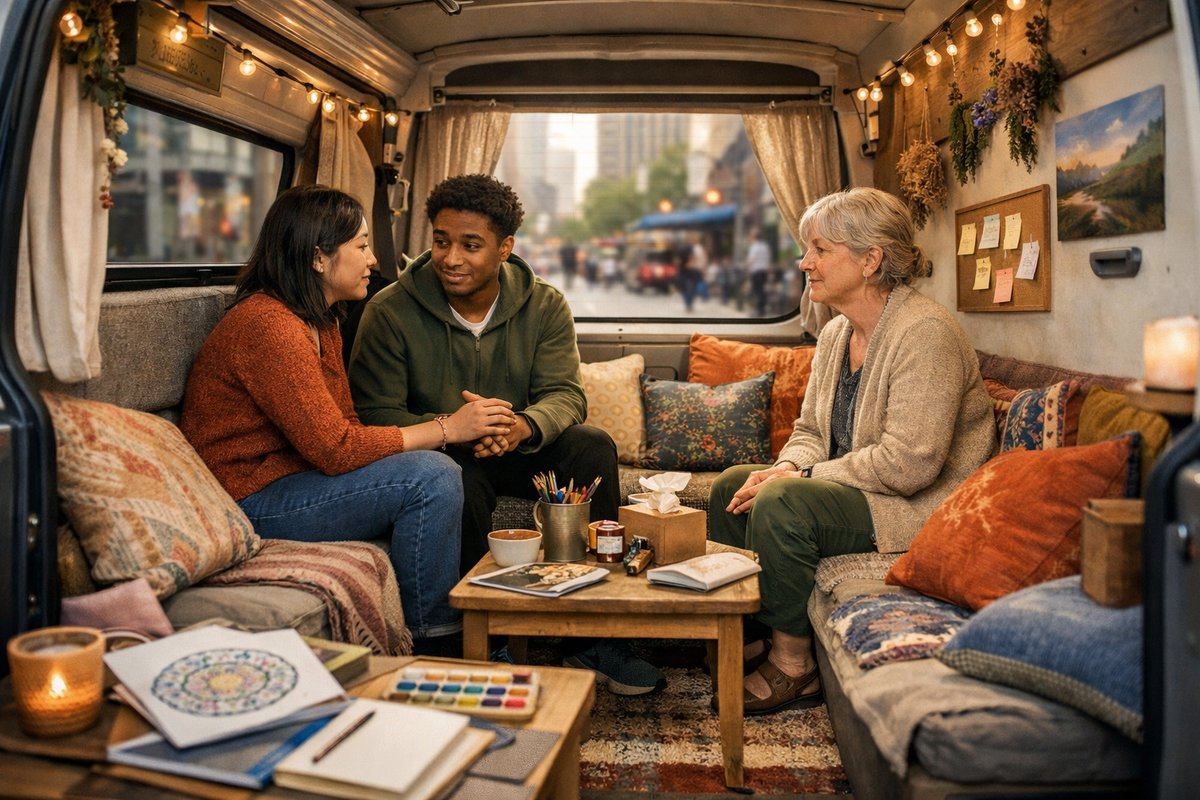
A converted van outfitted with cozy cushions and peer counselors has become an unlikely sanctuary for city dwellers grappling with loneliness, anxiety, and grief. The Mobile Empathy Lab weaves together art therapy, journal prompts, and quiet conversations to foster connection and resilience across diverse neighborhoods.
On an overcast morning at the edge of a busy downtown plaza, a battered grey van rolls to a gentle stop. Its windows are frosted over with chalkboard paint, bearing hopeful messages scrawled in pastel chalk: “You matter,” “Tell your story,” and “Breathe.” Inside, beneath a canopy of paper lanterns and fairy lights, volunteer peer counselors invite passersby to sit on a patchwork of floor cushions and folding chairs. They offer steaming mugs of herbal tea, coloring sheets, and a safe space for people to share the weight of their worries.
Dubbed the Mobile Empathy Lab, the project began eighteen months ago when a small group of social workers, artists, and health advocates pooled their savings to retrofit a retired ambulance. Their mission was simple: bring informal mental health support directly to city streets, parks, and bus stops where many residents wrestle with isolation, job loss, or trauma. What started with weekend pop-ups has now grown into a weekday fixture in neighborhoods where spaces for honest conversation are scarce.
“We wanted to meet people where they are,” says Maya, a licensed counselor who patrols the streets in shifts. “Often, the hardest step is admitting you need someone to listen. This van removes so many barriers. You don’t need an appointment or insurance; you just stop by.” Over time, volunteers have stocked the Lab with art supplies, pipes of soft cushions, yoga mats for stretching breaks, and pocket journals filled with prompts about gratitude, fears, and small victories.
City health data shows that rates of anxiety and depression among adults have climbed steadily in recent years. More than one in four residents report feeling lonely on a regular basis, and surveys reveal that access to affordable counseling remains out of reach for many. Traditional clinics and hotlines struggle to bridge the gap between demand and capacity, leaving a void that projects like the Mobile Empathy Lab aim to fill.
At noon, children spill out of a nearby after-school program to join a group mandala-making workshop on a foldable table set up beside the van’s open doors. Parents watch from a bench, relieved to see their youngsters express themselves with colored pencils and glitter glue rather than screens. Across the street, a retiree who lost her partner last year tentatively approaches. She hesitates for a moment, then asks for a clean sheet of paper. Within minutes, she’s tracing her feelings in swirling lines and shapes, finding release in every loop and arch.
The impact of these impromptu conversations often extends long beyond the van’s eight-hour run. Volunteers distribute small packets containing contact information for local support groups, crisis lines, and free or sliding-scale clinics. They also hand out mindfulness coloring books, portable water bottles, and referral cards for neighborhood yoga classes. In some cases, a single interaction has inspired participants to enroll in a job training program, reconnect with family members, or seek professional help for untreated depression.
Behind the scenes, a rotating crew of six full-time coordinators and twenty part-time helpers keeps the Lab rolling. They load supplies at a central warehouse each morning: stacks of bright notebooks for journaling, jars of non-toxic paint, meditation cushions, folding stools, and battery-powered Bluetooth speakers for soft background music. A solar panel strapped to the van’s roof recharges jump drives, lights, and audio equipment, reflecting the team’s commitment to sustainability even as they tackle urgent social needs.
Late one afternoon, a college student named Adrian steps up to the van’s side window with tears in his eyes. He had been homeless for three nights after a series of setbacks, including a failed scholarship and a falling-out with his roommate. He didn’t know where to turn. A volunteer offers him a hot cup of chai and invites him inside, where he meets someone who once faced similar struggles. They talk for an hour about resilience, coping strategies, and local services that could help him find temporary housing. Before he leaves, the volunteer hands him a small stainless steel water bottle and a pocket-size gratitude journal.
These spontaneous acts of care have given the Lab a reputation as a beacon of hope. City officials have taken notice and allocated a modest grant to expand operations. Organizers are now exploring partnerships with public libraries and community centers, hoping to anchor branches in underserved districts. Meanwhile, local businesses have donated blankets, tea blends, and healthy snacks to fill the Lab’s pantry.
Still, the Mobile Empathy Lab faces challenges. Volunteers often confront issues that exceed their training-suicidal thoughts, severe addiction, or complex family crises. The team has developed a protocol for urgent referrals but acknowledges that deeper systemic change is essential. They advocate for increased funding for affordable mental health care and for the removal of bureaucratic hurdles that keep people from seeking help.
In a city that can feel overwhelming and indifferent, the van’s painted slogan-“Healing Happens Here”-serves as a promise and an invitation. It reminds residents that vulnerability is not a weakness but a doorway to community. It celebrates the courage required to ask for help and the quiet power of listening without judgment.
On the last stop of the day, as dusk settles in, volunteers pack up art supplies and fold away yoga mats, careful not to leave a scrap of litter behind. They swap stories of encounters that gave them hope: the mother who found relief in deep-breathing exercises, the veteran who sketched his nightmares into safety, the teenager who discovered he wasn’t alone in his grief. The van hums to life, headlights cutting a path through city lights.
For those who boarded the Mobile Empathy Lab, the road ahead may still hold uncertainty and hardship. Yet as they step back into crowded streets, they carry something vital: proof that a single conversation, a shared cup of tea, or the blank page of a journal can spark healing. In that, there is a quiet kind of revolution-one built on empathy, resilience, and the belief that every story is worth holding.