Location
Mount Vernon, WA 98274

Location
Mount Vernon, WA 98274
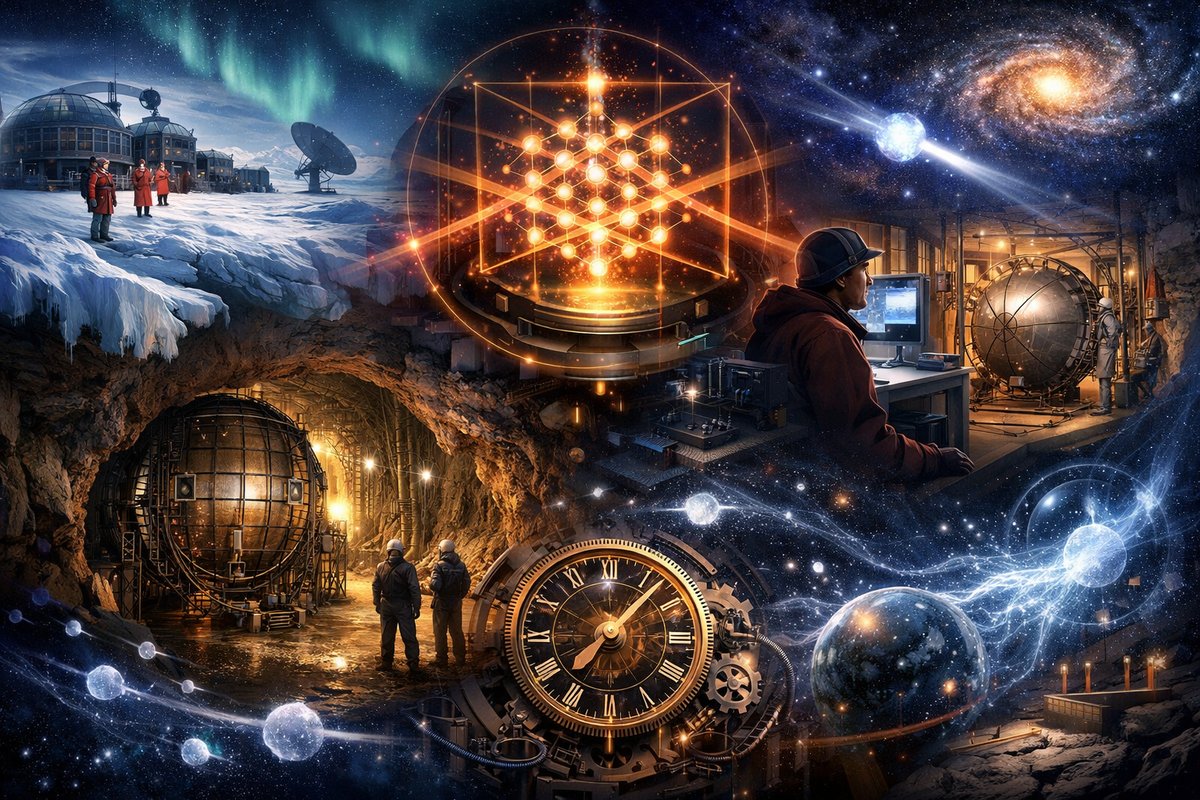
In remote laboratories and polar ice, scientists are chasing the faintest whispers of the universe-precision clocks that measure time to unfathans and detectors hunting ghostly particles. From optical lattice frequencies to dark matter hunts deep underground, the interplay of time, matter, and mystery is reshaping our understanding of reality.
In the predawn hush atop a remote plateau, an array of lasers hums with uncanny stillness. Precision optical lattice clocks tick in unison, their atoms held in a lattice of light, each oscillation a testament to our mastery over the flow of time. Far below, deep beneath a mountain cavern, a vat of liquid xenon lies waiting for a particle that might pass through without a trace. Scatterings the size of whispers could reveal the elusive dark matter that outmasses every star in the visible universe. This is the stage where time, matter, and cosmic mystery converge, and researchers are fine-tuning their instruments like virtuosos, striving to hear the cosmos whisper its secrets.
On the timekeeping front, a multinational collaboration recently unveiled an optical lattice clock boasting uncertainty in the 10 to the minus eighteen range-so precise that it can detect the difference in tick rate between sea level and a mountaintop just a few meters higher. By suspending ultracold atoms in a standing wave of laser light, the clock achieves stability unrivaled by any mechanical or microwave standard. Not only does this advance promise more accurate global navigation systems and synchronization across data networks, but it also offers a novel tool for testing Einstein’s theory of general relativity, mapping tiny gravitational shifts with a sensitivity once thought impossible.
Meanwhile, in subterranean vaults shielded by kilometers of rock, physicists have doubled the target mass of a liquid xenon detector designed to catch interactions with dark matter particles. These detectors operate at cryogenic temperatures, monitoring scintillation flashes and ionization trails as potential evidence of weakly interacting massive particles (WIMPs). Recent upgrades to photodetectors and purification systems have pushed background noise to record lows, enabling scientists to set the most stringent constraints yet on dark matter properties. Though no definitive signal has emerged, each null result narrows the field of theoretical candidates and guides the next generation of experiments.
Far to the south, beneath the frozen expanse of Antarctica, a network of optical sensors arrayed in the ice sheet listens patiently for neutrinos born in distant cosmic accelerators. These ghostly particles pass through ordinary matter almost unimpeded, but when one finally collides with an atomic nucleus in the clear ice, it produces a fleeting flash of light detected by photo-sensors embedded deep below the surface. After years of data collection, researchers have identified high-energy neutrinos that trace back to violent astrophysical phenomena such as supernova remnants and active galactic nuclei. Each neutrino event carries a message in the language of particle physics, shedding light on processes that forge the heaviest elements in the universe.
On another front, gravitational wave observatories across the globe have just completed a major sensitivity upgrade, enabling the detection of fainter ripples in space-time from black hole mergers occurring billions of light-years away. By measuring minute distortions in kilometer-scale laser arms, these instruments convert the subtlest spacetime tremors into electrical signals, unveiling cataclysmic dramas in the deep cosmos. The latest observing run has already reported new classes of events-possibly collisions between black holes of unexpected masses-challenging our models of stellar evolution and compact object formation.
Beyond individual experiments, cosmologists are grappling with a nagging discrepancy known as the Hubble tension. Measurements of cosmic expansion derived from the cosmic microwave background and those based on local supernova observations diverge more than current errors allow. New polarization data from ground-based telescopes may offer clues about early-universe physics, while alternative models involving exotic forms of dark energy or unaccounted-for neutrino species are under active investigation. Resolving this tension could rewrite our understanding of the universe’s birth and evolution.
The interplay of precision timekeeping and matter studies has given rise to advanced quantum sensors capable of mapping Earth’s gravitational potential with centimeter-scale resolution. By carrying portable atomic clocks on aircraft or in satellites, geophysicists can detect subterranean features such as magma chambers or aquifers, opening new horizons for resource management and natural disaster forecasting. This is no longer science fiction; field trials have already demonstrated the ability to chart geological structures purely from time measurements, forging a link between fundamental physics and practical applications that touch everyday life.
The implications cascade outward. Improved clock networks bolster the performance of positioning systems, enhancing navigation for autonomous vehicles and powering next-generation communication links. Advances in dark matter detection inform material science, inspiring novel shielding techniques and ultra-low background electronics. Neutrino observatories contribute to nuclear nonproliferation by monitoring reactor emissions, while gravitational wave findings sharpen our picture of black hole demographics and the cosmic cycle of star birth and death.
Looking ahead, plans are underway for a spaceborne optical clock mission that would synchronize with ground stations to test general relativity on an interplanetary scale. Similarly, satellite arrays dedicated to hunting signatures of dark matter annihilation in the Milky Way halo aim to complement earthbound detectors. Meanwhile, the next generation of gravitational wave detectors-stretching laser arms into space-promises to open a new window on low-frequency phenomena, capturing mergers of supermassive black holes and shedding light on galaxy formation across cosmic time.
Yet for all these achievements, the universe retains its air of enigma. Strange anomalies persist, like hints of unknown interactions in rare isotope decays or unexpected excesses in cosmic-ray spectra. Each mystery beckons researchers to devise more sensitive instruments, to push the boundaries of what can be measured, and to question long-held assumptions.
In the end, the dance of time, matter, and mystery is a reminder that science is both a rigorous discipline and a grand adventure. From desert plateaus to frozen continents, from mountain vaults to orbiting satellites, humanity’s quest to decode the universe unfolds in laboratories and observatories large and small. Every tick of a clock, every faint flash in a detector, brings us one step closer to understanding the deep rhythms that underlie reality itself.
As this era of precision experiments and cosmic searches marches on, one thing remains clear: the next breakthrough could emerge anywhere, whether in the whisper of a laser, the scintillation of xenon, or the tremor of a colliding black hole. In exploring the nexus of time and matter, we not only map the cosmos but also chart our own place in the grand narrative of existence.