Location
Mount Vernon, WA 98274

Location
Mount Vernon, WA 98274
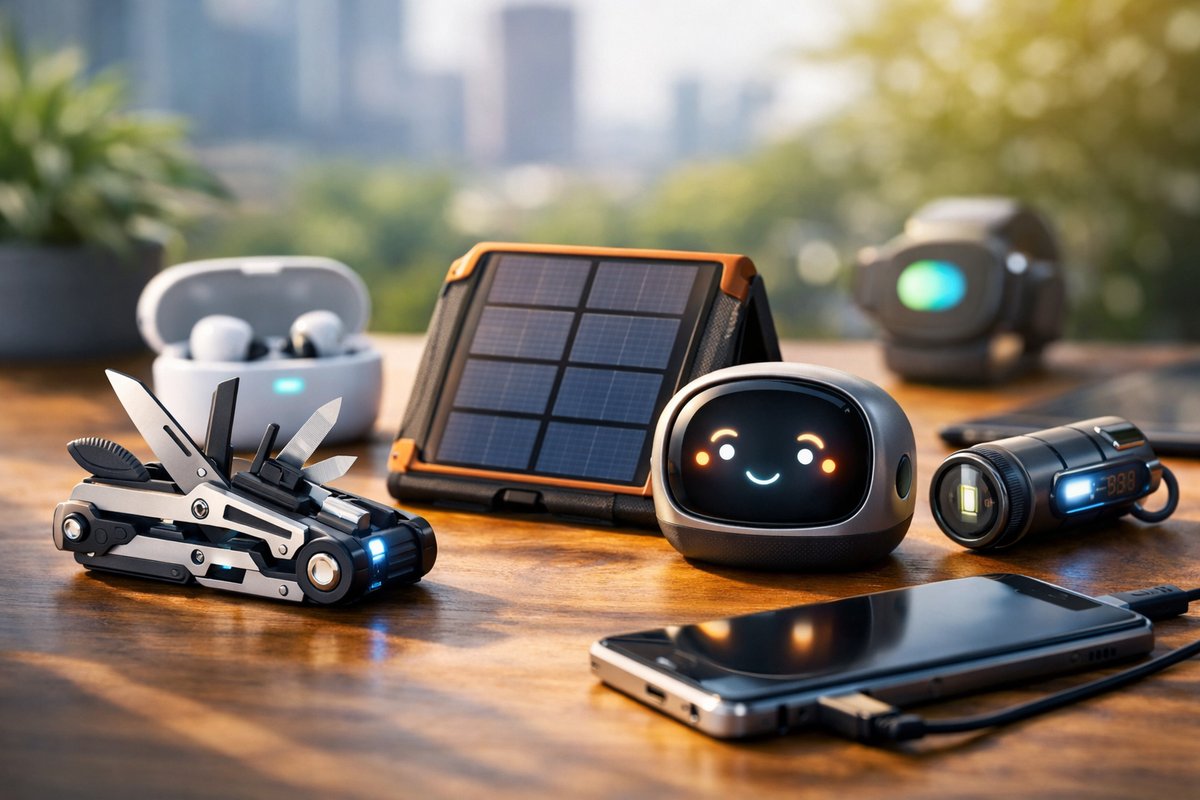
From ultra-compact modular multi-tools to solar-powered chargers you slip into your pocket, the latest wave of devices is redefining how we interact with technology on the go. This article examines trends in ambient computing, sustainable micro hardware and emotional AI that promise to reshape our daily routines.
In an age of constant connectivity, the next frontier isn’t a bigger screen or a faster processor-it’s making devices smaller, smarter and more mindful of the environment. Emerging tech companies are racing to pack artificial intelligence, sustainable power management and intuitive design into handheld gadgets that anticipate our needs as we move through day-to-day life. These pocket powerhouses tap into ambient computing, invisible interactions and modular materials to blur the line between tool and companion.
It started with ultra-compact projectors that turn any surface into a touch interface and quickly moved on to solar-charging battery bricks you can clip to a backpack strap. Now, micro drones that auto-navigate indoor spaces, wearable haptic interfaces that translate data into gentle taps on your wrist, and multi-function keychain modules that swap sensors on demand are gaining traction. Handheld tech shipments in the wearable and portable category climbed over 15 percent last year, according to the Consumer Technology Association, as consumers demand more flexibility and fewer cords in everyday life.
These gadgets embody four core principles: effortless integration, sustainability, emotional intelligence and modular adaptability. Gone are the days of single-purpose devices. Today’s designs focus on providing an ecosystem of services in one palm-sized unit. Imagine a prism-shaped gadget that combines voice-driven reminders, biometric sensing, wireless charging for your earbuds and low-power location tracking-all without ever connecting to a bulky cloud server. When you glance down at it, the device senses your gaze and displays a subtle pulsing glow to call your attention to upcoming tasks.
At the heart of this shift is ambient intelligence: technology that learns from our patterns and operates almost invisibly. Early examples include smart thermostats and voice assistants, but the next generation lives on you-not in your home. These devices use tiny machine-learning chips that process speech commands locally, preserving privacy by avoiding constant cloud roundtrips. They rely on on-device neural networks to recognize emotional cues in your voice: detecting stress, offering a breathing exercise prompt, or playing a soothing ambient track before you realize you need it.
Research from a leading nanomaterials lab shows that integrating graphene-based electrodes in wearable modules can boost battery life by up to 40 percent while maintaining a featherlight profile. Solar harvesting fabrics woven into phone cases and smartwatch bands are also gaining ground, converting ambient indoor light into trickle charges for your sensors. At a recent industry expo, a prototype solar strap demonstrated 10 hours of supplemental power for fitness trackers under typical office lighting.
Modularity plays a key role in extending a gadget’s lifespan and reducing electronic waste. Instead of discarding a device when the battery or camera module fails, users can swap individual components-similar to snapping together building blocks. Standardized magnetic connectors let you detach a portable SSD, thermal imaging sensor or Bluetooth speaker module from a base unit. That base can carry your smartphone functions, then transform into a podcast recorder or a handheld gaming console with the right add-on.
From an ecological perspective, this approach aligns with circular design principles. A recent study published in an environmental engineering journal estimates that modular electronics can cut e-waste by 30 percent over the product lifecycle. Manufacturers are also experimenting with bio-derived plastics and anodized aluminum alloys for casings, reducing reliance on petroleum-based resins and embracing renewable feedstocks.
Emotional intelligence in micro gadgets isn’t just marketing jargon-it’s becoming fundamental to enhancing user well-being. One device quietly monitors your posture and breathing patterns, delivering a gentle vibration when you’ve been hunched over your desk too long. Another wearable uses skin-conductance sensors to detect when you’re feeling anxious and automatically plays ambient soundscapes through your wireless earbuds, calibrated to your heart rate.
These intimate interactions raise important questions about data privacy. Forward-looking brands store the most sensitive biometric data exclusively on the device, encrypted under your passphrase. When insights are shared, they’re anonymized and scrubbed of personal identifiers. This local-first strategy not only safeguards your information but also reduces the carbon footprint of data transfers.
Voice-driven ambient assistants previously meant shouting across the room, but now they slip into your pocket in the form of voice-activated smart tags. Embedded far-field microphones and noise suppression algorithms let you ask for directions, translate foreign phrases in real time or dictate a quick voice memo-all without pulling out your phone. The assistant fades into the background until you need it, then springs to life with minimal latency.
Travelers are discovering that these compact gadgets excel off the grid too. In remote villages, modular lighting modules powered by solar-charged battery packs light up classrooms and charge medical sensors. Backpackers rely on pocket-sized power stations equipped with AC outlets, USB ports and wireless charging pads-some models supplying enough energy to run a laptop for several hours.
As gadget makers push nano and microscale manufacturing, cost is also coming down. What once required six figures in tooling can now be prototyped in a local makerspace with 3D printers and open hardware designs. A growing community of tinkerers on online forums is sharing blueprints for everything from ultra-thin RFID wallets to gesture-controlled rings that let you tap a finger to answer a call.
The convergence of these innovations-ambient AI, modularity, sustainable materials and emotional awareness-signals a shift from devices we carry around to companions we carry with us. Instead of isolating us behind screens, these micro gadgets aim to harmonize with daily life. They listen when we need guidance, remind us when we lose focus, and recharge themselves quietly in the background.
What lies ahead? Expect more interoperability. Standard developer kits for wearable ambient computing will let third-party creators build apps that run directly on your wrist or keychain. Open protocols for low-power mesh networks will enable devices to share data locally without congesting Wi-Fi or cellular bandwidth. And advances in ultralight flexible batteries could soon lead to truly disposable power modules you slide into a fabric pocket for a few days of use before replacing them.
We’re at the dawn of a new era where technology becomes not just smaller, but more adaptive and considerate of our needs. These pocket powerhouses may be pint-sized, but their impact on sustainability, privacy and well-being could reshape our routines in ways we’re only beginning to imagine.