Location
Mount Vernon, WA 98274

Location
Mount Vernon, WA 98274
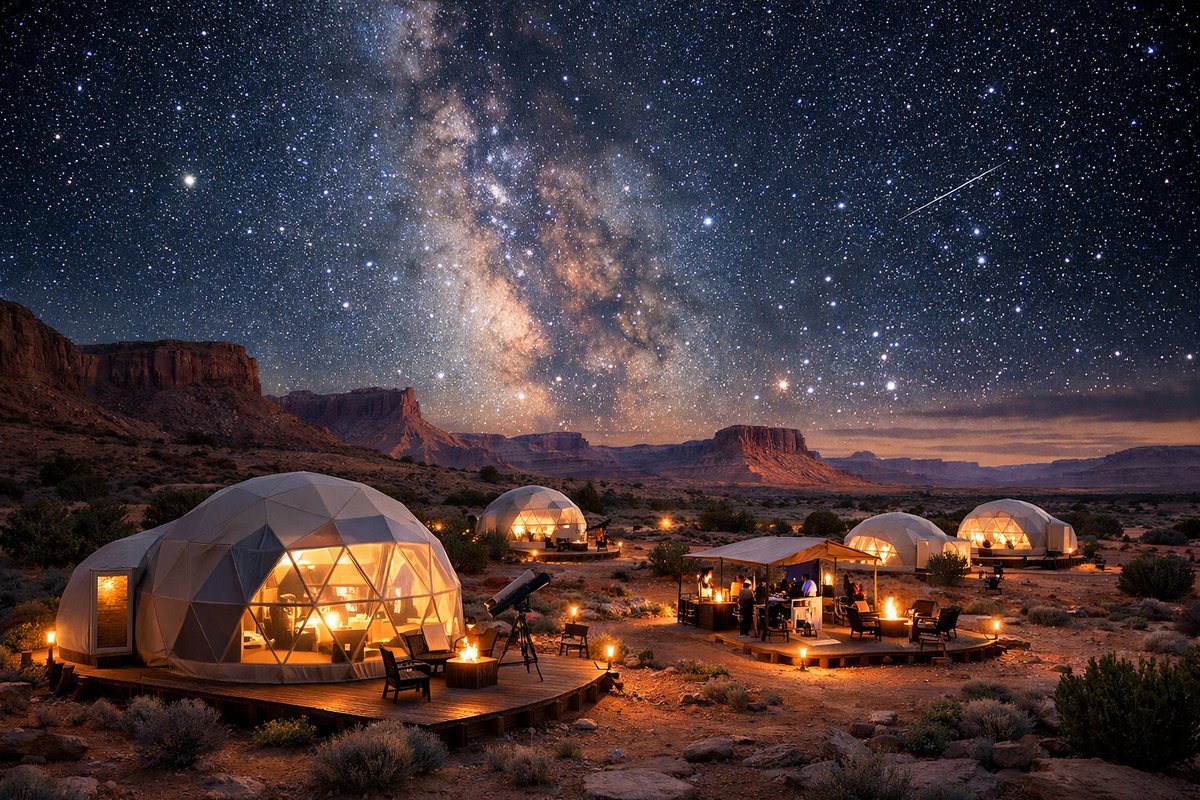
A cluster of eco-friendly dome hotels has just opened on the outskirts of Moab, Utah, capitalizing on a new International Dark Sky Sanctuary designation. Blending off-grid luxury with immersive astronomy programs, these desert retreats offer travelers a chance to connect with the cosmos-and themselves-in one of America's most rugged landscapes.
When the last sliver of sun dips behind the red-rock cliffs east of Moab, Utah, dozens of translucent domes begin to glow under a vault of emerging stars. These aren’t the inflatable igloos of a ski resort, but purpose-built, geodesic sanctuaries tucked into the high desert, each outfitted with panoramic roof panels, composting toilets, and solar-charged LED lighting. Launched in spring, this new stargazing dome hotel network sits at the heart of an International Dark Sky Sanctuary, offering travelers an intimate portal to the night sky-and a bridge between remote landscapes and inner reflection.
The Dark Sky designation, granted last year by a global conservation body, covers a thousand square miles of canyon country and high plateau north of Canyonlands National Park. With strict lighting ordinances now in place, the region has become one of the darkest inhabited places on the continent, reclaiming the ancient brilliance of the Milky Way and frequent sightings of zodiacal light, meteor showers, and the northern edge of the Milky Way’s galactic core. Local entrepreneurs saw an opportunity: to craft minimalist lodgings that celebrate the primal wonder of looking up.
Each dome is constructed from sustainably harvested timber framing and recycled steel nodes, wrapped in a double-skin UV-resistant polymer that’s both insulating and transparent enough to dissolve boundaries between bed and sky. Energy is provided entirely by roof-mounted solar arrays paired with battery packs stored underground; water arrives via a nearby spring, filtered on site, and recycled through greywater gardens scattered among sagebrush and juniper. Without noisy generators, Wi-Fi routers, or neon signage, the property feels like a throwback to life before electric light-only with heated floors, memory-foam bedding, and a telescope on a swiveling stand.
Under a fresh moonless sky, guests gather each evening at the communal “Cosmic Pavilion,” a timbered open-air structure ringed with low benches. There, resident guides-trained in astronomy, geology, and desert ecology-lead stargazing sessions armed with laser pointers, star charts, and a dozen different telescopes. They trace Orion’s belt across centuries of mythology, point out Saturn’s rings through high-aperture refractors, and share real-time astrophotography feeds from the domes themselves. Participants learn to read the heavens not just as a backdrop, but as a living tapestry of fuel-burning suns, collapsing star remnants, and the ghostly arcs of the Northern Lights when solar activity peaks.
By day, the property transforms into a hub for lunar-surface simulations and geology walks. Guides lead small groups through slickrock formations where ancient sea beds and wind-scoured fins rise like petrified waves. At an on-site lab tent, travelers examine desert varnish-microscopic colonies of bacteria that coat sandstone in dark layers, preserving millennia of particle films and perhaps offering clues for Mars rovers scouring the Red Planet for signs of life. For those seeking solitude, a network of hidden trails leads to hoodoos and hidden alcoves where silence reigns and the view stretches all the way to the Abajo Mountains.
The design of the dome hotels owes much to the region’s Indigenous heritage. Before construction, developers consulted with the Ute and Paiute tribes to identify plant species for the on-site gardens-wuinitu sage, Fremont cottonwood, and Navajo tea-that support pollinators and reflect ancestral land stewardship. Storytellers from local communities host evening gatherings in which creation myths are retold, stars are named anew, and travelers learn how their own place on small, spinning rock echoes through generations of sky watchers.
Inside each dome, technology and tranquility coexist. A touchscreen console lets guests control interior climate, schedule dinner service, or launch a guided meditation set to the sounds of desert night winds. A selection of astrophotography apps, loaded on waterproof tablets, helps novices frame the perfect shot of the Pleiades cluster or the International Space Station’s path. But there’s no mandatory agenda: many visitors simply lie back on their beds to watch the stars drift overhead, or step onto a private observation pad to capture long-exposure shots with their own cameras.
Booking a stay requires careful planning. The remote site lies nearly forty miles from Moab, accessible via a graded dirt road passable by most vehicles but best tackled in daylight. Winter reservations sell out for peak aurora forecasts, while shoulder seasons bring fewer crowds and clearer skies. To preserve the experience, only twenty domes operate at once, and check-in is staggered after sunset to avoid headlights intruding on the dark sky. Guests receive a headlamp with red-light mode for safe navigation around the grounds without disturbing neighbors.
Beyond the thrill of the cosmos, the experience carries a deeper resonance. Several travelers describe a shift in perspective-a humbling reminder of our planet’s fragility and the scale of the universe. One guest, a first-time solo traveler, said she left behind work emails and deadlines to follow a trail of light and darkness, returning home with a sense of calm and curiosity that defied her usual routine. By stepping out of urban glare and immersing in starlight, many find a renewed appetite for exploration: a desire to chart new trails, learn constellations by heart, and bring a piece of that quiet magic back to everyday life.
Local economies are already feeling the ripple effect. Nearby outfitters report increased demand for four-wheel-drive rentals, mountain bikes, and guided canyoneering trips. Small cafes in Moab offer stargazing-inspired menus-constellation cocktails made with edible glitter and lavender syrups, meteor-shaped pastries dusted with black cocoa. Artisan workshops sell night-vision playing cards, glow-in-the-dark pocket maps, and mobile app subscriptions that translate celestial coordinates into musical compositions.
Environmental scientists are watching closely to gauge the long-term impact of such tourism on a fragile desert ecosystem. To mitigate foot traffic and light pollution, the hotel network employs strict Leave No Trace policies: group sizes are capped at ten, all waste is carried out or composted, and any artificial light is filtered through red or amber lenses. Solar panels and rainwater catchment systems were calibrated through a multi-year study to minimize interference with native wildlife-nocturnal rodents and burrowing lizards that rely on pitch-black nights for foraging.
Innovations under development include an augmented-reality stargazing app that overlays live constellations onto the sky through a smartphone camera, and a “quiet drone” system for aerial time-lapses that capture dome-dot patterns under star trails. A localized weather-radar network, supported by university researchers, will feed real-time data on cloud cover and humidity levels to ensure optimal viewing windows.
As the sun returns to the desert horizon each morning, guests gather over solar-heated coffee and red-rock pastries at a small café built from reclaimed railroad ties. Conversation often drifts from the previous night’s star charts to a shared sense of stewardship: if we can safeguard a swath of desert starlight, could other landscapes-urban centers and sky-glow suburbs-follow suit? The dome hotels, organizers hope, will become models for combining sustainable architecture with immersive nature programs, sparking a wave of dark-sky destinations in remote corners of the world.
Walking back to a dome at dawn, dust still settling from a sunrise breeze, travelers exchange plans for sunrise hikes, photography workshops, or silent meditation circles at a nearby hoodoo formation. Each step on the trail carries the promise of discovery above and below-the shifting ochre sands underfoot, the glimmer of Vega overhead later that night. In a world overwhelmed by screens and noise, the desert’s stripped-down canvas offers a rare chance to look up, wonder, and feel small in the best possible way.
Whether you’re a seasoned star chaser or simply seeking a moment of quiet, Utah’s new stargazing dome circuit reminds us that some journeys unfold in darkness: a path of light guided not by a map, but by curiosity, humility, and the timeless pull of the sky.