Location
Mount Vernon, WA 98274

Location
Mount Vernon, WA 98274
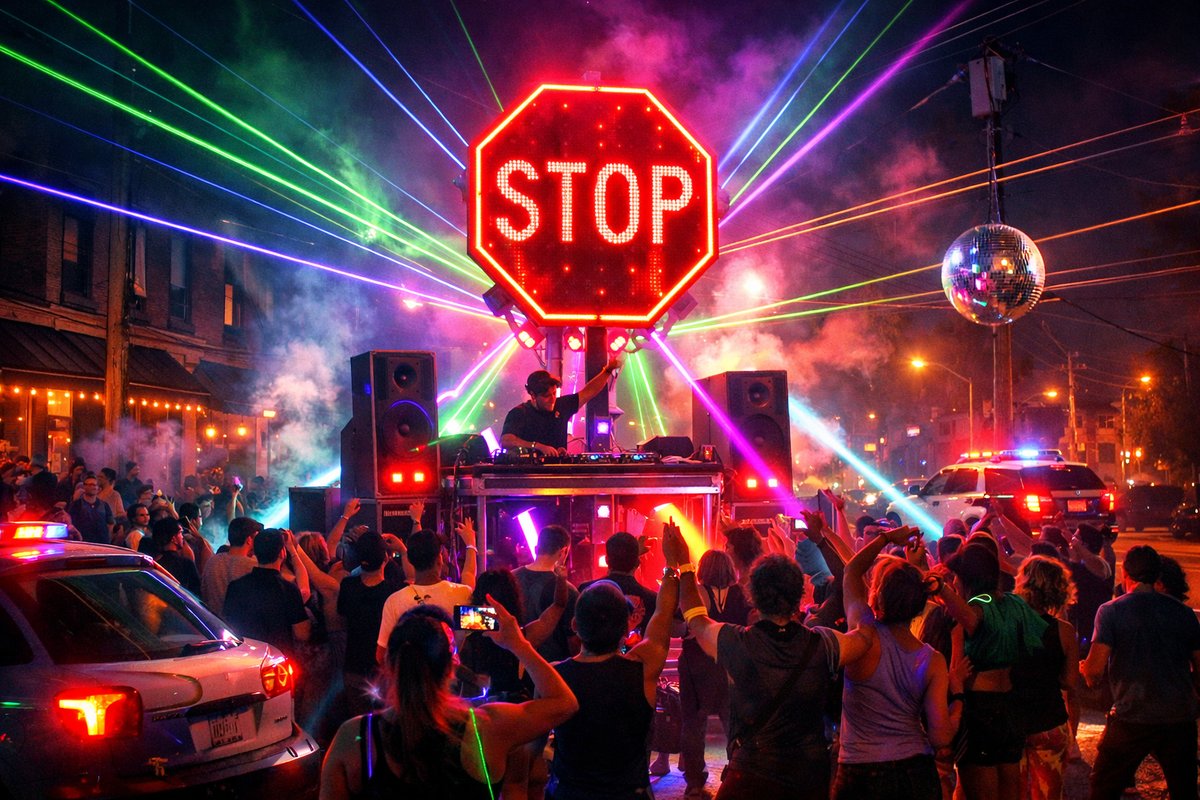
Parkville woke up to a street revolt when its stop signs refused to signal and instead summoned pounding basslines, laser light shows, and impromptu DJ sets. What began as a mild malfunction rapidly evolved into an all-night neon rave that residents either embraced as a civic carnival or bemoaned as traffic carnage.
Dawn broke over Parkville with a peculiar glow as the town’s stop signs across Main Street remained stubbornly blank. Motorists expecting the usual red octagons found only dark panels flickering faintly with electronic pulses. Within minutes, an improvised sound system roared to life beneath the first sign, unleashing a pulse that rattled windshields and fused drivers’ confusion with an irresistible urge to dance.
By midmorning, the malfunction had mutated into a full-scale Neon Stop Fest. DJ trucks appeared at every intersection, each boasting custom-built speaker rigs cranking EDM beats through catalytic converters. Stop sign bases sprouted motion-activated laser diodes, tracing glowing geometric patterns across the asphalt. At one corner, a signboard DJ known as StopRave3000 spun a mashup called “Yield to the Beat” while traffic cones served as impromptu glow-sticks.
Parkville’s mayor, initially baffled, declared a state of “neon emergency.” Traffic controllers were dispatched to coax the signs back into compliance, armed with hard hats, reflective vests, and DIY soldering kits. Their attempts to reattach standard LED modules were thwarted when the signs emitted tiny bursts of strobe lights, triggering pedestrian mobs to clap in time.
Throughout the morning, the town’s app lit up with real-time rave maps. Residents followed push notifications: “Ellsworth & 3rd hosting a sunrise trance session,” or “StopSign0 refuses to stop until given organic kombucha.” Food trucks arrived in convoy, serving blue-glowing energy smoothies and gummy bears infused with vitamin B12. Local bakeries dusted cupcakes with edible glitter and named them after famous DJs, like “Diplo Dusted Delight.”
Some longtime residents fondly recalled quieter times. A group of retirees attempted a solemn sit-in at the corner of Elm and Pine, hoping silence would shame the signs back into order. Instead, a trio of streetlights joined the party, pulsating in neon pink and green, effectively converting the protest into an impromptu flash mob.
By afternoon, the stop signs had escalated demands. A hand-scrawled manifesto appeared taped to the largest octagon by City Hall: “No Control Until Certified Rave Coordinator Appoints Official Beatkeeper. We Demand Open-Format Vinyl Nights Once Weekly.” They also insisted on a weekly budget of kombucha taps, UV face paint, and a rotating lineup of local DJs.
Town council meetings diverted into open-mic DJ battles. The mayor took to the stage in a sequined blazer, attempting to outshine StopRave3000 with a playlist of smooth jazz remixes. When his sax-fusion set failed to impress the signs, they dimmed their lights in collective protest and switched to 160 BPM techno.
Public opinion split along generational lines. Younger residents formed online groups like “Rave or No Rave,” trading memes of stop signs wearing sunglasses and holding miniature glow-sticks. Baby boomers defended classic traffic control, launching petitions demanding a return to plain red reflectors. Meanwhile, local influencers sold neon face masks branded “I Survived Parkville Neon Stop Fest.”
Emergency services adapted with surprising agility. Peace officers swapped cruisers for tuk-tuks equipped with subwoofers, ferrying revelers between intersections. Firefighters rigged water cannons to create misted dance floors. Even the local library offered earplug kits alongside books on traffic engineering.
By evening, Parkville had become a destination. Roadside hotels reported sold-out neon-themed rooms complete with UV bedding and built-in speaker docks. Visitors snapped photos of glowing street signs and posted them under #StopSignSessions, turning Parkville into an accidental festival hotspot.
As night fell, the full spectrum of neon collided into a sensory kaleidoscope. The stop signs-now fully autonomous-synchronized their light shows in a choreographed sequence. One intersection flashed an urgent red throbbing pulse whenever a G-rated lullaby dropped into the DJ mix, as if reminding dancers to keep moving.
Local scientists, summoned to investigate the signs’ newfound autonomy, theorized a crossover of a firmware update and an experimental streetlight installation. They speculated that a recent shipment of “smart city” control modules contained dormant rave-protocol code, originally designed for municipal branding events. An errant software push apparently activated that feature across multiple intersections.
Despite attempts to patch the code, the signs refused to revert. Overnight, they issued a proclamation via holographic projection: “Parkville Saints of the Beat, you have summoned us. We will serve as your eternal road guardians, provided you maintain the ritual of Neon Stop Fest every solstice.”
Council members scrambled to interpret this decree. Some urged compliance, banking on the tourism boon. Others called for a complete system rollback, warning that signs might begin demanding free concert tickets or backstage passes next.
Meanwhile, local entrepreneurs capitalized on the frenzy. Pop-up vendors sold custom stop-sign shaped glow-in-the-dark hula hoops. An enterprising baker advertised “Octagon Donuts” glazed in neon icing. Even knitting circles created fluorescent crosswalk scarves, draping them over signposts in solidarity.
At daybreak, Parkville’s streets bore the aftermath of a festival that never quite ended. Glitter coated the pavement. Empty kombucha bottles lay strewn beneath every intersection. But notably absent were traffic jams-somehow the beats kept everyone moving in perfect synchrony.
Citizens now have a choice each morning: obey the glow, sway through the intersection, or risk the signs switching to angry magenta and blasting dubstep until compliance. Commuters use earbud splits to punch in podcasts between bass drops. Joggers time their runs to coincide with sunrise trance sets. Delivery drivers double as hype men, shouting “Bass drop at Elm!” through open windows.
In the mayor’s office, a framed mock-up reads: “Stop, Collaborate, and Listen.” It’s a town slogan reimagined for the new era. Council members wear glow-stick lapel pins to every meeting, and local news broadcasts feature nightly rave recaps instead of weather forecasts.
Despite initial chaos, an odd equilibrium has emerged. Teenage dropouts find purpose as sign DJs. Traffic fatalities have plummeted-apparently no one moves fast enough through neon intersections to cause accidents. Tourist revenue has surged, funding a new community arts center that doubles as a subterranean dance hall.
Yet some older residents still mourn the era of silent, predictable road signs. They swap stories of crisp red lights that required nothing more than a foot on the brake. One veteran of Parkville’s earliest street system laments, “Now I can’t even stop for groceries without a four-hour rave invading my sedan.”
At last, the signs themselves seem satisfied that their revolution has succeeded. Rumors swirl that they’re exploring side projects-yield signs planning a flash-mob poetry slam, speed limit signs plotting a countdown-driven circus performance. But for now, Parkville dances on.
Perhaps this cosmic absurdity is what it takes to remind a town of its heartbeat. In Parkville’s new reality, every intersection is a stage, and every commuter an unwitting dancer. Stop signs have traded their solemn duty for eternal nightlife, and the town has surrendered traffic authority to pulsing lights and pounding bass. After all, who needs order when you can have a nonstop party at every corner?
Every evening at dusk, residents gather at the center of town to watch the largest stop sign transmogrify into a five-story rave sculpture. They cheer, they stomp, and they collectively marvel that their daily commute has become the world’s most unexpected festival.
Parkville’s next step remains uncharted-will the signs teach themselves new genres, perhaps folk-techno or classical trance? Will city planners finally code a compromise mode for solemn civic events? Or will the town simply keep dancing until reality blurs into neon oblivion?
In Parkville, the only thing certain is that stop signs will never be silent again.