Location
Mount Vernon, WA 98274

Location
Mount Vernon, WA 98274
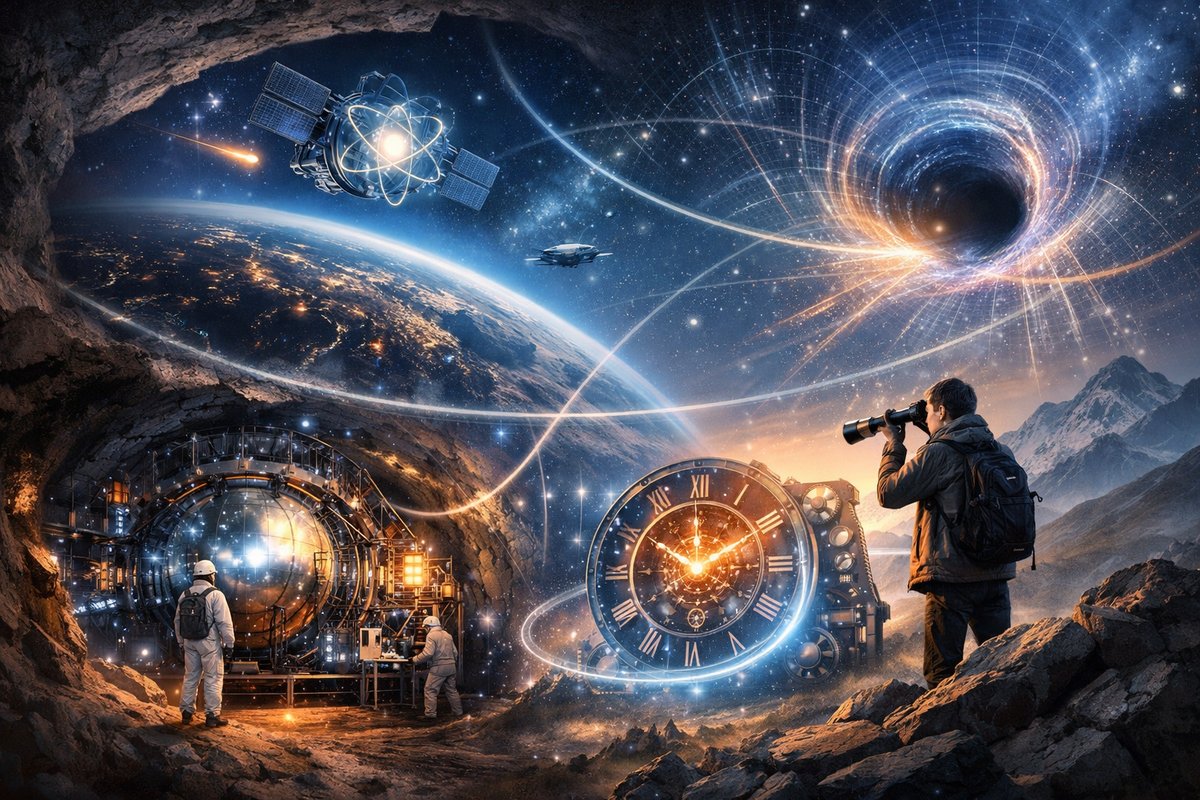
From subterranean labs hunting ghostly particles to atomic clocks racing around the Earth, scientists are uncovering hidden threads that bind time and matter. A new wave of experiments is challenging our assumptions about reality and inviting the next generation of curious minds to explore the unknown.
Deep beneath a mountain range in Europe, steel chambers and cables snake through a cavern the size of a football field. Here, an array of detectors sits in silence, waiting for a whisper-a neutrino or a fleeting tremor in space-time itself. Far above, physicists synchronize atomic clocks on satellites, comparing tick rates to probe whether gravity can bend time more than Einstein predicted. Across continents, hobbyists assemble cloud chambers in garages, tracking cosmic rays with glowing trails.
In recent months, this global symphony of instruments has produced data that hint at cracks in our understanding of the universe’s most fundamental fabric. A collaboration of underground labs reported a tiny discrepancy in neutrino mass measurements, while a team of astronomers using a ground-based optical array captured fluctuating light curves from a distant quasar never seen before. Even the atomic clock network, designed for the world’s most precise timekeeping, recorded shifts correlated with a solar storm that bathed Earth in high-energy particles.
These anomalies may yet resolve into known phenomena, but they also resonate with an older, deeper question: What is time? In everyday life, seconds feel uniform and predictable, but at the frontiers of physics they stretch, contract, blur, and even tangle with mass and energy in bizarre ways. When you factor in quantum uncertainty, where particles can exist in superposition, the idea of a single, orderly timeline fractures further.
The quest to chart these anomalies is driving innovation in lab equipment and measurement techniques. High-speed cameras, capable of recording millions of frames per second, are now capturing laser-induced particle interactions that once left only blurry afterimages. Portable atomic clocks-once the size of refrigerators-have slimmed into briefcase modules, enabling physicists to compare time directly across laboratories separated by continents with nanosecond precision.
Underground experiments remain essential because they shield delicate sensors from the cosmic-ray buffet that bombards Earth’s surface. In a shielded cavern in South America, researchers lowered a cloud chamber filled with supercooled alcohol vapors and aligned it next to a DIY muon detector array. When high-energy particles pierce the chamber, they ionize the vapor, leaving visible streaks that map their journey. By correlating these streaks with synchronized atomic-clock readings, scientists hope to detect subtle time delays tied into mass fluctuations at quantum scales.
Meanwhile, back in observatories perched on volcanic ridges, astronomers track flickering light from quasars and pulsars. These distant beacons serve as cosmic clocks and mass probes at once: their pulses pass through interstellar space, bending around dark matter concentrations on their way to Earth. By comparing arrival times at radio, optical, and X-ray telescopes, researchers can reconstruct a three-dimensional map of the unseen matter that shapes galaxies.
The excitement isn’t confined to professional labs. University physics clubs and makerspaces worldwide are building backyard telescopes outfitted with high-speed intervalometers and open-source spectrometers. These tools let hobbyists capture transient events-meteor showers, fast radio bursts, or atmospheric auroras-in exquisite detail. Amateur observations frequently feed data into citizen science platforms, adding precious points for triangulating cosmic phenomena.
But this democratization of discovery brings challenges. Instruments must be calibrated precisely; even the faintest electromagnetic interference can skew readings. That’s why many citizen scientists now invest in real-time clock breakout boards and GPS timing modules to anchor their measurements to international time standards. Some researchers joke that the next big discovery could come from a suburban garage rather than a billion-dollar collider.
The philosophical stakes are high: if time and mass can fluctuate under certain conditions, then the neat separation between past, present, and future may collapse into a quantum soup of probabilities. Could human consciousness itself be just another wave function, collapsing upon observation? Though such questions border on metaphysics, they spur real experiments. Psychophysics labs are exploring whether observers can detect minute time distortions in visual stimuli under controlled conditions.
In one recent study, participants viewed a rapidly flickering light pattern alongside an audio click delivered through noise-canceling headphones. By fine-tuning the delay between the two stimuli, researchers measured the smallest intervals the human brain can perceive, in some cases down to microseconds. These thresholds now inform calibrations for optical sensors in space telescopes, ensuring planetary transits aren’t misread due to temporal lags.
On a grander scale, gravitational-wave observatories continue to listen for ripples in space-time produced by merging black holes or neutron stars. When a wave passes, it stretches and compresses distances by less than the width of a proton. Yet state-of-the-art laser interferometers detect these tiny oscillations by comparing the relative phase of light beams over kilometers. Data from the latest detection campaign suggests the waveforms carry unexpected distortions that some theorists attribute to dark matter interactions near galactic cores.
The convergence of these efforts-underground particle hunts, cosmic timekeepers, citizen-piloted telescopes, and human psychophysics-reveals a universe more entangled than we imagined. Specialists in optics, electronics, software, and even philosophy now collaborate in interdisciplinary centers, decoding the feedback loops between mass and time. Grad students cross-train in quantum field theory and neurobiology; amateur stargazers learn atomic physics; museum-goers don VR headsets to simulate living inside a black hole.
As these lines blur, one thing remains clear: our familiar arrow of time may prove to be an emergent phenomenon, a collective illusion arising from countless quantum events. If so, the path ahead will be less a single river flowing from past to future and more an ever-shifting network of streams diverging and reconverging in surprising ways.
For readers inspired by these cosmic investigations, the tools to begin exploring lie within reach. A backyard telescope can reveal Jupiter’s swirling bands and the shadows of its moons, while a cloud chamber kit transforms your kitchen table into a portal for cosmic rays. High-speed cameras and intervalometers unlock the secret rhythms of lasers and particles, and DIY muon detectors let you glimpse the universe passing through your home. Even a compact real-time clock module can tie your experiments to the global cadence of atomic time.
Together, these instruments invite you to join the quest-whether you’re chasing neutrinos in an underground cavern, tuning a spectrometer to capture starlight, or simply timing a flickering LED with microsecond accuracy. In every flicker and flash, you may find not only the echoes of distant events, but also a mirror reflecting our own quest to understand existence itself.