Location
Mount Vernon, WA 98274

Location
Mount Vernon, WA 98274
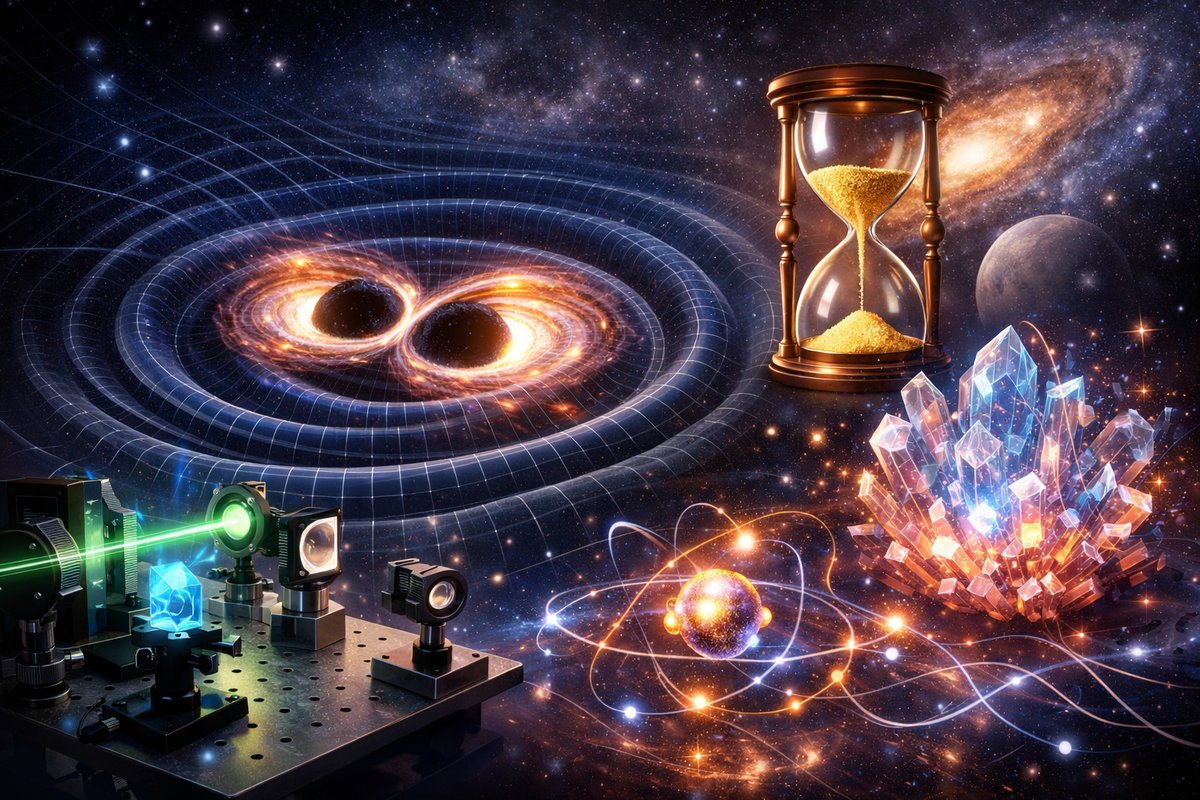
A recent spate of experiments and observations is illuminating the interplay between time, matter, and the deeper mysteries of the universe. From gravitational waves rippling spacetime to laboratory-crafted time crystals, researchers are uncovering clues that could reshape our understanding of reality.
In the past year, a series of breakthroughs has sent ripples through the world of physics, reigniting curiosity about how time and matter intertwine across cosmic and quantum scales. High-precision atomic clocks have recorded minuscule time dilation effects in Earth’s gravitational field. Gravitational wave observatories have captured fresh signals from black hole mergers, revealing subtle distortions in spacetime’s fabric. And in controlled laboratory settings, physicists have engineered exotic “time crystals” that exhibit periodic behavior without energy input. These advances, taken together, hint at an emerging picture: time may be far more dynamic and matter far more enigmatic than classical intuition suggests.
Atomic clocks, already famed for ushering in the era of nanosecond-accurate timekeeping, have become key probes of gravitational time dilation. Teams operating space-borne and terrestrial clocks placed at varied altitudes compared tick rates with unprecedented resolution. In one set of experiments, clocks separated by just a few dozen meters in elevation showed time running faster at higher points by trillionths of a second each day. Though Einstein’s general relativity predicts such effects, the new precision allows tests of potential deviations or unknown influences from dark matter clumps lurking near Earth.
Meanwhile, gravitational wave detectors continue to deepen our grasp of time’s elasticity when massive objects collide. Over the last twelve months, multiple new merger events-some involving unexpected stellar-mass black holes-have been cataloged. Each chirp encodes how spacetime stretched and snapped back as the two massive bodies spiraled together. Analysis teams have begun to search these signals for anomalous time-domain features, such as echoes that could hint at ultradense exotic matter or microscopic black hole remnants. Early reports have flagged a handful of anomaly candidates, though further data and refined models are needed to confirm if these are genuine signatures of new physics.
In parallel, the field of condensed-matter physics has staged an audacious experiment: the creation of time crystals. Unlike ordinary crystals, whose atoms repeat in space, time crystals repeat their state periodically in time without an external energy drive. First theorized a decade ago and demonstrated in isolated quantum systems, time crystals challenge conventional thermodynamic expectations. Recent iterations employ trapped ions and superconducting circuits to sustain their rhythmic oscillations for longer durations. Observers note that these systems effectively “tick” like clocks with no energy cost, raising questions about entropy, the arrow of time, and potential applications in quantum computing.
Taken together, these frontiers-from gravitational ripples to laboratory timepieces-suggest that time is not merely a backdrop for matter to unfold but an active participant in the cosmic narrative. Dark matter, which makes up roughly 85 percent of the universe’s mass, remains invisible to direct detection. Its presence is inferred through gravitational effects on galaxies and cosmic expansion. Yet if dark matter interacts ever so slightly with temporal dynamics, our new timekeeping experiments could offer a window into that hidden sector.
Theory groups around the world are racing to develop unified models that weave together quantum mechanics, general relativity, and emerging empirical hints. Some candidates propose that dark matter comprises ultralight particles forming a coherent field that oscillates in time, subtly modulating clock rates on Earth. Others suggest that unknown high-spin particles might couple to time crystals in unique ways, creating observable resonance patterns. On the gravitational wave front, proposals involve exotic compact objects-beyond classic black holes-whose internal structure could leave imprints in the ringdown phase of a merger.
As scientists refine detectors and expand observational campaigns, they face formidable challenges. Terrestrial noise-seismic activity, thermal fluctuations, electromagnetic interference-continues to plague precision measurements. Space-based clock networks must contend with solar wind disturbances and expensive launch logistics. Gravitational wave observatories, though highly sensitive, still capture only the loudest cosmic collisions. Upgrades are underway, including new vibration-isolated facilities and next-generation laser interferometers intended to probe lower frequencies and longer wavelengths.
Beyond the lab and the observatory, this wave of research resonates with broader philosophical questions about humanity’s place in an evolving universe. If time itself can oscillate or tangle, what does it mean for our lived experience? How might such discoveries shape technology, culture, and metaphysical outlooks in the decades to come? Science fiction writers have long explored time’s oddities-looping narratives, paradoxical travelers, sentient universes-but now fiction edges closer to fact.
Educators are seizing the moment. University courses on quantum foundations and relativity are bursting with new enrollment, while public science centers feature interactive exhibits on time dilation and gravitational waves. Virtual reality experiences let participants “watch” a black hole collision in immersive 3D, witnessing spacetime’s dramatic flexing. These efforts aim not just to inform but to inspire a new generation of thinkers who can bridge quantum puzzles and cosmic wonders.
Policymakers, too, are taking note. National science agencies are increasing budgets for fundamental research, viewing potential spinoffs in navigation, communication, and computing. Precision timekeeping already underpins global positioning systems and telecommunication networks. Atomic clocks more accurate by factors of ten or hundred could revolutionize geodesy-mapping Earth’s gravitational field in real time-and enable novel synchronization for quantum communication channels.
Yet for all the excitement, researchers urge caution. The universe has a history of surprises that evaporate under deeper scrutiny. Past anomaly reports-from faster-than-light neutrinos to certain quantum gravity signals-faded as measurement errors were corrected. Rigorous cross-checks, blind analyses, and independent replications remain the gold standard. In the coming months, data from new satellite clock missions, upgraded interferometers, and laboratory protocols will either shore up these budding ideas or consign some to the realm of statistical fluctuations.
In the meantime, the tapestry of time and matter continues to reveal unexpected patterns. The interplay between cosmic scale and quantum fabric underscores a unity that transcends everyday experience. Every microsecond measured, every gravitational wave captured, every engineered time crystal realized, draws us closer to a grander synthesis of reality.
Whether the end result will be a revolutionary new physics framework or a refined understanding that bolsters existing theories, the journey itself illuminates our quest to comprehend existence. As our instruments grow ever more precise, perhaps we will discover that time is not a mere dimension but a dynamic canvas, painted by the subtle interplay of mass, energy, and the deepest laws of nature.
In the silent ticking of atomic clocks, in the faint hum of a laboratory time crystal oscillator, and in the faint echoes of black holes colliding billions of light-years away, the universe whispers its secrets. It beckons us to listen more closely, think more boldly, and weave our own stories into the vast, unfolding chronicle of time and matter.