Location
Mount Vernon, WA 98274

Location
Mount Vernon, WA 98274
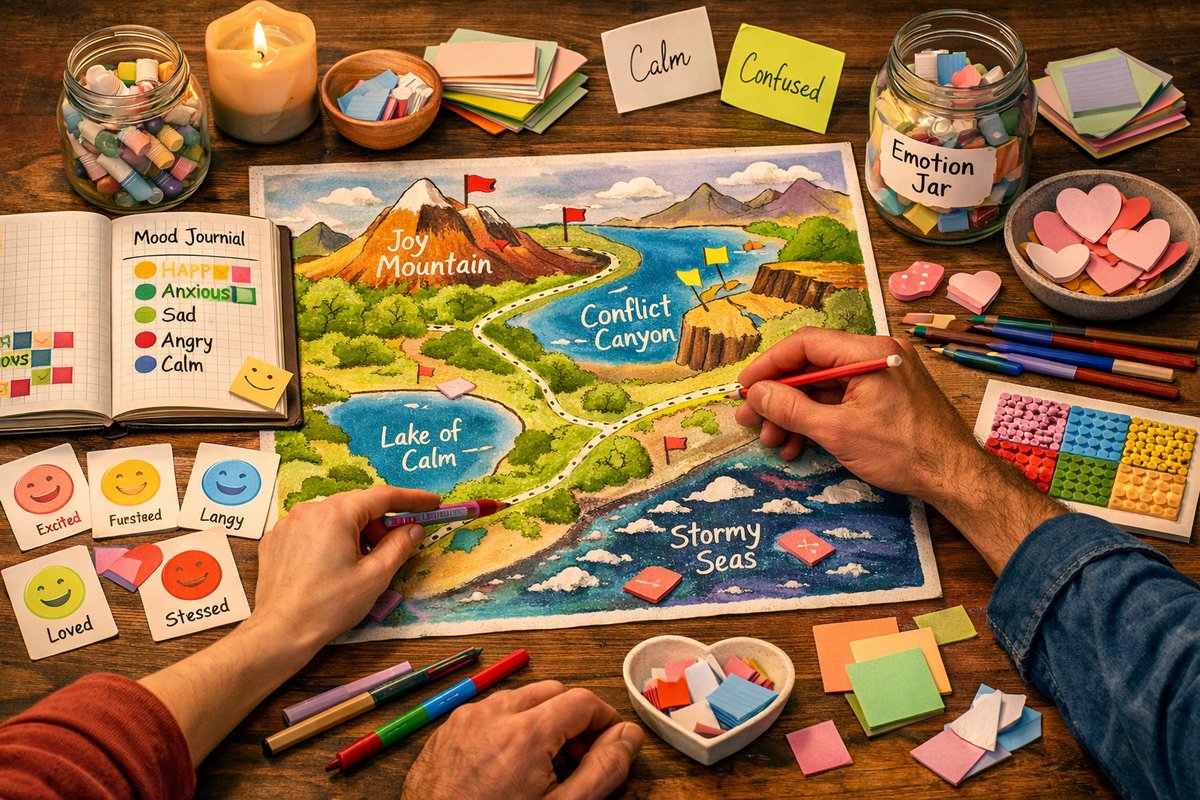
A growing wave of couples are turning feelings into maps, using journals, color codes and collaborative art to navigate the highs and lows of partnership. From mood-tracking workshops to DIY message jars, these emotional cartography methods are reshaping how partners communicate, resolve conflict and grow together.
When partners find themselves stuck in repeating arguments or drifting into emotional distance, conventional advice-like “talk it out” or “date night”-often falls short. A new movement swept through relationship seminars and weekend workshops in recent months: emotional cartography. By mapping feelings visually and collaboratively, couples are discovering fresh pathways to empathy, clearer communication and more intentional growth.
At a recent weekend retreat in Portland, participants sat side by side before a blank canvas. They each received a palette of colored markers, sticky notes and a large chart titled “Emotional Journey.” The instructions were simple: illustrate the emotional highs and lows of the past year, assign each feeling a hue and connect key moments with threads of yarn. By the end of the session, partners revealed anniversaries marked with bright yellow circles for joy, seaside strolls in pale blue for calm, and conflict episodes in crimson. Strands of yarn intertwined the moments where one partner’s joy sparked the other’s contentment-or where unspoken tensions built walls between them.
Workshops like these emerged after a 2023 survey by a respected relationship institute found that nearly 70 percent of couples reported feeling misunderstood at least once a week. Many cited vague language and mismatched emotional expectations as root causes. “Couples often live in separate emotional worlds,” says Dr. Lena Vasquez, a clinical psychologist and facilitator of the Portland retreat. “By externalizing feelings on a shared map, they move from vague frustrations to concrete touchpoints. It’s like exploring a new city hand in hand, rather than shouting directions from different GPS devices.”
Emotional cartography spans a variety of formats. Some partners prefer analog tools: a hardcover mood-tracking journal that prompts daily check-ins, lined pages for reflection and color-coded stickers for quick emotional tags. Others embrace digital mapping apps that visualize week-long emotional heat maps, letting couples compare patterns and set joint intentions for the coming week. A trending smartphone app, for instance, transforms daily mood entries into circular diagrams that pulse and shift with each update. By granting partners simultaneous access, the app becomes a real-time emotional dashboard.
It isn’t just about tracking; the cartographic ritual invites playful creativity. One couple in Chicago assembled a DIY message jar system. Each empty jar holds 52 rolled paper strips-one for every week. Partners write hopes, appreciations or questions on the slips. Every Sunday evening, they draw a slip together and use it as a prompt for conversation or action. Some weeks yield declarations of gratitude; others surface that long-avoided topic about household chores or family boundaries. Over time, the jar evolves into a living emotional archive.
Cultural context shapes these mapping practices, too. In multilingual households or cross-cultural relationships, certain feelings lack direct translations. By assigning colors or symbols instead of words, couples can circumvent linguistic barriers. A symbol for “overwhelmed” might be a spiral in deep teal, while “excited” becomes a burst of orange rays. When words fail, symbols invite inquiry and curiosity, rather than judgment. “My partner comes from a culture where anger isn’t openly discussed,” explains Amina, who joined a New York workshop last month. “Mapping gave us a neutral vocabulary. I could point to a jagged red line and ask, ‘What was happening here?’ She felt safe explaining the context without fearing I’d criticize her expression.”
Behavioral shifts often follow emotional insights. Couples who once clashed over screen time, for example, discovered on their maps how digital overload colored their interactions with shades of gray and brown-tired, distracted, distant. With that clarity, they implemented a nightly ritual: a five-minute “screen free” debrief after dinner, using a sand timer to mark the interval. Within weeks, the map’s color palette lightened, and partners described a renewed sense of presence.
Experts caution, however, that emotional cartography isn’t a silver bullet. “Mapping is a tool, not therapy in itself,” notes relationship researcher Dr. Markus Young. “It surfaces patterns and prompts dialogue, but couples still need skills to navigate what emerges-like active listening and non-defensive feedback. Without follow-through, maps can become records of frustration rather than guides to growth.” Many workshops integrate short tutorials on reflective listening or “I” statements alongside mapping exercises, ensuring couples have both the compass and the map legend.
A case in point: Maria and Sam, both in their early thirties, tried charting their feelings after hitting a communication lull. In their first map, fiery red spikes indicated arguments about money, while muted grays marked extended phone calls where one partner felt ignored. Across several months, they mapped recurring patterns and identified triggers-like overcommitment to work or unspoken expectations around household chores. Armed with this visual insight, they established weekly check-ins and delegated tasks more equitably. Their second map, sketched in a cozy living-room session, glowed with pastel pinks and mint greens-emotions they labeled as “connection” and “support.”
Beyond individual couples, relationship educators are exploring group-based cartography. In cities from Austin to Berlin, community centers host monthly “Map & Mingle” evenings where pairs set up stations, work through mapping prompts and then share insights across the room. The shared experience normalizes emotional exploration and invites new ideas: one couple swapped techniques for integrating mindfulness breaks, while another introduced a laughter-based check-in using playful stickers.
Social media channels have also embraced the trend. On short video platforms, couples reveal snippets of their mapping sessions-rolling out a charcoal paper backdrop, dipping brushes into watercolor pigments, and tracing emotional arcs with slow, meditative strokes. Viewers comment on favorite color-coding methods, ask for printable templates and trade recommendations for the most evocative metaphorical symbols. This digital community transforms private rituals into shared inspiration, while still preserving each couple’s unique map.
Even seasoned therapists are integrating cartography into remote sessions. A recent pilot project by a family therapy clinic offered online mapping workshops via video calls. Therapists mailed couples tactile kits-small canvases, colored yarn and instruction cards-before the session. During the call, each partner sketched the emotional terrain, then guided the therapist through their personal map. The visual element removed the pressure of speaking for long, allowing both partners to point, pause and reflect. Early results showed improved session engagement and greater willingness to share vulnerable feelings.
As emotional cartography gains momentum, its adaptability stands out. Couples can tailor the process to their style-opting for minimalist journals, elaborate painted murals or quick digital heat-maps. They can map weekly moods or chart milestone moments over years. What matters is creating a shared language for feelings that too often remain uncharted.
In a culture that prizes efficiency and often skims the surface of communication, mapping invites couples to slow down and notice subtleties. It transforms abstract emotions into tangible landscapes, complete with valleys of vulnerability and peaks of elation. Whether partners meet at a retreat, gather around their kitchen table or tap entries into a smartphone app, the act of cartography fosters curiosity and care. And as any map can attest, the journey is as important as the destination.