Location
Mount Vernon, WA 98274

Location
Mount Vernon, WA 98274
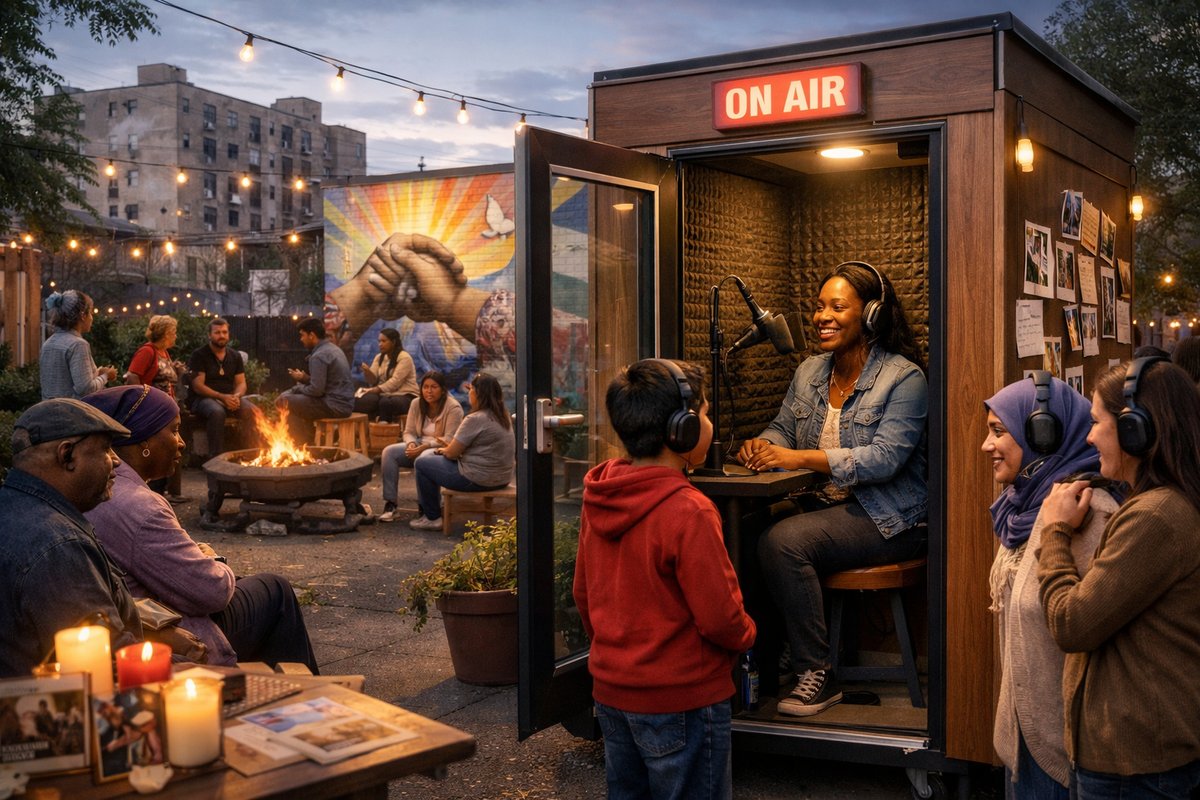
In neighborhoods stitched together by upheaval and hope, mobile audio booths are offering residents a chance to share personal stories. These pop-up installations not only capture fleeting memories but also spark communal healing, weaving an audible tapestry of collective resilience.
Just after dawn on a rainy April morning, a weatherproof tent rises above the cracked pavement of a once-abandoned lot. Inside, a simple wooden stool sits before a compact microphone and a small mixer, coaxing passersby to pause and speak. The pop-up recording booth itself looks unassuming, but the quiet hum of the audio interface and the soft click of a record button have begun to transform this urban corner into a living archive. A high school student takes the seat, adjusts a pair of over-ear headphones, and begins to describe the sound that makes her feel most at home: the rumble of a subway train, rolling beneath the city’s streets, carrying her dreams along with its commuters.
These mobile audio booths first appeared as a grassroots response to an invisible crisis: social isolation. After months of emergency measures and restricted gatherings, community groups set out to find low-barrier ways for residents of all backgrounds to reconnect. Instead of curating an event or organizing a panel, they built stalls that speak for themselves-literally. Each tent houses a digital voice recorder, an insulated microphone, and a backup battery system. Volunteers guide participants through the process: choose a prompt-“share a childhood sound,” “tell a moment of hope,” or “describe home in five words”-then press record and speak from the heart. No prior experience is required, and every contribution is automatically saved to a central archive.
By harnessing simple broadcast technology and public spaces, these pop-up booths have seeded dozens of mini story hubs across the city. You might find one on a library plaza, another outside a community center, and even a third nestled between food trucks at a weekend market. The teams behind the project worked closely with local artists, social workers, and urban planners to ensure each booth reflects its neighborhood’s character: murals painted by volunteers, bilingual signage, and hand-stitched cushions for comfort.
So far, more than 2,000 voices have been recorded, ranging from a retiree recounting wartime radio broadcasts to a new parent describing the lullaby they hum at midnight. In a borough where socioeconomic divides can feel insurmountable, the simple act of listening has begun to bridge gaps. For a teenage barista who once felt invisible at her crowded high school, the booth became her microphone to the world. For a first-generation immigrant who feared speaking broken English in public, it offered a forgiving space where every word-hesitant or fluent-was honored.
The organizers envisioned more than just an archive. They wanted to create a living, breathing community ritual. After each recording cycle, selected clips are featured at neighborhood gatherings-on open-air speakers during block parties, inside transit stations before rush hour, and even in short segments on a community radio station. Listeners gather around, headphones in hand, to trade impressions. A passing commuter might pause mid-stride, one eye on a screen, as the voice of a former factory worker describes the squeal of a loom in her childhood home. The effect is magnetic: people stop texting, look up, and listen.
In collaboration with a local university’s sociology department, the project team also hosts monthly listening salons. Residents share reactions to the latest selections, probing questions like “What rhythm of sound reminds you of your youth?” or “How does hearing another person’s memory shift your sense of belonging?” These salons, held in repurposed storefronts, have become a forum for intergenerational exchange. Grandparents and teenagers, once strangers in the same block, now debate the merits of vinyl records versus digital playlists. Their shared laughter and thoughtful pauses underscore the power of narrative to reshape public spaces.
Looking ahead, organizers plan to integrate these oral snapshots into an interactive mobile app and a real-time public display at a central transit hub. Imagine walking down a corridor and seeing waveform visualizations accompany audio clips from your own neighborhood. The goal is to foster continuous encounters with local stories, embedding them into daily routines rather than confining them to special events. By making these voices omnipresent, the team hopes to cement empathy as a civic practice rather than a fleeting sentiment.
Of course, no community initiative is without hurdles. Weather remains a constant threat-sudden storms can swamp electronic equipment, and scorching summer rays test the resilience of volunteers. To address this, teams have experimented with easy-up canopies, sealed electronic housings, and solar-powered battery packs. Occasional vandalism and noise complaints prompted organizers to install soft floors and acoustic screens, creating a cocoon of quiet even in the busiest plazas. Grants from local foundations have covered most costs so far, but the ultimate aim is to equip each neighborhood association with the know-how to run their own booth indefinitely.
Behind the scenes, a small group of digital archivists cleans and tags each recording, cataloging themes like “migration,” “family rituals,” and “urban nature.” This metadata not only makes the archive searchable but also supplies raw material for community radio producers, poets, and filmmakers. Plans are underway for an annual anthology-a limited edition vinyl record featuring the most moving excerpts, hand-numbered and distributed at a winter solstice celebration in the town square. Those recordings, etched in grooves, will serve as both an art object and a time capsule of collective memory.
In an era of constant messaging and fleeting headlines, the pop-up recording booths remind us that every voice carries weight. They transform anonymous passersby into storytellers, inviting listeners to slow down and honor a single human moment. As the initiative continues to grow-spreading to nearby towns and even inspiring rural versions with acoustical tree houses-its core lesson remains simple: when we listen without judgment, we find the shared rhythms that unite us.
For residents weary of empty slogans and glossy campaigns, these booths have become a grassroots beacon of hope. They prove that authentic connection can flourish in impromptu settings, fueled by nothing more than curiosity, a microphone, and the courage to speak. In each crackle of a recording and every played-back word, there lives a reminder that resilience is neither solitary nor silent-it reverberates through the voices of us all.