Location
Mount Vernon, WA 98274

Location
Mount Vernon, WA 98274

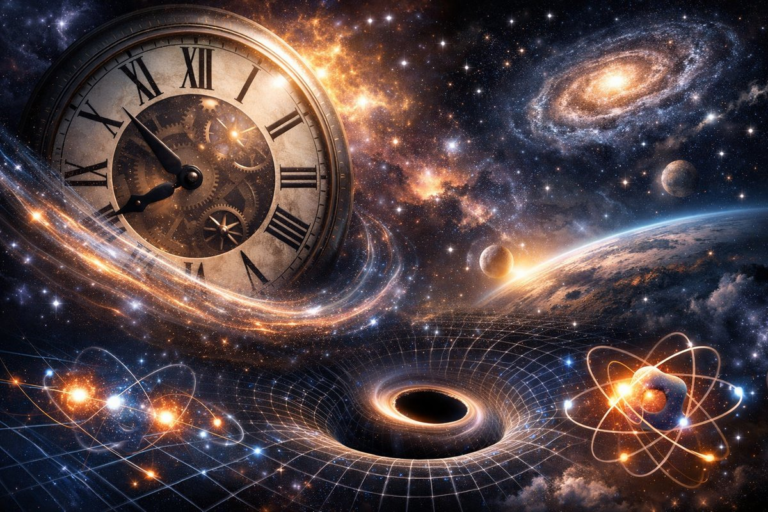
From ultra-stable clocks to exotic states of matter in deep-underground labs, researchers are piecing together the hidden tapestry of reality. By tracing fleeting particles and listening to spacetime's gentle tremors, we're unlocking the secrets that bind the cosmos and our everyday lives.
In a remote desert plateau, dust settles around a ring of gleaming instruments, each tuned to capture the faintest tick of a clock that loses less than a billionth of a second per day. Nearby, a lattice of superconducting magnets encloses chambers of ultracold gas, coaxing atoms into states never seen outside the lab. These installations might seem disconnected-one devoted to perfecting our grasp of time, the other to coaxing matter into exotic forms-but they share a deeper quest: to unravel the hidden patterns that shape reality.
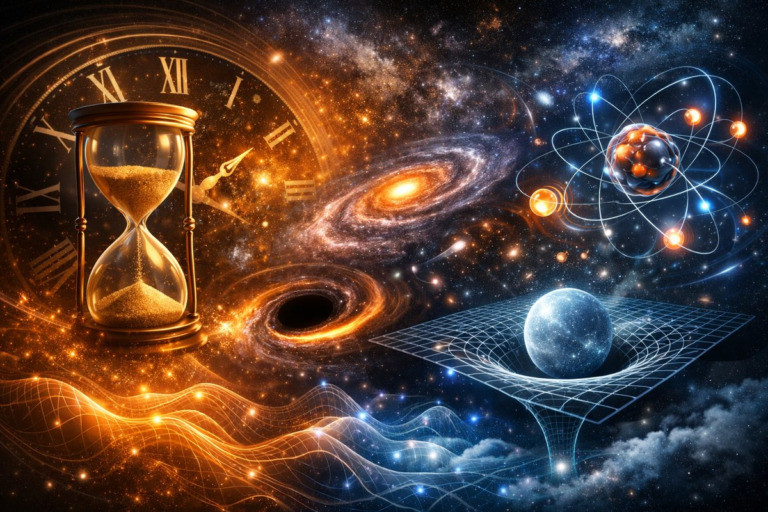
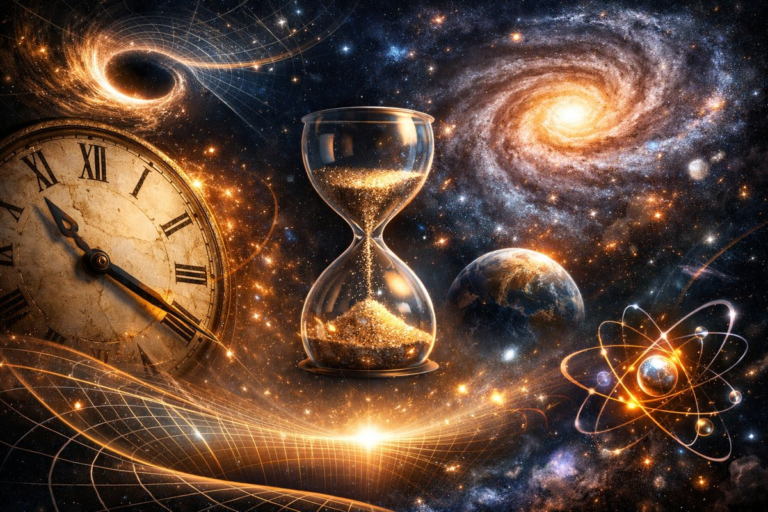
Time and matter, once considered separate pillars of physics, are now viewed as interconnected threads in a cosmic tapestry. Recent advances in measurement and experimentation have blurred the boundaries between the two, challenging our intuition and offering glimpses of a universe richer than we ever imagined.
It began when researchers refined atomic clocks using lasers that cool atoms to microkelvin temperatures. In these clocks, laser pulses slow rubidium or ytterbium atoms until they barely drift, allowing scientists to count the cycles of an electronic resonance with unprecedented precision. A single second can be divided into quadrillions of tiny intervals, and these clocks run so stably that they would lose or gain less time than a heartbeat over the age of the universe. Such exactitude isn’t an academic exercise: it underpins global navigation systems and enables tests of fundamental physics, like whether the speed of light is truly constant across different gravitational potentials.
Meanwhile, deep underground in shielded caverns, physicists hunt for dark matter ever so slightly interacting with ordinary particles. These experiments often rely on cryogenic detectors cooled by liquid helium to just a fraction of a degree above absolute zero. Inside, a collision with a hypothetical dark matter particle would deposit a whisper of energy, detectable as a flash of light or a tiny phonon ripple. Year after year of data collection and painstaking background rejection are required to spot these rare events, but even a single confirmed detection would revolutionize our understanding of matter and the hidden mass that gravitationally shapes galaxies.
At the intersection of these efforts lies the study of gravitational waves. Gigantic interferometers stretch laser beams across kilometers of vacuum tubes, measuring distortions in spacetime as faint as a fraction of a proton’s diameter. The first detection arrived less than a decade ago, revealing the collision of two massive objects spiraling into each other a billion light-years away. Since then, dozens of events have been recorded-from merging neutron stars that seed the cosmos with heavy elements to more mysterious signals that defy easy classification.
This convergence of high-precision clocks, ultracold matter experiments, and gravitational-wave astronomy has fostered an ecosystem of cross-pollination. Atomic clocks are now being used to detect passing gravitational waves by monitoring tiny shifts in ticking rates. Exotic matter states generated in lattice traps offer analogues for phenomena inside neutron stars or the early universe’s primordial soup. Even quantum entanglement, once a theoretical oddity, is being harnessed to enhance sensor sensitivity, pushing the frontier of what we can observe.
These developments aren’t confined to sprawling national labs. A new generation of portable atomic clock modules and compact particle detectors is enabling university labs and start-ups to join the race. Enthusiasts and citizen scientists are also participating: open-source hardware designs for cosmic ray detectors and magnetometers allow backyard experiments that align time-stamped events with global networks.
Alongside these tools, digital platforms are transforming how we experience cosmic data. Virtual-reality stargazing headsets immerse users in a simulated night sky, complete with real-time data overlays showing gravitational-wave events or gamma-ray bursts. Interactive apps let curious minds tune into the “hum” of the universe, converting inaudible frequencies into musical tones that represent the subtle warping of spacetime.
The philosophical implications are profound. If time can be measured with such fineness that its flow varies across a single building, what does that mean for our notion of simultaneity? If dark matter reveals discrete interactions with ordinary matter, might there exist hidden realms accessible only through specially tuned instruments? Each experiment peels back a layer, exposing new questions about causality, locality, and the nature of existence itself.
Yet the human element remains at the heart of discovery. Early mornings in the desert control rooms, late-night coding sessions analyzing terabytes of detector data, collaborative video conferences across continents-all these moments of shared curiosity drive progress. Researchers describe a feeling of standing at the edge of a vast unknown, where each data point is a stepping stone toward deeper insight.
Public outreach efforts mirror this spirit. Science festivals featuring portable telescopes and time-flight demonstrations invite audiences to see for themselves how lasers trap atoms or how atomic clocks differ by fractions of a second. Museums spotlight interactive exhibits that let visitors manipulate virtual wormholes or observe simulated particle collisions. By weaving the story of measurement and matter into everyday experiences, these programs inspire the next generation of explorers.
No single instrument holds all the answers. Instead, a network of complementary approaches-from tabletop quantum sensors to kilometer-scale observatories-forms a resilient fabric of inquiry. As researchers fine-tune clocks, cool clouds of atoms, and listen for spacetime’s murmur, they chart a path forward: a holistic view of reality where time and matter coevolve, and mysteries yield to creative synthesis.
The journey is far from over. International collaborations are planning networks of quantum-linked clocks stretching across continents, capable of mapping Earth’s gravitational field with unmatched resolution. Proposed satellites aim to place atomic clocks in deep space, probing time’s behavior near black holes. Deep-sea labs consider deploying neutrino detectors in the abyss, turning the planet’s vast water shield into a cosmic observatory.
Each new venture promises surprises. Exotic phases of matter could reveal unknown symmetries. Tiny deviations in clock rates might hint at undiscovered forces. Gravitational-wave archives may contain echoes of the universe’s infancy. And as tools become more sensitive, phenomena once deemed unmeasurable will enter the realm of observation.
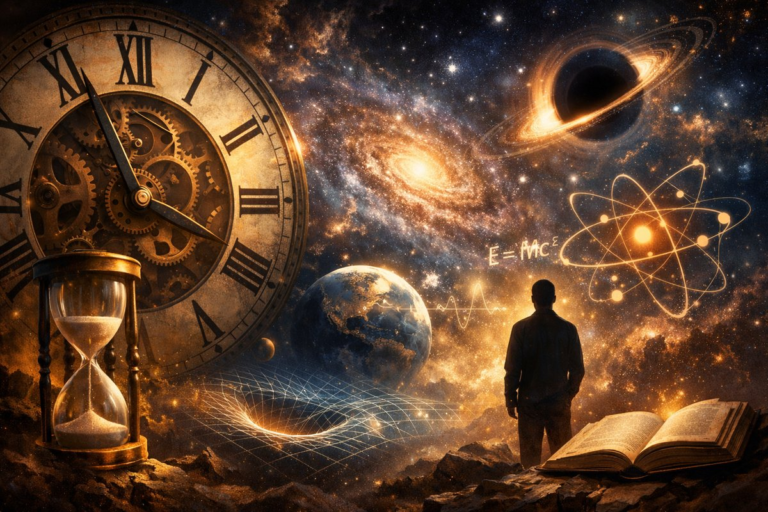
In this era of unprecedented precision and collaborative ingenuity, the lines between story and science, observer and observed, grow delightfully ambiguous. The next time you glance at a watch or gaze into the night sky, remember that you’re peering into an ever-evolving narrative-one that binds time and matter in a dance of mystery and revelation.