Location
Mount Vernon, WA 98274

Location
Mount Vernon, WA 98274
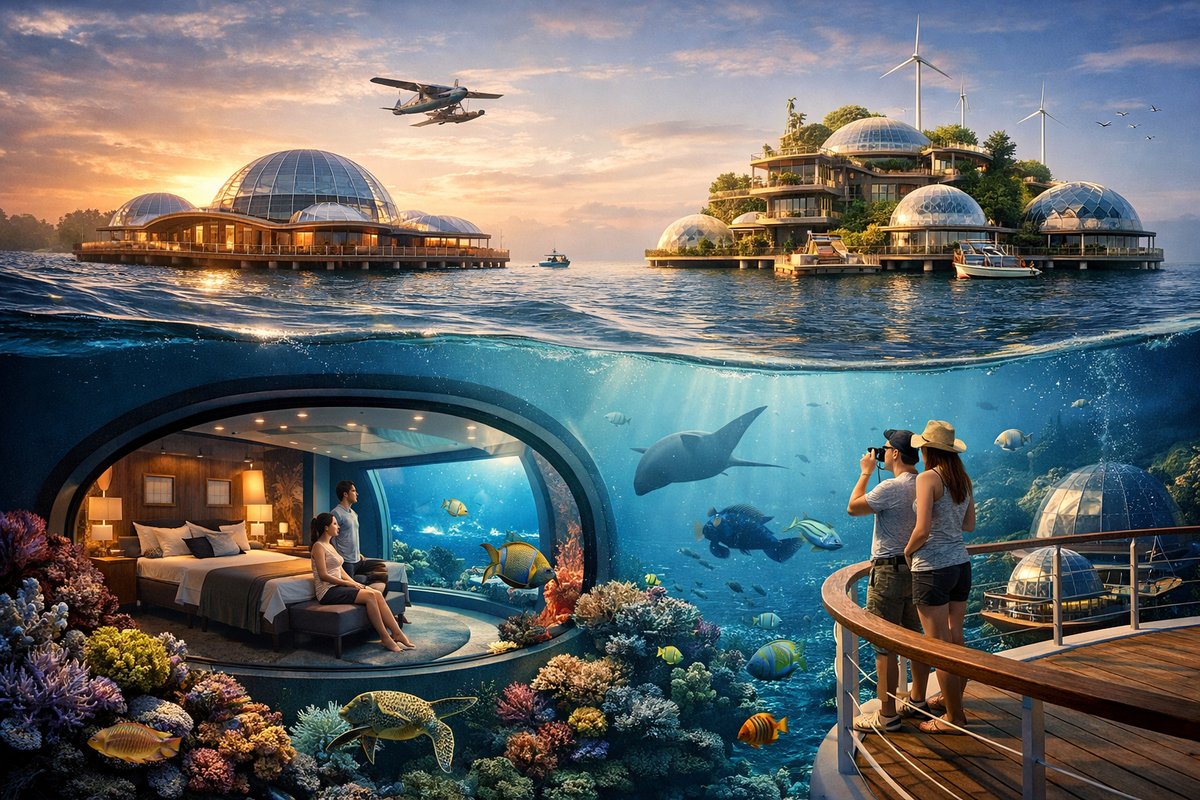
From submerged suites illuminated by coral gardens to self-sufficient floating villages, travelers are diving into a new era of ocean tourism. Discover how undersea accommodations and drifting eco-resorts are reshaping sustainable journeys and inviting curious explorers to see the world from a whole new perspective.
Travel has always been an invitation to expand our horizons, but recent innovations in ocean tourism are turning the sea itself into a destination. Gone are the days when a cruise ship or beachfront bungalow represented the height of maritime exploration. Today’s intrepid travelers are seeking immersive stays beneath the waves and on state-of-the-art floating platforms, where biophilic design merges with cutting-edge sustainability.
In the crystal-blue waters of the Indian Ocean, an underwater suite perched four meters below sea level welcomes guests with panoramic portholes framing vibrant coral reefs. Furnished in calming neutrals and equipped with discreet LED lighting to protect marine life, these submerged rooms bring the ocean’s heartbeat into every waking moment. The gentle sway of fish schools, the quiet hum of passing rays, and the soft glow of moonlight reflected against a mosaic of corals create an otherworldly ambience.
Farther north, a pioneering resort chain has unveiled its second undersea villa near a remote atoll. Powered by a combination of solar panels and an offshore wave-energy array, the property maintains greenhouse-style water treatment units that recycle greywater and desalinate seawater. Locally sourced timber, reclaimed metal, and naturally dye-infused fabrics give the interiors an artisanal quality, while a dedicated marine biologist leads guests on guided reef-restoration dives. These stays are as much about contributing to ocean health as they are about luxury.
Underwater hotels aren’t the only frontier. Floating resorts are rising on calm lagoons and coastal bays, each designed to operate off-grid with solar roofs, wind turbines, and hydroponic gardens. Constructed from corrosion-resistant composites and buoyant concrete, these structures drape over gentle waves like geometric lily pads. Some incorporate botanical terraces where mangroves and salt-tolerant plants stabilize floating walkways; others feature submerged labs where students and scientists study plankton blooms. Shared lounge decks open to the sky, offering sunrise yoga, stargazing, or open-air cinema nights above a blanket of calm water.
Technology plays a starring role in these ventures. Remote monitoring systems track energy output, water quality, and structural integrity, transmitting real-time data to onshore control centers. Underwater drones mapped ocean floor topography to guide the strategic placement of underwater pavilions, ensuring minimal disturbance to delicate ecosystems. Meanwhile, augmented-reality headsets deliver immersive educational tours: imagine placing your hand on a digital seahorse that materializes in real space, then following its life cycle through narrated visual overlays.
Closer to populated shores, a repurposed offshore oil-rig platform has been transformed into a floating community of micro-hotels. Elevated above the surf, each pod spans roughly 25 square meters and features fold-out terraces with binocular mounts and waterproof lounge chairs. Guests embark on morning kayak excursions through kelp forests, return to communal kitchens teeming with catch-of-the-day harvests, then join sunset gatherings around solar-fired grills. By day’s end, the rig’s gentle creaks and the distant songs of seabirds serve as lullabies.
For those who crave deep-sea thrills, luxury submersibles are now ferrying guests to historic shipwrecks and underwater canyons. Pressurized cabins with expansive windows offer unfiltered views of twilight-zone dwellers-transparent jellyfish, luminous crabs, and the occasional curious shark. Many operators partner with oceanographers to include citizen-science features: permanent water samples are collected, quasi-scientific observations are logged, and local conservation efforts receive donations from each dive. These excursions highlight the fragile beauty that lies beneath routine scuba depths.
Accessibility has improved as well. High-speed electric ferries and hybrid catamarans reduce transit times and carbon footprints. Seaplane networks link coastal towns and private atolls, while amphibious aircraft are experimenting with eco-friendly fuel blends. The result is an increasingly connected blue economy where remote archipelagos and floating habitats feel less like inaccessible dreams and more like attainable escapes. Insurance providers and regulatory bodies are streamlining safety standards for undersea structures, creating a framework that balances innovation with responsible stewardship.
Travelers who’ve experienced these developments often report a profound sense of connection-to the planet, to local communities, and to their own curiosity. One guest described drifting to sleep while manta rays glided overhead, comparing the sensation to being cradled by the ocean itself. Another spoke of the floating rig’s community dinners as an antidote to digital overload, where conversations around long communal tables grew as rich as the seafood paella. It’s a reminder that travel isn’t only about new places; it’s about meaningful interactions layered atop every mile traveled.
Sustainability sits at the heart of these oceanic odysseys. Many projects convert seawater into drinkable water on site, cultivate native seaweed to filter carbon, and use biodegradable materials for everything from toiletries to packaging. When disassembling an aging structure, teams adopt circular-economy principles-steel is recycled, buoyant modules are refurbished for new uses, and organic waste becomes compost for onshore gardens. In some cases, revenue from high-end stays subsidizes local fishing co-operatives and coastal cleanup initiatives.
Of course, cost remains a factor. Underwater suites and floating cabins carry premium price tags, often appealing first to well-heeled early adopters. But as modular construction techniques and mass-manufactured buoyancy systems mature, entry points are beginning to diversify. Community-run eco-lodges are integrating micro-pods at affordable rates, and some cruise lines are leasing floating villas for day trips. Scholarship programs and discounted slots are emerging to widen access for researchers, students, and nonprofit volunteers.
What lies ahead? Visionaries are sketching plans for underwater concert halls, fully submersible art galleries, and floating campuses where marine science students live and learn. An experimental project dubbed “Ocean Spiral” aims to connect surface-level villages with deep-sea research labs via spiral tunnels. Meanwhile, advances in bioplastic and seawater-based building materials promise to reduce environmental impacts further.
For curious explorers, the message is clear: the ocean is no longer just a backdrop for travel-it is the destination. Whether you’re drifting above a coral reef in your submerged suite, joining a citizen-science sub dive, or gathering under the stars on a floating deck, these journeys reshape our relationship with water. They challenge us to travel more thoughtfully, embrace sustainable innovation, and listen closely to the silent stories carried by waves. In doing so, we return home not just with photographs and souvenirs, but with new perspectives that ripple far beyond the shoreline.