Location
Mount Vernon, WA 98274

Location
Mount Vernon, WA 98274
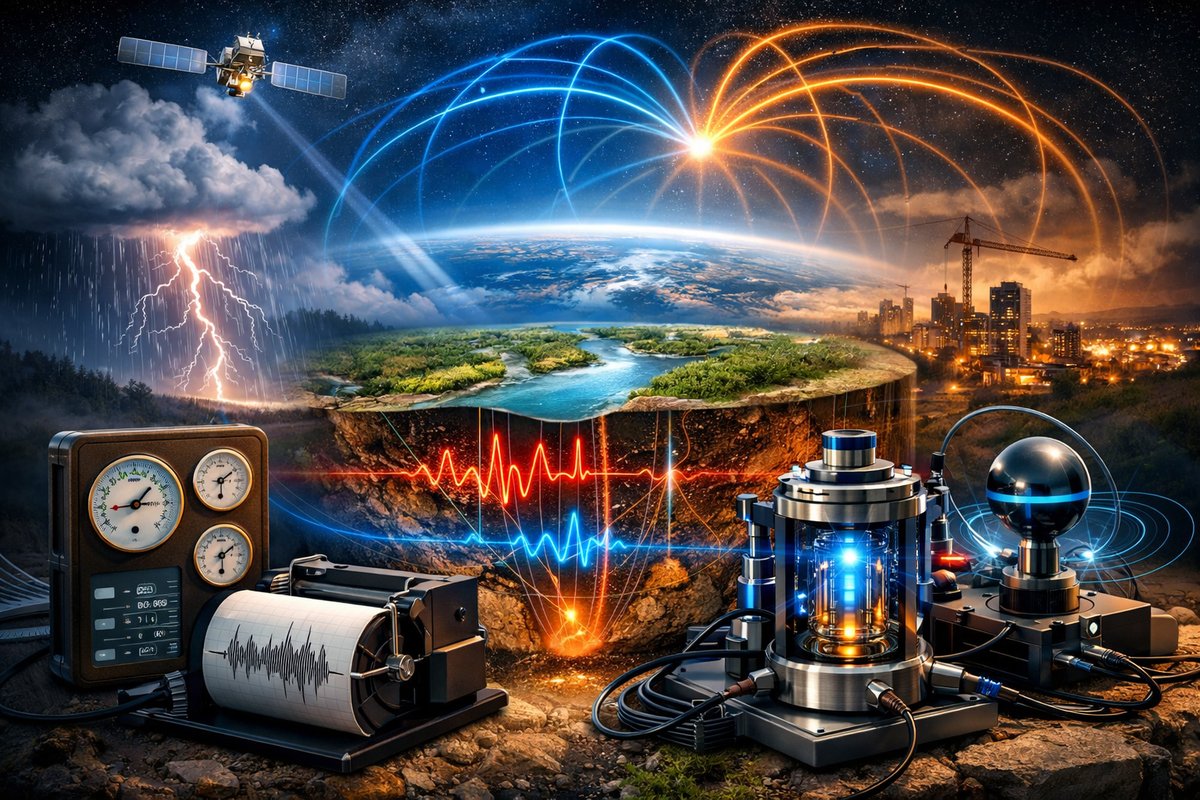
A new international collaboration has combined citizen science barometers, bespoke seismographs, and cutting-edge quantum sensors to map subtle gravitational and magnetic patterns across the planet. This initiative uncovers how rainfall, lightning, and human activity drive interconnected vibrations that echo through Earth's crust and atmosphere.
A coalition of geophysicists, physicists, and citizen scientists has unveiled the first truly global map of subtle natural oscillations by integrating traditional ground sensors with emerging quantum devices. Published in a leading open-access journal, the study harnesses data from over 5,000 portable barometers, DIY seismograph kits, tri-axial magnetometers, and atom-interferometry units deployed from urban rooftops to remote islands. The result is a high-resolution, continuous portrait of how tiny fluctuations in gravity and magnetism dance across the planet in response to rainfall, lightning strikes, ocean tides, and even large-scale human events.
“It’s like tuning into Earth’s heartbeat,” said the project’s lead geophysicist. “We knew the planet hummed, but until now we couldn’t hear how one force ripples into another over thousands of kilometers.” By cross-correlating barometric pressure anomalies with microseismic tremors and magnetic field variations, the team identified surprising couplings-such as gravity dips immediately following intense rainstorms, followed by magnetic spikes linked to local electrical discharges.
The backbone of the network combines low-cost, off-the-shelf environmental kits contributed by volunteers with next-generation quantum gravity sensors built by research labs. While DIY seismographs detect ground motions down to a few nanometers, atom-interferometry gravimeters measure changes in gravitational acceleration as small as one part in 109. When deployed side by side, these instruments paint a detailed picture of mass redistribution in soil layers, groundwater levels, and subterranean fluid flows.
In one striking example, a cluster of sensors in Southeast Asia recorded a rapid drop in local gravity during a monsoon downpour. Within seconds, nearby magnetometers registered brief pulses of electromagnetic noise-likely caused by the sudden inflow of charged water through mineral‐rich sediments. Similar patterns emerged in West Africa and South America, suggesting a universal process wherein rain-triggered gravitational shifts energize geoelectric currents.
Beyond precipitation coupling, the network has also shed light on how distant storms can influence ground vibrations. When powerful lightning strikes occur thousands of kilometers away, tiny magnetic perturbations arrive first at the sensor nodes, followed by subtle seismic waves minutes later. These magneto-seismic echoes reveal the planet’s capacity to guide energy through both its solid and plasma envelopes.
The integration of quantum devices has been pivotal to these discoveries. Traditional gravimeters mounted on tripods require careful calibration and vibration isolation. In contrast, portable atom-interferometry units-roughly the size of a carry-on suitcase-operate on the same principle as precision atomic clocks, splitting and recombining matter waves to detect gravitational changes. Their deployment at more than 200 sites worldwide has tripled the spatial resolution of previous gravity surveys.
To manage the flood of data, the team developed an open-source, cloud-based platform that ingests streams from heterogeneous devices in real time. Machine-learning algorithms sift through millions of readings each hour to flag correlated events across modalities. This event-driven approach reduces storage needs while highlighting meaningful patterns-such as synchronized gravity dips and magnetometer spikes that might otherwise be buried in noise.
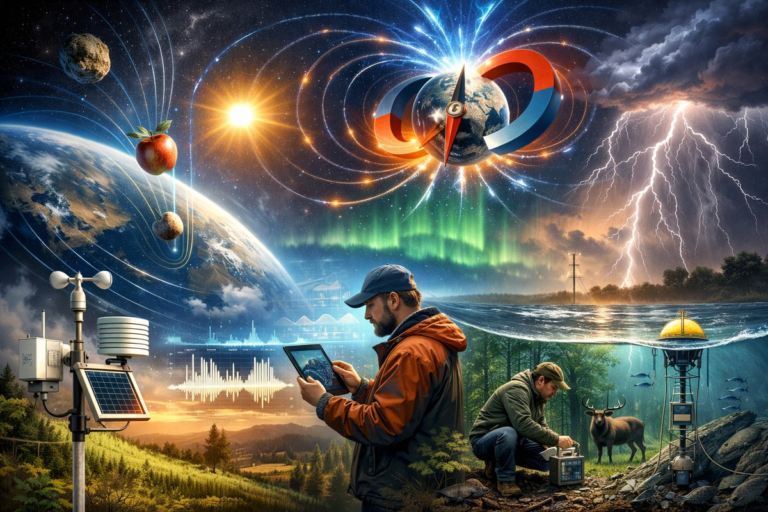
Citizen scientists have played a central role, contributing sensor setups in backyard gardens, university labs, and rooftop observatories. A simple smartphone app guides volunteers through calibration and data validation, ensuring readings meet quality standards. “The community engagement has been incredible,” noted the project’s outreach coordinator. “People are excited to see their own instruments pick up signals from storms halfway around the world.”
Among the early applications is refining flood forecasting. By detecting gravity-driven groundwater surges before surface runoff becomes visible, local authorities can issue warnings days in advance. In agricultural regions, farmers have begun using sensor feeds to optimize irrigation, monitoring soil moisture fluctuations inferred from gravitational anomalies.
The network’s magnetic observations are informing research into space weather impacts on power grids. Sudden magnetic pulses linked to distant geomagnetic storms appear to coincide with small but measurable ground currents that can strain transmission lines. Utilities are exploring how real-time integration of ground magnetometer data could help anticipate transient grid loads.
Looking ahead, the collaboration plans to incorporate autonomous drone swarms equipped with miniaturized sensors. These aerial units will fill gaps in remote regions and over oceans, capturing vertical profiles of pressure, magnetism, and microseismic signals. Combined with satellite gravimetry missions already in orbit, the expanded network aims to deliver continuous, three-dimensional monitoring of the planet’s dynamic forces.
As the initiative scales up, questions arise about data ownership, privacy, and sustainability. The coordinating body has adopted a values-driven framework that keeps all data open and anonymized, while encouraging low-power, solar-driven sensor designs. By reducing reliance on centralized labs, the project promotes decentralized science-empowering communities worldwide to explore the subtle rhythms of their own landscapes.
In an era when global challenges demand deeper understanding of Earth’s systems, this modular network offers a new lens for wonder and discovery. From the faint whisper of falling rain to the distant rumble of ocean swells, every natural force leaves an imprint, waiting for curious minds to decode. With each added node, the planet’s hidden symphony becomes just a little clearer.