Location
Mount Vernon, WA 98274

Location
Mount Vernon, WA 98274
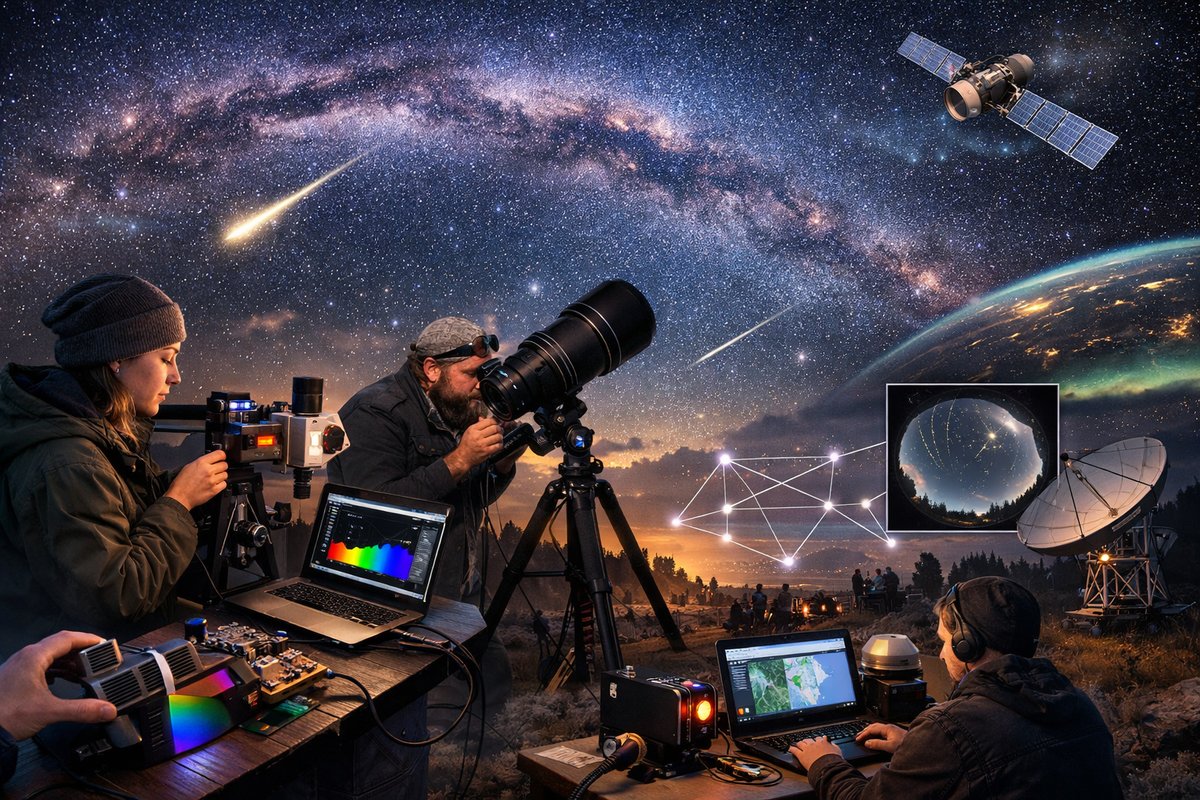
A groundswell of amateur astronomers, open-source engineers, and citizen scientists is reshaping how we engage with the night sky. From DIY spectrometers to crowd-sourced meteor networks, discover the tools and communities turning stargazers into active cosmic investigators.
When a brilliant fireball streaked across the pre-dawn sky over multiple continents last spring, it wasn’t only professional observatories that lit up in response. Thousands of backyard astronomers armed with telescopes, smartphones, homemade spectrometers, and binoculars recorded the event, sharing real-time data, images, and videos with global networks of researchers. The result: a detailed trajectory map more precise than many dedicated space-agency simulations. This moment exemplifies a larger shift in how humanity approaches the cosmos-one that places the power of scientific discovery into the hands of everyday explorers.
Just a decade ago, citizen science in astronomy meant the occasional online classification of a distant galaxy. Today, open-source hardware and inexpensive electronics have turned kitchen tables into makeshift observatories. Crowdfunded components-Raspberry Pi boards, low-light CMOS sensors, 3D-printed mounts-are now standard issue for curious individuals who once merely glimpsed the Milky Way through a haze of light pollution. With each technological leap, these avocational researchers contribute ever more sophisticated observations: meteor shower flux rates, spectral analyses of variable stars, even radio-frequency recordings of solar bursts.
The rapid proliferation of modular telescope designs means that an entry-level reflecting telescope can be assembled and tuned in an afternoon. Online tutorials guide users through collimation of mirrors, alignment of GoTo mounts, and polar calibration techniques. Add-on kits-smartphone adapters, field-flattening lenses, and multispectral filters-expand the range of possible investigations, from capturing planetary details to studying the faint glimmer of dwarf galaxies. For a fraction of the cost of vintage hobby setups, newcomers can now record images rivaling mid-tier research-grade observatories.
Yet it’s not just optics driving this renaissance. Amateur groups across six continents operate radio antenna arrays that monitor solar activity, track Jupiter’s magnetic storms, and pick up mysterious bursts from pulsars. By sharing raw data on communal servers, these networks enable cross-validation of signals and foster rapid responses to sudden events-solar flares, gamma-ray bursts, or the approach of near-Earth objects. In a participatory model reminiscent of open-source software, contributors refine signal-processing algorithms, debug noise-reduction code, and publish improved versions to benefit the entire community.
That collaborative spirit extends into the realm of spectroscopy, where do-it-yourself astronomy kits have broken down barriers to entry. A plug-and-play spectrometer able to split starlight into its component wavelengths can now be purchased for under a few hundred dollars. Hobbyists calibrate these devices using reference lamps or neon tubes and then point them toward emission nebulae, young star clusters, or even the planets in our solar system. By measuring elemental fingerprints, they estimate chemical abundances, surface compositions, and gas velocities. Those measurements, once the exclusive domain of university observatories, form the basis for amateur-led papers and conference presentations.
Underpinning these hardware advances is a blossoming ecosystem of software tools. Mobile apps use augmented-reality overlays to help users identify constellations, verify star positions, and plan observing sessions around the moon phase or weather forecast. Cloud-based platforms ingest photos and align them with contextual metadata-timestamp, location, instrument specs-and produce shareable visualizations. Some platforms even run basic machine-learning routines to flag potential novae or supernova candidates, alerting users to double-check their images and report findings to professional alert services.
Educational institutions are adapting, too. Planetariums integrate live feeds from citizen-run telescopes, streaming deep-sky vistas to urban audiences deprived of dark skies. After-school programs in underserved neighborhoods distribute mini-observatory kits, complete with folding tripods, digital sensors, and guided lesson plans. Virtual workshops teach youth how to measure meteor speeds, calculate asteroid orbits, and model crater formation. These initiatives cultivate a sense of stewardship and inspire the next generation of astrophysicists and aerospace engineers.
Even cultural attitudes toward the cosmos are shifting. Social-media communities dedicated to space exploration no longer center solely on breaking news from space agencies. Instead, threads bubble with personal discoveries: the first time a student resolved Saturn’s rings, the satisfaction of capturing a lidar profile of a shooting star, or the moment an older enthusiast rents a rooftop observatory to share the universe with neighbors. Weekly livestreams highlight a community member’s progress tweaking a homemade radio observatory. Periodic “data jamborees” gather contributors to sift through raw recordings, identify anomalies, and brainstorm follow-up observations.
These communal efforts have tangible scientific outcomes. Early last year, a trove of citizen-collected spectra pinpoints the appearance of a rare interstellar comet as it plunged through the inner solar system. Another network of volunteer radio telescopes detected an unexpected drift in the rotational period of a distant pulsar, prompting follow-up studies by professional facilities. During a recent lunar eclipse, coordinated observations from five continents produced a time-lapse mosaic of Earth’s shadow sweeping across the moon-a feat nearly impossible before this era of distributed astronomy.
Looking ahead, technological democratization shows no sign of slowing. Open-hardware blueprints for cooled CMOS cameras, spectrograph modules, and radio receivers circulate freely online. Additive-manufacturing services will soon let individuals print precision mirror mounts and optical benches on demand. Low-power computing platforms embedded in remote-controlled observatories-complete with solar panels and mesh-network radios-could enable autonomous stargazing out in remote deserts or high‐altitude plateaus, far from any city lights.
Artificial-intelligence assistants, too, are entering the fold. Imagine a voice-enabled guide that helps line up your telescope, calibrate your tracking, and diagnose focus errors in real time. Or algorithms that integrate data from hundreds of citizen telescopes to forecast meteor rates at a neighborhood level. Early prototypes of these systems have already demonstrated improved detection rates for faint satellite trails and reduced false positives in transient searches.
None of this progress diminishes the mystique of the night sky; rather, it deepens our bond with the cosmos. In an age of digital distraction, the act of gazing upward-hands on knobs, eyes at the eyepiece, hearts racing at the first glimpse of Jupiter’s cloud bands-reconnects people with a sense of wonder that transcends screens and schedules. Participants often describe a profound emotional shift: a reminder of their place in a vast universe, a feeling of humility and connection that lingers long after the observing session ends.
As astronomy outreach expands beyond lecture halls and research journals, it illuminates new pathways for public engagement in science. The night sky, once the province of dedicated professionals, has become a shared frontier. In this collaborative cosmos, every observation matters, every contribution counts, and every curious mind can help unravel the universe’s secrets. Whether through a simple pair of binoculars or a community-built spectrometer, the tools of discovery are now accessible to all. And as more people lift their eyes-and their instruments-to the heavens, we stand at the threshold of revelations that belong to everyone under the stars.
In a world racing toward the next digital breakthrough, these grassroots space initiatives remind us that some of the greatest wonders remain written in light years, waiting to be read by those willing to look. It’s an invitation to all: step outside, aim skyward, and join the unfolding story of cosmic curiosity.