Location
Mount Vernon, WA 98274

Location
Mount Vernon, WA 98274
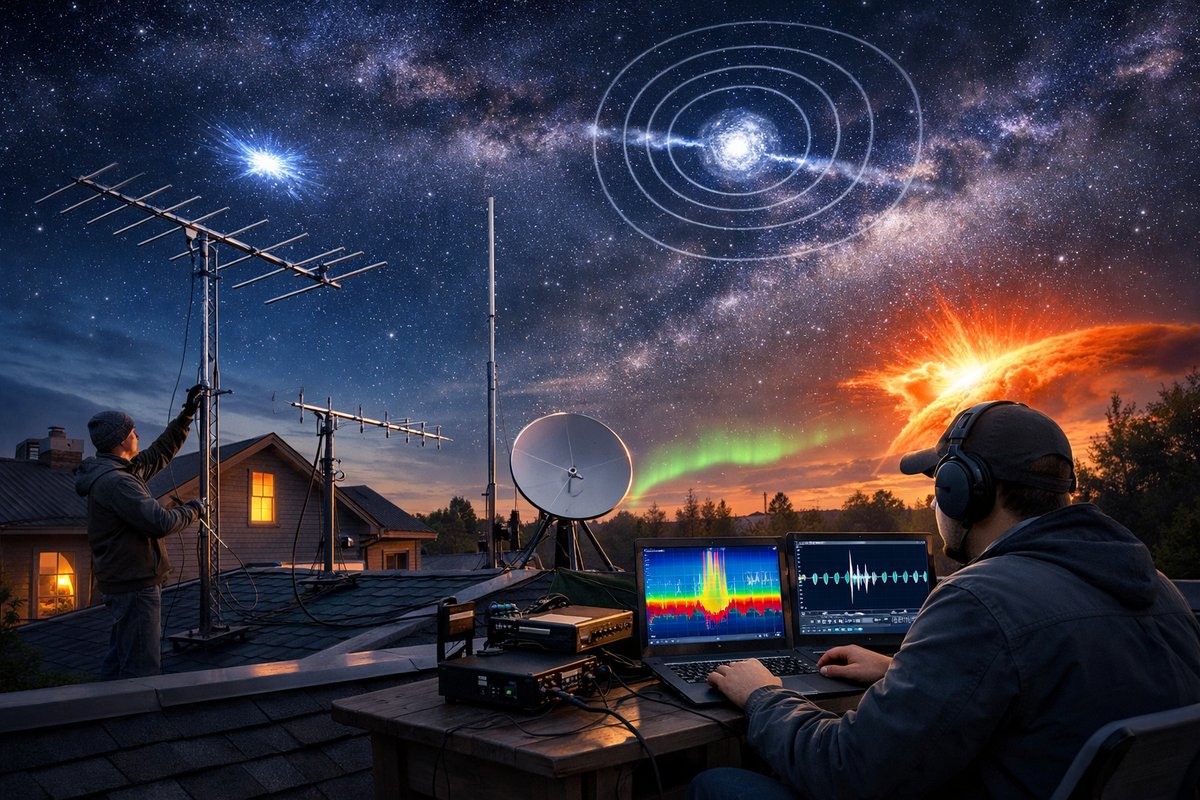
A growing network of backyard radio arrays and software-defined receivers is capturing previously unseen cosmic radio bursts. Volunteers around the globe are banding together to chart interstellar magnetic fields, track solar storms, and eavesdrop on the whispers of distant pulsars-all from their own rooftops.
In backyards, patios, and university rooftops around the world, curious minds are assembling arrays of low-cost radio receivers to pick up signals that have traveled across light-years. What began as a handful of science enthusiasts experimenting with surplus electronics has grown into a coordinated, open-source network that is reporting fresh insights into cosmic magnetic fields, pulsar glitches, and even the subtle radio glow of the Milky Way’s spiral arms.
With the advent of affordable software-defined radio (SDR) USB dongles and open-source signal-processing software, amateur astronomers no longer need a million-dollar dish to participate in cutting-edge research. Under the banner of projects like the Cosmic Radio Array Consortium (CRAC), dozens of local clubs and individual hobbyists have set up small Yagi and loop antennas, feeding their signals into SDR receivers that stream live spectral data to a central database. Within months of its launch, CRAC contributors reported dozens of new observations: solar flare radio bursts that matched satellite records, Jupiter’s storm-driven decametric emissions, and even weak signatures that could be traced back to a handful of millisecond pulsars.
“The beauty of this network is how it blends technology, community, and curiosity,” says a project coordinator based at a European research institute. “Participants tune in on their own schedules, but the combined dataset is something no individual observatory could match. We’re seeing the interstellar medium in three dimensions, tracing how magnetic filaments warp and twist.”
Interstellar magnetism has long been a blind spot in astrophysics. Traditional optical telescopes can map stars and galaxies, but magnetic fields are most clearly revealed by polarized radio waves. Large radio observatories require vast, heavy dishes and cryogenic receivers to reduce electronic noise. The SDR revolution changed the game: by digitizing broad swaths of the radio spectrum in real time, volunteers can now detect fluctuation patterns and feed them into machine-learning pipelines that distinguish genuine cosmic events from terrestrial interference.
During a recent solar storm, several citizen observers in North America detected a pronounced spike in decametric radio noise-an observation later confirmed by ground-based space weather monitors. Meanwhile, a surprising uptick in correlations between detectors in South America and Africa hinted at a previously unnoticed radio transient, sparking a follow-up campaign using larger university-grade dishes.
These volunteer efforts are not just an educational exercise. They have practical ramifications for space weather forecasting-solar radio bursts can disrupt satellite communications and GPS signals, and early warning can mitigate risks to aviation and power grids. By widening the monitoring net, the CRAC network provides a distributed early-alert layer that complements satellite-based sensors.
Data sharing is central to the model. Contributors upload raw spectrograms to an online repository, where open-source tools tag features and alert the community when an unusual event appears. An integrated chat platform allows instant coordination: when a cluster of detectors in Asia registers a fast radio burst candidate, follow-up observations can be triggered within minutes by radio arrays in Europe and Oceania.
Despite the distributed nature of the project, quality control remains rigorous. Automated pipelines flag recordings with excessive interference, and a peer review board of professional astronomers vets high-impact findings before public release. A recent milestone saw the first joint publication between volunteers and academics in a leading astrophysics journal, documenting the detailed spectrum of a fast radio burst repeat source.
The equipment requirements are surprisingly modest. A typical setup costs under a few hundred dollars: an SDR dongle, a compact directional antenna or magnetic loop, a preamplifier, and a laptop or single-board computer. Many hobbyists repurpose USB cables and salvaged coaxial connectors, minimizing e-waste and fostering a sustainability mindset. Videos and step-by-step assembly guides abound online, encouraging newcomers to solder their first BNC connectors and learn basic RF shielding techniques.
For some, the journey begins simply by pointing a pair of astronomy binoculars skyward. Spotting Jupiter’s belts or tracing the arc of the Milky Way inspires a desire to probe beyond the visible. Others start with introductory star charts and sky-mapping apps, then discover that those same coordinates align with peaks in their radio waterfall displays. The interplay between optical stargazing and radio listening deepens the sense of wonder: a bright cluster visible in binoculars may harbor a network of magnetic filaments detectable only at a few dozen megahertz.
With demand surging, a new wave of community workshops is springing up. Libraries, science centers, and makerspaces are hosting “RF star parties,” where participants swap hardware, share antenna-building tips, and compare live spectrograms. At one recent gathering in a coastal city, volunteers deployed portable loop antennas on the beach to listen for marine radar interference and then pivoted westward to catch Jupiter’s nighttime bursts. The event culminated in a collaborative mapping of local radio frequency interference, teaching practical skills in signal identification and electronic forensics.
While the current focus is on radio astronomy, many participants see broader horizons. Plans are underway to integrate small optical telescopes and infrared sensors into the network, creating a multi-wavelength citizen observatory. Others are exploring the potential for distributed microwave detectors that could help chart the relic glow of the Big Bang, known as the cosmic microwave background.
Back on the amateur front, enthusiasts are already dreaming bigger. Some hope to deploy balloon-borne SDR payloads, capturing radio signals above the bulk of Earth’s ionosphere. Others are experimenting with remote-controlled truss antennas on cargo-shipping containers, providing stable platforms in areas where land-based interference is prohibitive. Even satellite uplinks are on the table: a handful of groups plan to launch CubeSats equipped with SDR modules, turning the entire network into a hybrid space-ground observatory.
The true innovation lies not in any single discovery, but in the collaborative spirit and democratization of exploration. As one veteran volunteer puts it, “We’re proof that science doesn’t require a gated ivory tower. All it takes is curiosity, some soldering iron skills, and the willingness to listen.”
By embracing a modular approach-open-source hardware designs, shared data standards, and cross-platform software-the citizen radio array movement is setting a template for 21st-century science: decentralized, sustainable, and driven by collective intelligence. As more people tune their receivers to the whispers of the universe, we’re bound to uncover surprises, not only in the radio sky but in our own capacity to explore, innovate, and connect across cultures and time zones. The cosmos is calling-and now, more than ever, anyone with a few wires and a sense of wonder can answer.