Location
Mount Vernon, WA 98274

Location
Mount Vernon, WA 98274
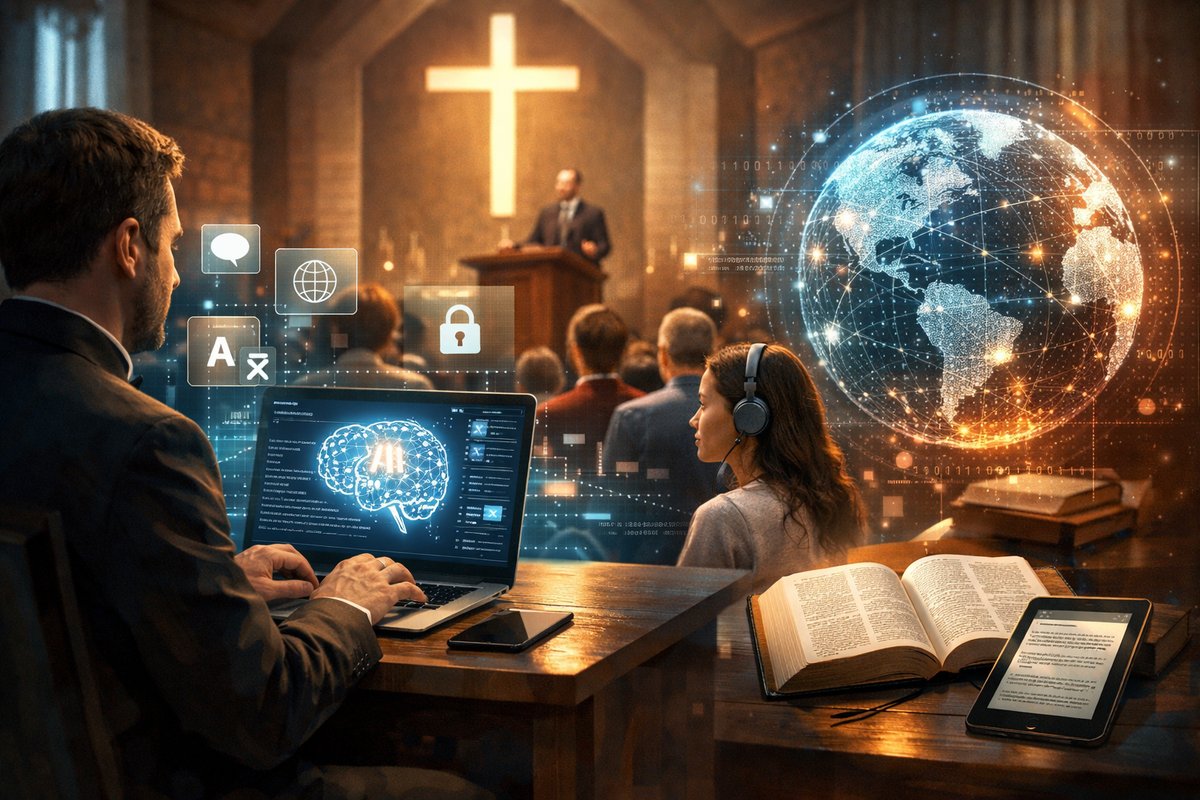
A growing number of Christian congregations are turning to generative AI platforms to streamline sermon writing, foster multilingual outreach, and engage younger members. While the shift promises efficiency and innovation, it also raises questions about authenticity, theological integrity, and data privacy.
In a small town outside of Austin, Texas, Grace Fellowship Church recently unveiled a new behind-the-scenes process for crafting weekly sermons: generative AI. Instead of poring over commentaries and penning outlines late into the night, the pastor enters key themes-grace, community, service-into an AI-based text generation service. Within minutes, a multi-point outline appears, complete with suggested scripture references and historical context. For many congregations, this leap represents a bridge between time-honored traditions and 21st-century innovation.
Pastor Maria Lopez, who leads the 200-member congregation, describes the tool as a “digital co-pastor.” Where she once spent four to six hours each week consulting biblical lexicons and drafting talking points, she can now refine and personalize an AI-generated framework in less than two. “It’s not about replacing the Spirit’s movement,” she explains. “It’s about gaining space to listen, pray, and connect rather than wrestling with blank pages.” The congregation has noticed more interactive discussions during the midweek study and a livelier atmosphere in the fellowship hall afterward.
The momentum behind AI in ministry is reflected in recent research. According to a 2023 survey by a leading religious research institute, nearly one in five Protestant pastors in North America has experimented with AI tools for sermon prep or small group materials. Among those under 40, adoption climbs to almost one in three. Denominations from mainline to evangelical are hosting workshops, and seminaries are beginning to introduce modules on ethical AI use in pastoral education.
Beyond sermon outlines, churches are deploying AI for translation and accessibility. A bilingual congregation in Miami leveraged an AI engine to produce real-time Spanish subtitles during livestreamed services. Meanwhile, a church in Seattle used an AI transcription service to generate accessible closed captions for deaf and hard-of-hearing worshippers. These applications have expanded attendance online and in person by creating a more inclusive environment for those who might otherwise struggle to engage.
Youth ministries are also exploring AI’s potential. The high school group at Trinity Community Church in Ohio runs an AI-powered chatbot built on a language model fine-tuned for Bible Q&A. Teens can message the bot at any hour with questions about Scripture narratives, ethical dilemmas, or prayer prompts. Youth leaders report that students who once hesitated to approach mentors in person feel freer to explore spiritual topics in private conversation with the chatbot. Pastors caution that the bot is a supplement, not a substitute, for pastoral care-but they celebrate the curiosity it has ignited among digital natives.
On seminary campuses, students are using AI tools to speed up research. Rather than transcribing hundreds of pages by hand, they feed scanned Greek manuscripts into an AI-assisted text recognition service. Thesis drafts benefit from natural language summaries of patristic writings, enabling deeper comparative analysis in less time. Professors stress that the service does not replace rigorous exegesis; instead, it frees students to focus on interpretation and critical engagement rather than mechanical tasks.
Church communications teams have discovered AI’s worth in newsletter creation and social media outreach. By inputting worship themes and upcoming event details, ministry staff generate polished copy for email blasts and digital bulletins. Graphic designs-such as verse-art backgrounds and event flyers-can also be drafted by AI image generators, offering quick mockups that staff then adjust. This streamlined workflow has been a boon for congregations with small staffs, allowing them to maintain professional-quality communications without outsourcing.
Yet the rapid uptake of AI in Christian ministry invites sober reflection. Some pastors worry about eroding authenticity if sermons become too polished or formulaic. Others fear that reliance on AI could diminish the relational core of pastoral work. “Our calling isn’t to preach perfect prose,” notes Reverend Daniel Kim of a midwestern interdenominational coalition. “It’s to share life-changing truths from our own hearts. We must guard against a generation of sermons authored more by algorithms than by lived experience.”
Data privacy and security are additional concerns. When sensitive pastoral counseling notes or prayer requests are entered into cloud-based AI services, who truly owns that content? Denominational leaders are drafting guidelines to ensure congregants’ confidentiality and data sovereignty. Some churches have opted for on-premises AI servers to keep proprietary materials within their own digital walls.
Theologically, Christian ethicists are engaging the question of human-machine collaboration. A recent white paper from a faith-based think tank argues that AI should be treated as a “tool of human imagination,” not an oracle. The paper urges clear disclaimers whenever AI-generated content is used, and it encourages pastoral teams to view AI as a collaborator that requires ongoing human discernment and theological oversight.
Workshops on AI in ministry have proliferated. Last month’s national clergy conference featured a breakout session titled “Faith, Data, and the Future: Navigating AI in Church Life.” Participants returned home with practical templates for AI-assisted sermon workflows, checklists for ethical review, and contact lists for denominational tech support networks. Some saw the session as a watershed moment: a recognition that technology and theology must walk hand in hand rather than at odds.
Looking ahead, experts envision hybrid workflows where pastors and ministry staff alternate between AI-generated drafts and human-led revision circles. Some churches foresee volunteer “AI stewards” who curate and vet generative outputs for theological clarity before they reach the pulpit. Others plan to integrate voice-activated sermon assistants into worship spaces, allowing preachers to reference key points or scriptures hands-free during delivery.
For congregations both large and small, the integration of AI tools into Christian ministry is more than a trend-it’s a fresh chapter in the ongoing story of faith and innovation. As leaders navigate questions of authenticity, ethics, and privacy, they are forging new pathways that honor centuries-old traditions while engaging the questions and opportunities of a digital age. Many believe that with wise stewardship, AI can free the church to focus on its timeless mission: nurturing spiritual growth, fostering compassionate community, and proclaiming a message of hope that transcends every generation.
In the end, the true measure of success will not be how sophisticated the algorithms become, but how deeply congregations listen for and respond to the still, small voice amid the digital noise. By holding fast to spiritual practices of prayer, Scripture reflection, and human connection, churches hope to ensure that technology remains a servant rather than a master in the work of ministry.