Location
Mount Vernon, WA 98274

Location
Mount Vernon, WA 98274
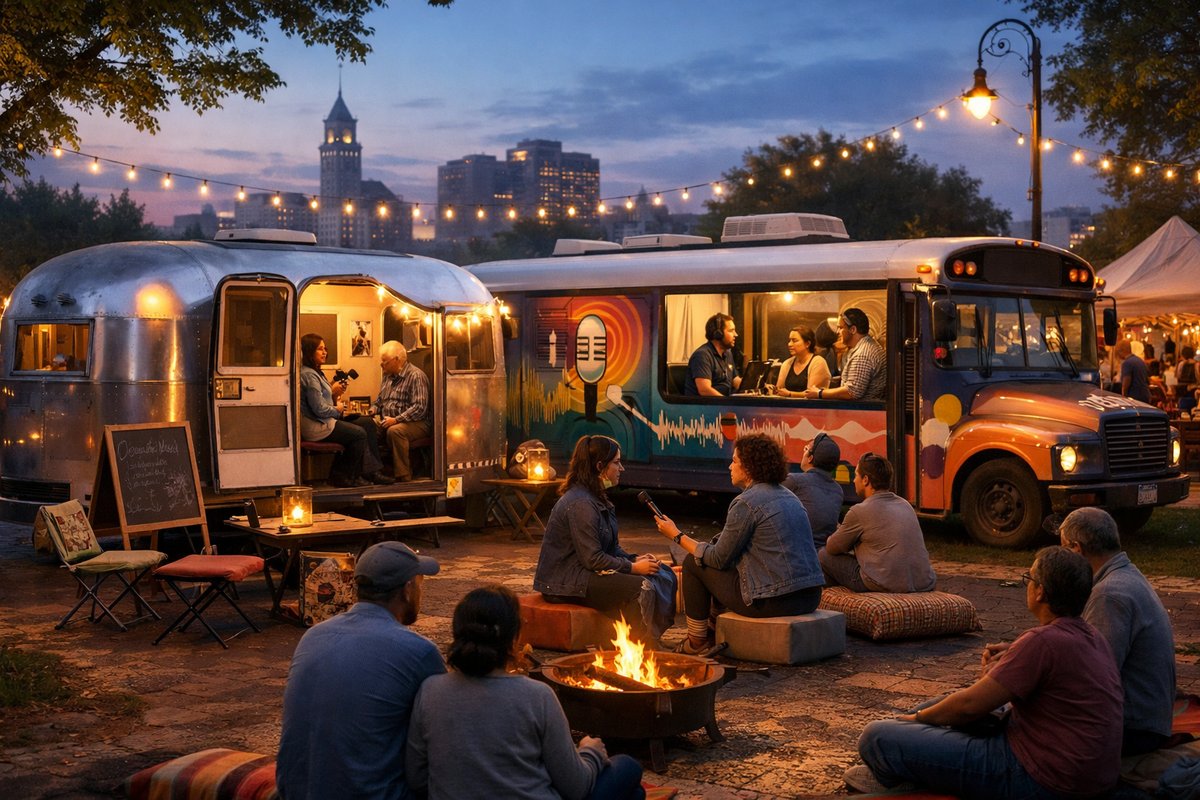
Across cities and small towns, retrofitted trailers and buses are anchoring at street corners, parks, and market squares to gather and share personal stories. These mobile storytelling labs-backed by public art grants and fueled by grassroots organizers-are helping communities rediscover empathy, resilience, and the transformative power of listening.
At the corner of Main Street and Riverside Park, a former catering trailer painted in bright yellows and oranges has become something more than a backdrop for weekend food festivals. Inside, a simple microphone and cozy padded bench await neighbors who step up to share five minutes of their life-an intimate pocket of time where hopes, regrets, and dreams can unfold. Known locally as the “Rolling Story Lab,” this mobile storefront is one of more than three dozen similar setups now making stops in towns and neighborhoods across the country.
Spurred by a growing awareness of social isolation and digital fatigue, nonprofit groups and municipal arts councils have teamed up with legacy institutions to fund mobile storytelling initiatives. According to the National Endowment for the Arts, its “Our Town” creative placemaking grants have supported over thirty projects that bring narrative out of lecture halls and into public spaces. In the last two years, an estimated $4 million has flowed into retrofitted trailers, vintage school buses, and repurposed postal vans, transforming each into a rolling stage for community voices. These mobile labs are not just novelty acts; they are deliberate experiments in bridge-building, allowing people from different backgrounds to pause, connect, and reflect together in a fleeting moment of shared humanity.
One of the most visible pioneers is StoryCorps, the nonprofit best known for its intimate recorded interviews preserved in the Library of Congress. Their 26-foot MobileBooth-a gleaming, retrofitted Airstream trailer-travels from city to city, parking outside libraries, museums, and public squares. People are invited to record interviews with a loved one: a sibling recalling childhood antics, two friends marking a milestone, or a parent and child exploring family heritage. Each conversation is archived, with snippets broadcast on public radio, reminding listeners that every life holds a narrative worth preserving. Since its launch, the MobileBooth has visited over two hundred communities, collecting more than 60,000 interviews, and demonstrating that even in an age of instant sharing, nothing replaces the gravity of a face-to-face conversation.
Another model for mobile narrative work comes from the Brooklyn Art Library’s Sketchbook Project. Though not strictly a recording studio, its traveling card catalog of hand-bound sketchbooks offers a living testimony of individual creativity. Writers, artists, and doodlers mail in their journals, which are shelved in the library’s home base and periodically loaded onto a touring exhibit. As the Sketchbook Project truck rolls into community centers and college campuses, people leaf through volumes filled with poems, paintings, and personal essays. For many participants, the act of sharing an unpolished journal is an act of trust-a small gift to strangers who might find solace or inspiration in someone else’s private musings.
Beyond well-established organizations, dozens of grassroots collectives have launched their own micro-labs. In a former postal van parked outside a midwestern farmers market, an independent collective called Common Ground Records invites producers to bring short audio clips: a grandmother’s lullaby, a teenager’s spoken-word poem, or the hum of a nearby creek. In return, visitors can slip on headphones and wander through a soundscape mosaic of local life. In Pacific coastal towns, environmental groups have commissioned retired school buses to become “Climate Storymobiles,” hosting citizen scientists who share observations of changing tides and shifting bird populations. Each experiment looks different, but all share a guiding principle: when you give people a safe space and a moment to speak, they reveal the threads that tie them to others.
Maria, a recent immigrant who arrived six months ago, described her first visit to a story lab in the Bronx as a turning point. “I felt invisible before,” she said, voice cracking slightly. “But when I sat down in that little trailer, I realized my story mattered. I told them about my grandmother’s cooking, the street where I grew up, and how I want to build a home here too.” Her five-minute interview wasn’t broadcast to millions, but the act of telling set her mind alight. Soon she found a job at a community center and volunteered to help run the next pop-up event. “That moment reminded me that even small words can shift how we see ourselves and each other,” she reflected.
As cities grapple with the aftershocks of economic decline, gentrification, and pandemic-era disconnection, these mobile labs offer a low-tech antidote to pervasive isolation. They ask participants to silence notifications, lean into curiosity, and bear witness to one another’s struggles and triumphs. In neighborhoods fractured by housing insecurity or strained by cultural divides, the act of listening becomes an act of solidarity. When someone shares a story of loss or hope, bystanders often pause, gather, and sometimes join the queue to contribute their own voice. Over time, these small interactions seed relationships, turning casual passersby into allies, collaborators, and friends.
Looking ahead, advocates hope to expand the model beyond urban cores. Plans are underway for a mobile lab tour through rural counties in the South Atlantic region, where local libraries will partner with church groups to record multigenerational stories of migration, agriculture, and resilience. In college towns, student clubs are prototyping “Story Walks,” where QR codes affixed to public benches link to podcasts recorded on site. And even as much of the world shifts online, artificial-intelligence researchers are exploring ways to index and preserve these oral histories in accessible digital archives, ensuring that a grandmother’s lullaby recorded in a backyard gazebo endures for decades to come.
These mobile storytelling labs remind us that hope is not an abstract ideal but a practiced habit: the choice to listen, to affirm another’s experience, and to recognize that our own narratives are woven into a larger tapestry. In a culture that prizes the polished highlight reel, a five-minute confession beside a riverside trailer may seem humble. Yet it is here-on cracked concrete, beneath open skies, and inside patched-up walls-that we discover the ache of failure, the spark of curiosity, and the quiet courage it takes to say, “This is who I am.” As the sun dips below the skyline and the trailer’s lights glow a soft amber, each microphone becomes a beacon, guiding communities back to the shared ground of empathy and collective renewal.