Location
Mount Vernon, WA 98274

Location
Mount Vernon, WA 98274
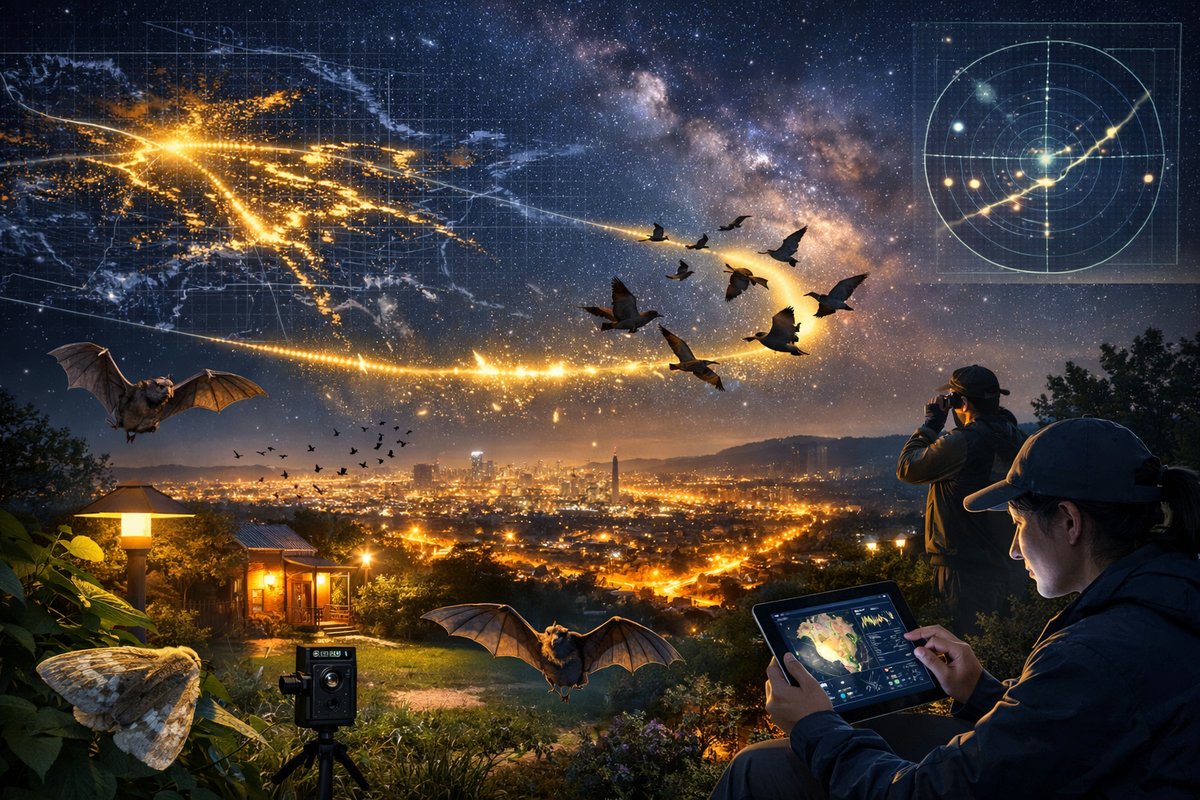
New analysis of satellite data uncovers how urban lightscapes redirect the nighttime journeys of insects, bats, and migratory birds. As researchers map "luminous corridors," cities weigh safety against biodiversity and invite citizens to monitor their own backyards.
Under the steady glow of streetlights and storefronts, the rhythms of urban nights have quietly reshaped the natural world. A groundbreaking study in a recent issue of PLOS ONE uses NASA’s Black Marble satellite imagery to trace how artificial light at night creates unseen corridors that guide or confuse migrating insects, bats, and birds across metropolitan areas. By overlaying high-resolution light maps with GPS tracking data from tagged animals, scientists have revealed a landscape of illuminated highways that both attract and disorient creatures whose ancestral patterns relied on moonlight and starlight.
The research team, led by ecologist Dr. Lena Martinez, analyzed data from the Visible Infrared Imaging Radiometer Suite (VIIRS) onboard NASA’s Suomi NPP satellite. Between spring and fall migration seasons, tiny transmitters attached to common nocturnal pollinators-moth species like the large yellow underwing-recorded flight paths that tended to hug well-lit routes. Bats, too, appeared to follow ribbons of amber-hued streetlamps when traversing urban canyons, occasionally veering off to forage on insects drawn into the glare. Even night-migrating songbirds, which normally rely on celestial navigation, exhibited shifts in altitude and course when passing through brightly lit zones.
“The satellite imagery gave us an aerial view of what many field observations had hinted at: artificial light sculpts wildlife movement at night,” Martinez explains. “These lit pathways can act like highways or traps, depending on the species and the intensity of the glow.” The study found that moderate levels of light helped some bats conserve energy by concentrating prey near streetlights, while excessive brightness caused others to avoid entire neighborhoods, fragmenting their habitat.
Light pollution has long been flagged for its impact on astronomy and human health, but its effects on ecosystem dynamics are only now coming into focus. Countless moths drawn to LED billboards end up grounded or eaten, depriving bats of prey along traditional routes and triggering a domino effect. In cities that have upgraded to cooler-spectrum LEDs for energy savings, the blue-rich glow is particularly harmful to insects, whose visual systems are tuned to longer wavelengths. When one major Midwest city swapped out sodium vapor lamps for broad-spectrum LEDs three years ago, local conservation groups recorded a 40 percent drop in nocturnal moth populations.
Meanwhile, birds that rely on the Milky Way for navigation face veiled skies. In a companion paper published by the Ornithological Council, researchers documented disoriented flight behavior in a half dozen migratory species passing near the illuminated “urban dome.” Some flocks made costly detours of tens of miles to avoid glare, while others slowed down, extending their journeys by days and depleting critical energy reserves.
Cities across North America are beginning to respond. In late summer, a coalition of municipal planners, wildlife biologists, and Dark Sky advocates convened in Kansas City to trial “adaptive lighting.” Using sensors that dim or redirect streetlamps when human activity is low, the pilot project cut light levels by up to 70 percent after midnight. Early results show a rebound in local insect counts and increased bat traffic through restored corridors. Similar initiatives are under way in coastal towns where migrating shorebirds converge on beachfront streets lit by hotels and gift shops.
Technology is playing a crucial role. Drones equipped with thermal cameras survey insect swarms at dusk, while citizen scientists deploy affordable Sky Quality Meters to log ambient brightness in backyards and parks. Infrared trail cameras capture nocturnal visits by foxes and raccoons, offering snapshots of how urban fauna navigate shadowed spaces. Scores of smartphone apps now let birders and amateur naturalists annotate encounters with night-flying insects or sounds of echolocating bats, feeding real-time data back into open-source ecological models.
Dr. Martinez’s team is working with local schools to install simple bat detectors under double-layered porches. By tracking the ultrasonic chirps of species like the little brown bat, students can chart nightly activity and compare it with satellite light maps. Early findings suggest that neighborhoods with shielded fixtures and amber-tinted bulbs host roughly 50 percent more bat passes per hour than similarly built districts with unmodified lighting.
Beyond urban cores, the implications extend to rural highways, power corridors, and offshore structures. Oil rigs and wind farms use bright warning lights that can disorient night insects and seabirds. In the Gulf of Mexico, efforts to replace white flashing beacons with shorter-wavelength red lights are showing promise in reducing migratory bird fatalities during storm seasons.
Yet the transition is not without trade-offs. Municipal leaders cite public safety and crime reduction as reasons to maintain high illumination levels. Business improvement districts argue that vibrant nightscapes attract customers, and tourism boards promote midnight skylines as a city’s signature. Finding a balance between human needs and the call of the wild demands dialogue and design that centers ecological intelligence.
Advocates emphasize that small tweaks-like lowering lamp heights, adding motion-sensitive dimmers, or adopting full cutoff fixtures-can dramatically reduce skyglow without plunging streets into total darkness. Communities embracing “dark corridors” report not just ecological benefits but also financial savings from reduced energy use. In one Mid-Atlantic university town, the switch to dimmable amber LEDs cut nighttime power consumption by 30 percent, translating to tens of thousands of dollars in annual savings.
As starlight returns to patched-open skies, residents share stories of renewed wonder: foxes trotting under a pale horizon, bats swooping through quiet back alleys, and the gentle hum of life that thrives after dusk. At a recent event marking International Dark Sky Week, families gathered in a suburban park to witness the night sky through telescopes, while volunteers demonstrated how to build wildlife-friendly lighting fixtures from recycled materials.
The unfolding story of light and life is a reminder that every artificial glow carries ecological consequences. Satellite insights have illuminated patterns once invisible, inviting urban planners, activists, and curious neighbors to imagine a future where cities harmonize with the night. By embracing both technological innovation and citizen engagement, communities can weave darkness and light into a tapestry that sustains the creatures who share our nocturnal hours.