Location
Mount Vernon, WA 98274

Location
Mount Vernon, WA 98274
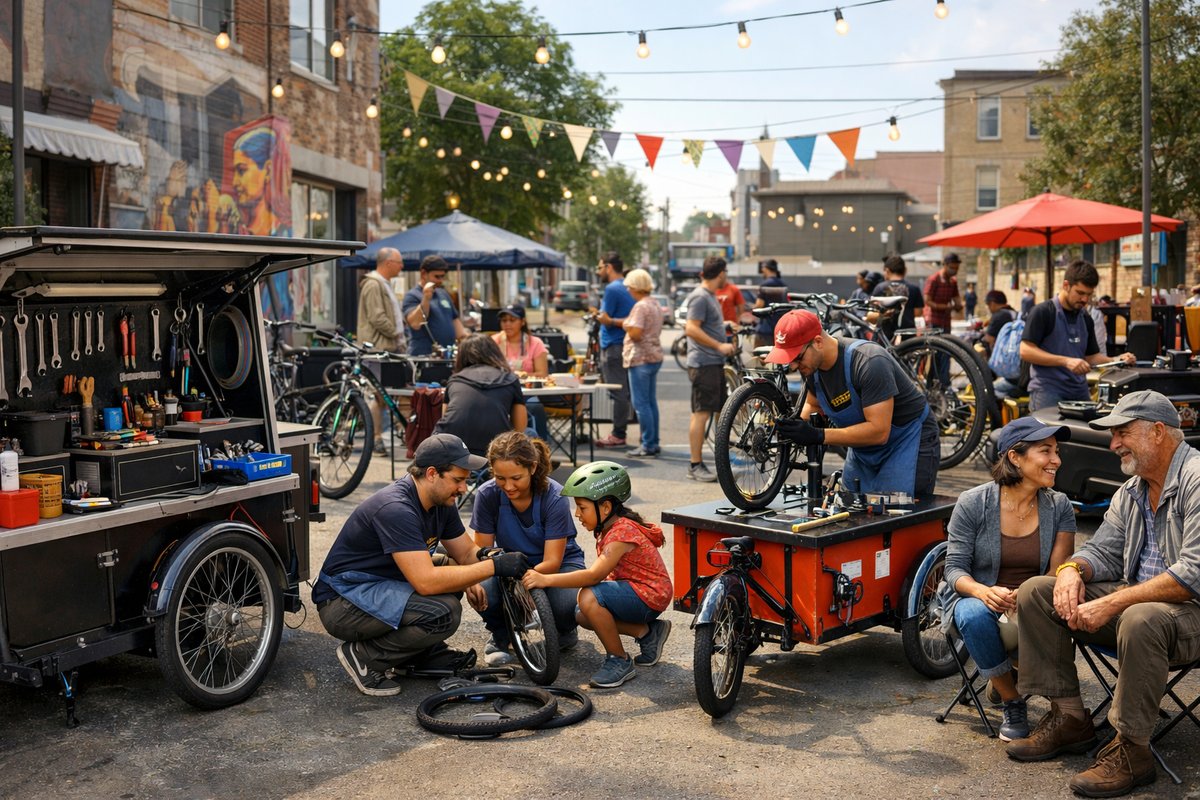
A travelling bike repair caravan has rolled into under-served neighborhoods, offering free maintenance workshops that double as social gatherings. By converting cargo bikes into mobile repair stations, volunteers are not only fixing flat tires but also mending social bonds and reigniting hope on urban streets.
Along cracked sidewalks and around street corners where weariness often overshadows opportunity, a bright green cargo bicycle-towed by a smaller tandem trailer stocked with wrenches, spokes and spare tubes-has become something of a local legend. This is the Pedal Forward caravan: a mobile bike repair workshop on wheels that has turned every block into a classroom in resilience. Since its first ride six months ago, it has served hundreds of riders, mentoring them in basic mechanical skills and introducing them to a more sustainable way of getting around.
The idea sprouted when a group of community organizers noticed a pattern: discarded bicycles rusting against chain-link fences and young people without reliable transportation. They wanted to address two issues at once-economic strain and social isolation-so they repurposed an old cargo trike and a secondhand trailer, loading them with tools and spare parts. What began as a single weekly stop in one neighborhood has now expanded to five distinct corridors, every visit a mini pop-up event where laughter, grease and conversation merge.
Each Pedal Forward setup centers on an array of equipment powered by a portable solar panel and battery system mounted on the trailer. This off-grid station energizes LED work lights after dusk and charges a communal speaker so volunteers can cue upbeat tunes while teaching tune-ups. The solar rig also keeps tablets alive for online repair tutorials, ensuring riders of all ages can follow along with step-by-step videos when they’re stuck. It’s a surprisingly interactive spectacle: under the tent’s glow, neighbors swap stories about flat tires and half-baked life plans.
Workshops typically begin with a quick demonstration: loosening a stubborn bolt, pumping a tire to the correct pressure, or truing a bent rim. Volunteers-many of them former bike shop employees or local mechanics-then invite participants to roll their own frames onto an adjustable repair stand. As hands learn to insert chain links and tighten hubs, safeguards are reinforced: safety precautions, helmet checks and basic signage on road rules. The goal is not just to mend bicycles but to strengthen confidence and self-reliance.
For Rosa, a mother of two in her neighborhood, the caravan was a lifeline. When her worn-out commuter bike developed a snapped chain, she feared missing work at the home care facility. But after learning to swap a new chain in under twenty minutes, she pedaled home exhilarated. “Fixing my own bike,” she reflected between sips of hot cocoa, “reminds me I can handle bigger challenges, too.”
A group of teenagers has also found purpose around the caravan’s folding tables. Initially drawn by the promise of free snacks and music, they gradually transformed into apprentice mechanics, testing brake cables and adjusting derailleurs. Weekend group rides have sprouted from these sessions, and rivalries have softened into camaraderie-proof that a simple mechanical skill can be a bridge to belonging.
City officials tracking social metrics have observed tangible benefits. In neighborhoods where Pedal Forward camps set up camp, foot traffic to nearby corner stores has risen by a reported 15 percent, and local transit surveys note a 20 percent uptick in cycling commutes among workshop participants. The ripple effect of repair knowledge is connecting riders to jobs, to schools and to each other, rewriting narratives of scarcity into ones of shared resourcefulness.
“I was a solitary wrench-turner in my own garage,” admits one volunteer, a retired machinist who once felt sidelined after losing his shop lease. “Now I’m teaching kids how to rebuild a wheel, how to get themselves to work. That means more than profit; it’s human connection through simple acts of care.”
Behind each repair station lies a toolbox stocked with essentials: a comprehensive bike multi-tool kit, replacement tubes and patch kits, lubricant and cleaning brushes. An adjustable bike repair stand hoists frames off the ground, while a floor pump with gauge ensures tires reach ideal pressure. For those who can’t roll in on two wheels, spare frames and donated parts provide a makeshift bike library, so that no one leaves empty-handed.
Rainy afternoons have tested the caravan’s mettle: sudden downpours chase volunteers under pop-up canopy tents, and the trailer’s solar output dips behind cloud cover. Yet those challenges only sharpen resolve. Under the tent’s canvas, mechanics wield waterproof tarps to shield tools and encourage riders to huddle close. Occasionally, LED string lights powered by the caravan’s battery create a warm enclave, where stories of resilience shine brighter than the weather outside.
Funding flows from a patchwork of community grants, crowdfunding campaigns and local business donations. Spare parts come from bike shops that collect unusable bicycles destined for scrap, then funnel what’s still serviceable into the caravan’s stock. Volunteers staff a tool lending library that circulates wrenches and cable cutters to anyone who commits to return them after use-a literal extension of trust in the neighborhood.
Pedal Forward does not exist in isolation. It has woven itself into a broader tapestry of urban renewal initiatives: community gardens, corner greening projects and street-art murals. Together, these efforts stitch neglected blocks into cohesive fabrics of hope. As one mural painted on a nearby wall declares: “Where wheels roll, spirits soar.”
City Council representatives who once viewed cycling initiatives as novelty acts are now drafting proposals to subsidize more of these mobile units. Public statements cite data from the caravan’s six-month run as evidence that small-scale, community-driven projects can outpace traditional infrastructure rollouts in impact and intimacy. Officials even floated the idea of retrofitting public buses with mini repair bays to follow the caravan’s example.
Looking ahead, organizers hope to pilot an electric cargo bike, capable of carrying heavier loads and stretching their reach into farther-flung neighborhoods. They’re exploring partnerships with local universities to track longitudinal outcomes: how learning mechanical skills influences career choices, mental wellness and neighborhood cohesion over time. The quiet revolution continues, one spoke at a time.
In a cityscape often defined by gridlock and uncertainty, Pedal Forward is proof that resilience need not wait for grand infrastructure or corporate investment. It springs from the simple act of inviting a neighbor to tighten a bolt or inflate a tire, then sharing the satisfaction of a ride home. In this shared motion, there is a shared story: of people who fell, who rose, and who refuse to stay stranded by the roadside.