Location
Mount Vernon, WA 98274

Location
Mount Vernon, WA 98274
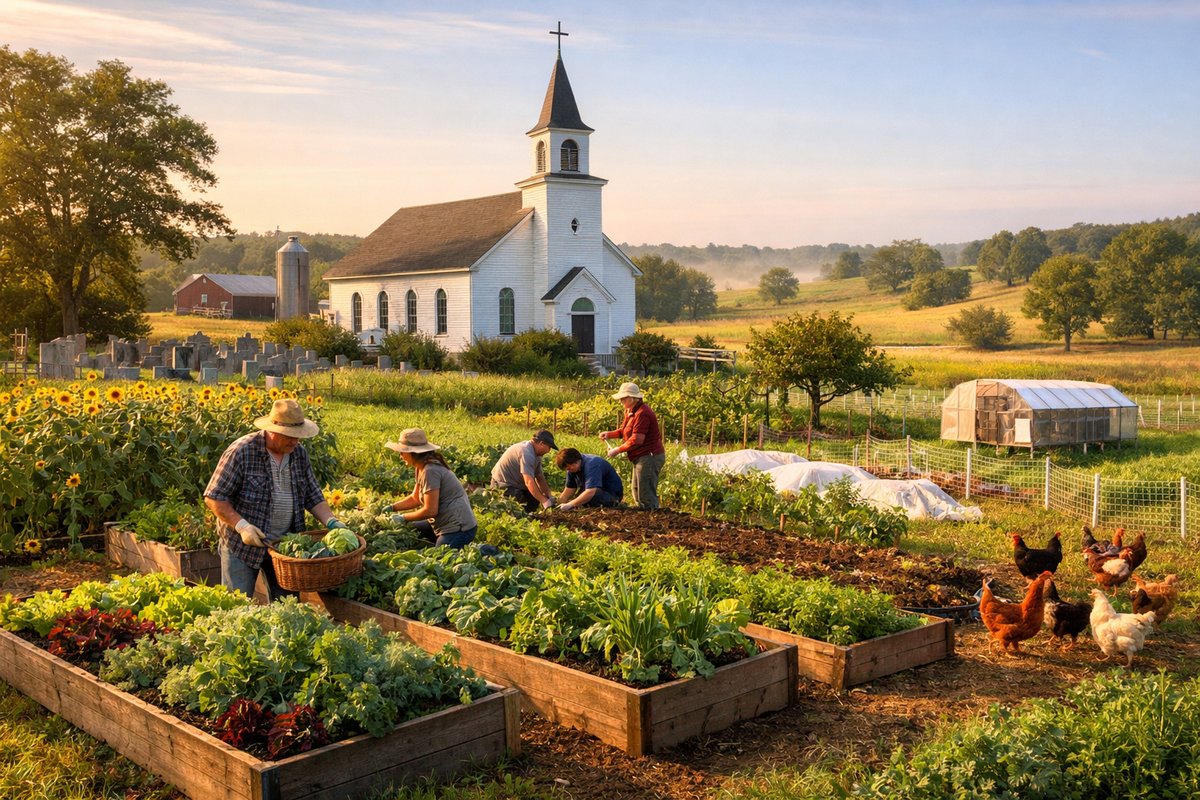
Amid rolling fields and quiet country roads, a growing number of rural congregations are turning their churchyards into regenerative farms. By combining soil-restoring techniques with a spirit of stewardship, these faith communities are nourishing both the land and their neighbors.
At dawn, volunteers gather beneath the stained-glass windows of a century-old church before heading out to a nearby pasture. Pitchforks and prayer journals in hand, they begin the day by tilting compost into raised beds, blessing the soil before sowing cover crops. In small towns across the Midwest and beyond, congregations are transforming their green spaces into experimental farms, guided by ancient biblical principles of stewardship and modern regenerative agriculture.
Regenerative farming emphasizes rebuilding healthy soils, increasing biodiversity, and capturing carbon. For many church leaders, this holistic approach resonates deeply with a theology that sees creation as sacred. Rather than treating the earth as a resource to be exploited, these communities view land care as a spiritual practice-one that knits together faith, environmental responsibility, and community resilience.
In central Iowa, Redeemer Fellowship launched its farm cooperative three seasons ago. What began as a handful of gardeners planting kale and radishes in the church parking lot has grown into a two-acre network of no-till beds and living hedgerows. Members rotate livestock through fenced paddocks, use cover crops to protect bare soil in winter, and test nutrient levels in fields with handheld soil probes. Each new technique arrives in tandem with scripture readings on Sabbath mornings, reminding participants that God’s covenant with earth extends far beyond Sunday worship.
“Farming has become our primary avenue for outreach,” explains the congregation’s lead pastor. “When families come to pick beans for our food pantry, they hear testimonies about how regenerating the soil also regenerates the human spirit. It’s a Gospel lived through seeds and spades.” His voice lights up as he describes youth groups measuring worm populations in compost piles, finding wonder in unseen ecosystems just beneath their fingertips.
Soil health is at the center of every meeting. Volunteers gather data using DIY soil test kits, recording pH levels and organic matter percentages. A compost tumbler stationed near the community hall turns kitchen scraps into black gold with the twist of a handle. Alongside these tools, leaders keep gardening journals that blend daily devotions with plots for crop rotations and rainfall logs. This blend of faith reflection and practical record-keeping has deepened participants’ sense of stewardship, bridging ancient faith traditions with twenty-first-century ecological science.
Local teens volunteer after school, studying plant anatomy under the shade of maple hedges planted as windbreaks. Some are novices who arrive in worn boots, curious to learn how to prune fruit trees or lay drip irrigation lines. Others have helped design a low-tech hoop house that extends the growing season into late autumn. Every discovery sparks fresh conversation about creation care-how each seed sown honors a hope for renewal that transcends a single harvest.
The initiative isn’t purely analog. A handful of volunteers map out planting schedules using farm management apps on tablets. Geotagged photos document the rise of pollinator habitat strips along field edges, which have attracted native bees and butterflies. Rainfall data collected from a simple weather station feeds into spreadsheets that help predict the best days for cover-crop seeding. Integrating these digital tools fosters curiosity, reinforcing the message that faith and innovation can flourish side by side.
Partnerships with county extension offices and nearby agricultural universities have been crucial. Professors lead weekend workshops on soil microbiomes and carbon sequestration, while church members share their field observations with researchers. In return, students bring soil-borne microbes for lab analysis, enriching both the church farm’s compost and the classroom’s curriculum. This reciprocal relationship transforms a small rural congregation into a node of practical research and faith-based inquiry.
Financial sustainability has been another success story. Produce subscriptions, often referred to as “farm shares,” send baskets of vegetables to church members and neighbors. A portion of every share supports a local homeless shelter’s kitchen. On Sundays, the farm stand outside the sanctuary features fresh bread alongside prayer cards. Proceeds fund new tools-a wheelbarrow here, a set of sturdy pruning gloves there-and help cover costs for farm apprenticeships offered to recent high school graduates exploring career paths in agriculture.
Surpluses find their way to nearby food pantries, where church members host “pick-your-own” events. Families select tomatoes and peppers for canning, guided by volunteers who overhear conversations about financial strain and food insecurity. These exchanges become moments of hospitality, as participants share recipes and stories, knitting a web of mutual care that extends well beyond a single season’s yield.
Spiritual practices have also taken root beside the fields. Informal liturgies begin at sunrise, with psalms recited as rows of lettuce witness the dawn. Fasting for the earth has emerged as a communal ritual, where members forgo meat one day a week to draw attention to industrial farming’s climate impact. Church bulletins now include compost-and-pray guides-a daily checklist reminding volunteers to turn piles, bless the rain, and reflect on stewardship responsibilities.
Environmental impact goes beyond soil fertility. By embracing no-till methods, erosion rates on church land have plummeted, and water retention in the fields has improved. Seasonal wetlands, once drained for conventional farming, are being restored to filter runoff and nourish amphibian populations. These intentional acts of land restoration echo themes of renewal found throughout scripture, inspiring congregants to view ecological care as integral to their faith journey.
Of course, challenges remain. Startup costs for fencing and hoop houses can strain small budgets. Volunteer fatigue sometimes sets in after long days of planting and pruning. Church leaders have responded by hosting potluck dinners atop freshly tilled beds, pairing community building with practical marketing for the farm’s next season. These gatherings feature guest speakers-from permaculture experts to local historians-providing moments of encouragement and fresh ideas.
Innovation has also sprouted through fundraisers tied to farm experiences. A “Harvest Dinner” invites guests to pick vegetables, cook alongside church cooks, and hear short testimonies around a communal table. A companion prayer journal, sold alongside event tickets, encourages families to record their own reflections on faith, food, and creation. The combination of hands-on activity and creative expression continues to draw new faces, binding experiential learning with spiritual renewal.
Looking ahead, leaders hope this model will inspire a network of regenerative farm churches across the region. Training resources are being refined into open-source manuals, which detail practical steps from soil testing to plant propagation. Video tutorials filmed on church properties will be shared online, inviting other congregations to take up the plow and join the movement. The vision is simple: to see church grounds transformed into living classrooms, where care for the earth becomes a radical expression of faith in action.
As the sun dips below a row of young apple trees, volunteers gather to give thanks. They close with a hymn that was originally sung in fields centuries ago-its lyrics now resonating in a new context of partnership with the soil. In this quiet moment, the turn of compost piles and the curve of a prayer journal page feel part of the same story: one of healing, renewal, and hope rooted in both earth and spirit.
Whether through a hand-drawn planting map or a smartphone app’s geotagged photo, these congregations are mapping a future where faith and regenerative agriculture grow hand in hand. The seeds sown today promise far more than a bountiful harvest; they herald a renewal of community, a restoration of landscapes, and the deepening of a faith that believes healing begins in the soil beneath our feet.