Location
Mount Vernon, WA 98274

Location
Mount Vernon, WA 98274
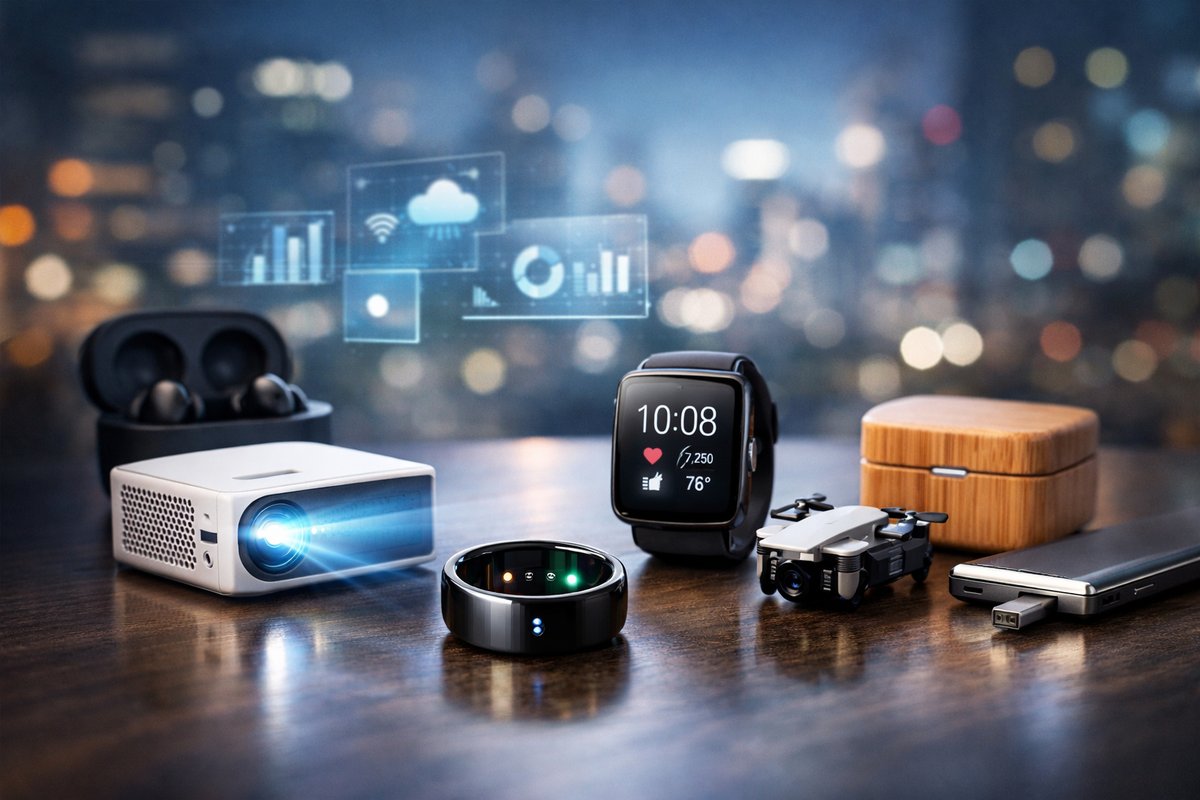
From ultra-compact projectors to AI-powered smart rings, the latest wave of miniature electronics is pushing boundaries in both form and function. These pint-sized powerhouses blend advanced connectivity, sustainable materials, and on-device intelligence to transform how we work, play, and stay informed on the go.
At a recent innovation summit, a wave of ultra-compact gadgets captured the spotlight. A credit-card-sized projector streaming high-definition video onto any surface shared the stage with a smart ring offering intuitive gesture controls and on-device AI for offline voice commands. Pocket-sized drones that fold as flat as a notebook, modular lens attachments that clip onto smartphones, and health monitors small enough to tuck into a keychain all underscored a growing focus on maximizing capability while minimizing footprint. Though some of these tools felt like prototypes, many are entering the market this quarter, signaling that miniaturization has moved firmly into mainstream adoption.
Miniaturization has long been a driving force in electronics, but recent advances in materials science, chip design and battery chemistry are accelerating the trend. Gallium nitride power transistors allow efficient, rapid charging in tiny wall adapters. System-on-chip solutions integrate multiple processors and AI accelerators onto a single die no larger than a fingernail. Flexible printed circuit boards and composite polymers enable curves and folds that once required complex assembly to now roll up like wallpaper. Together, these innovations are empowering startups and established manufacturers to rethink form factors from the ground up.
Modularity is equally central to this new wave. Instead of selling a monolithic device, companies are offering core platforms that users can customize with snap-on modules. Add-on cameras deliver wide-angle, telephoto or thermal imaging. Clip-on sensors track air quality, UV exposure or even biochemical markers in perspiration. Magnetic connectors allow accessories to attach and detach in seconds-no screws, no cables, no fuss. This level of adaptability not only extends gadget lifespans but also invites a maker-mindset, encouraging users to build personalized toolkits tailored to their routines.
Sustainability has surfaced as a guiding principle in this frontier. Several micro-device developers have adopted recycled aluminum and bioplastic housings, while open-source firmware ensures that security patches and feature updates can extend device lifecycles without premature obsolescence. Some power banks feature integrated solar cells for off-grid charging, and repair-friendly designs let end users replace batteries or upgrade memory modules with minimal tools. By emphasizing repairability and recyclability alongside compactness, manufacturers are answering growing demand for technology that treads more lightly on the planet.
On the software side, AI inference engines are shrinking to fit into tiny packages. Gesture-recognition algorithms can now run in a ring or wearable pendant, translating hand movements into app navigation without relaying data to the cloud. Edge computing in portable translators can handle multiple languages offline, preserving privacy by avoiding continuous network connections. Even visual-search features-once relegated to high-power smartphones-are finding homes in smart eyewear and miniature cameras, enabling instant identification of plants, products or landmarks without uploading images to remote servers.
Health-monitoring gadgets have benefited enormously from this miniaturization. Tiny biosensors can read heart rate variability, blood oxygen saturation and stress biomarkers through noninvasive skin contact. A wellness tracker worn as a sticker or lanyard can store weeks of data on a microSD card and sync to a smartphone when in range. Compact patches analyze electrolyte levels in sweat, potentially alerting athletes or outdoor workers to hydration needs before heat stress sets in. As these tools grow more precise while shrinking in size, the promise of continuous, unobtrusive health tracking edges closer to reality.
Connectivity standards have adapted as well, with ultra-low-power Bluetooth variants and mesh networking allowing devices to share data across home and office environments without draining batteries. Some mini gadgets now include dual-band Wi-Fi radios in sub-five-gram modules, letting them join existing networks with minimal power draw. Proprietary protocols designed for Internet-of-things applications are delivering multi-hop communication that can span entire buildings-perfect for sensor nodes that report air quality or occupancy in large workspaces without a tangle of wires.
On the power front, fast-charging capabilities outpace even some full-size laptops. Tiny gallium-nitride chargers rated at 65 watts can charge a smartphone to 50 percent in under 15 minutes. Several new battery chemistries promising both high energy density and rapid discharge rates are emerging from advanced labs, hinting at pocket-sized packs that could replenish a laptop or drone multiple times on a single charge. Solar-integrated foldable panels, often smaller than an A4 sheet, can top up these power banks during a hike, reinforcing the theme of true off-grid resilience.
Design aesthetics have not taken a back seat to engineering feats. Mini gadgets are marrying sleek lines, neutral color palettes and subtly textured finishes that fit seamlessly into work and leisure environments. Recessed LED indicators communicate battery and connectivity status without noisy beeps. Tactile feedback-be it in a clicky mini keyboard key or the precision of a stylus nib-echoes the quality of larger devices. Ergonomic curves and adjustable straps ensure that wearables feel as natural on the body as any sport watch or fitness band.
The impact on daily routines is already tangible. Business travelers are swapping clunky conference room equipment for pocket projectors that connect wirelessly to a laptop or smartphone. Digital nomads are pairing foldable keyboards with ultracompact tablets to create mobile offices that weigh less than a paperback. Outdoor enthusiasts are carrying multi-sensor weather monitors that provide real-time forecasts in areas without signal. For educators, miniature document cameras and portable translation devices promise to make classroom resources more inclusive and accessible across language barriers.
Such a swift evolution inevitably raises questions about long-term viability and compatibility. Industry analysts caution that fragmented standards could hamper interoperability unless platforms coalesce around common protocols. Battery disposal and e-waste recycling infrastructures must scale up to handle the influx of tiny electronic components. User education on privacy and security, particularly as more devices employ on-device AI and local data storage, will be key to building trust and avoiding surveillance concerns.
Looking ahead, the next frontier may lie in integrating energy harvesting and advanced materials even further. Researchers are exploring piezoelectric fabrics that generate power from motion, potentially allowing wearables to charge themselves as users move. Biodegradable circuit boards composed of cellulose and copper are under development, offering a path toward gadgets that dissolve harmlessly after their useful life. Combining these elements with ever more powerful processors could yield a class of self-sustaining, eco-friendly micro-devices that redefine the limits of portability and responsibility.
As these miniature marvels continue to evolve, they not only reshape expectations for what technology can do in confined spaces but also invite a reassessment of how people interact with devices throughout their day. Emphasizing adaptability, privacy and sustainability, they promise richer experiences that fit effortlessly into the pockets, purses and backpacks we already carry. The era of pocket-sized powerhouses is just beginning, and its full impact will unfold as these tools become ever more intelligent, collaborative and attuned to human needs.