Location
Mount Vernon, WA 98274

Location
Mount Vernon, WA 98274

In a shift that echoes new research on social-emotional development, families nationwide are weaving playful tools-from interactive story dice to color-changing mood lamps-into everyday routines. Recent surveys and pilot programs reveal how this blend of hands-on and tech-enhanced activities helps children build emotional literacy, curiosity, and a sense of agency.
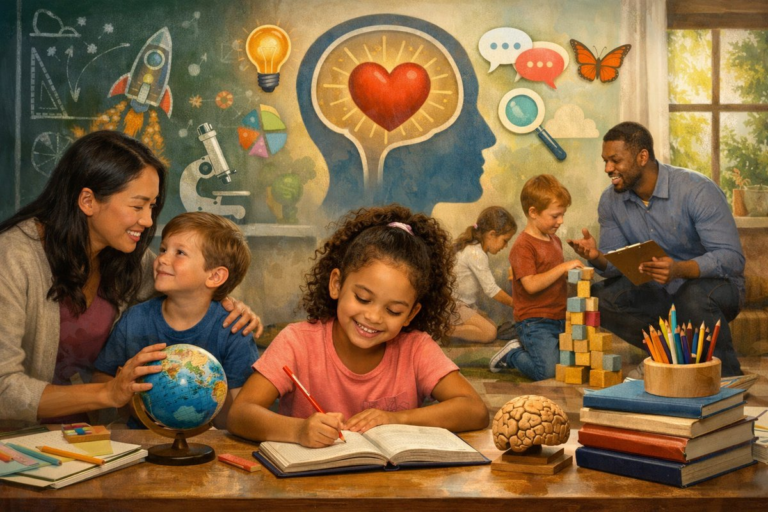
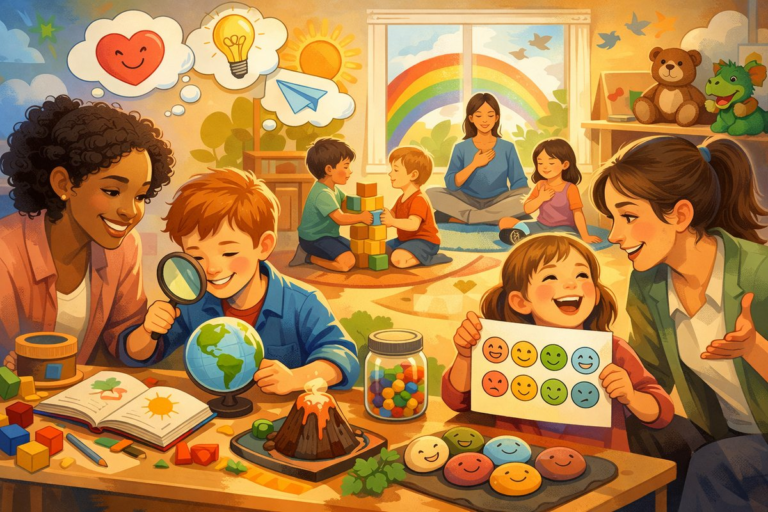
Each afternoon, the Rivera family gathers at their kitchen table for what they call “feelings lab.” Amid scattered magnetic building tiles and a softly glowing color-changing lamp, six-year-old Mia arranges tiles into tall towers while her brother Mateo uses a set of emotion flashcards to tell a story. As the tiles shift from green to blue to pink, they name each hue: calm, curious, excited. In this small ritual, the siblings practice putting feelings into words and shapes, turning abstract emotions into a form of creative play. What started as a local teacher’s suggestion has become a daily tradition that sets the tone for open conversation, mutual respect and imaginative exploration.
Behind moments like these is a growing body of evidence pointing to the power of playful, hands-on tools for social-emotional development. A national survey by the National Association for the Education of Young Children found that 68 percent of parents now seek out educational products designed to nurture emotional intelligence alongside cognitive skills. Meanwhile, Common Sense Media reports a 45 percent year-over-year rise in downloads of storytelling and mood-tracking apps for kids. The convergence of tactile materials and digital experiences reflects a new frontier in home education: one where curiosity meets compassion, and play becomes a vehicle for self-awareness.
Across the country, schools and community centers are piloting programs that extend into the living room. In one Midwestern city, an after-school initiative called “Emotion Play Passports” provides families with monthly kits containing sensory bins, calm-down jars, emotion dice, and reflective journaling prompts. Educators track how children use the kits and share insights with parents. Early results show improvements in children’s ability to regulate frustration, express needs and collaborate on group tasks. Parents, in turn, report fewer meltdowns and richer conversations at the dinner table.
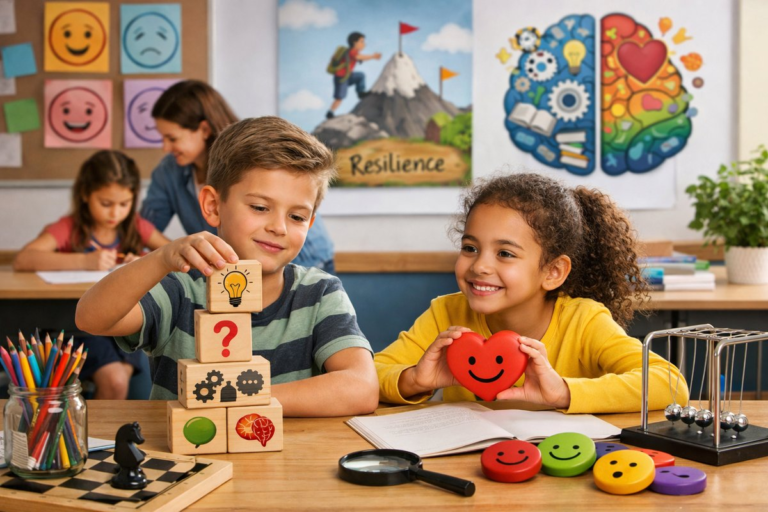
Key to this movement is the idea that emotional tools shouldn’t feel like therapy. Instead, they’re woven into everyday play and exploration. A sensory bin might contain foam letters, smooth river stones, or ribbons-items that invite all five senses while prompting questions like, “Which texture feels happiest to you?” Story dice, engraved with simple icons, encourage children to spin and craft imaginative narratives that explore fear, joy or sadness in safe spaces. By embedding emotional vocabulary in games and crafts, parents give youngsters the language and confidence to navigate real-world challenges.
Tech companies have noticed too. Mood lamps with customizable color palettes provide visual cues for emotional check-ins. Tap a widget on a connected tablet, and the lamp shifts to represent how the child feels: yellow for cheerful, orange for energized, violet for contemplative. Accompanying apps suggest follow-up activities-deep-breathing exercises, guided storytelling prompts or dance breaks-tailored to each mood. While some experts caution against over-reliance on screens, thoughtful integration of apps and analog tools has proven effective in blending digital convenience with tactile engagement.
Dr. Lena Morales, a child psychologist specializing in early development, emphasizes that these approaches are not about replacing human connection. “When families use a mood lamp or story dice,” she notes, “they’re creating opportunities for dialogue. The technology simply serves as a catalyst, prompting questions and play scenarios that might not emerge naturally in everyday conversation.” Morales encourages parents to observe rather than instruct-letting children lead with their choices of color, texture or story-and to frame each activity as a collaborative experiment rather than a test.
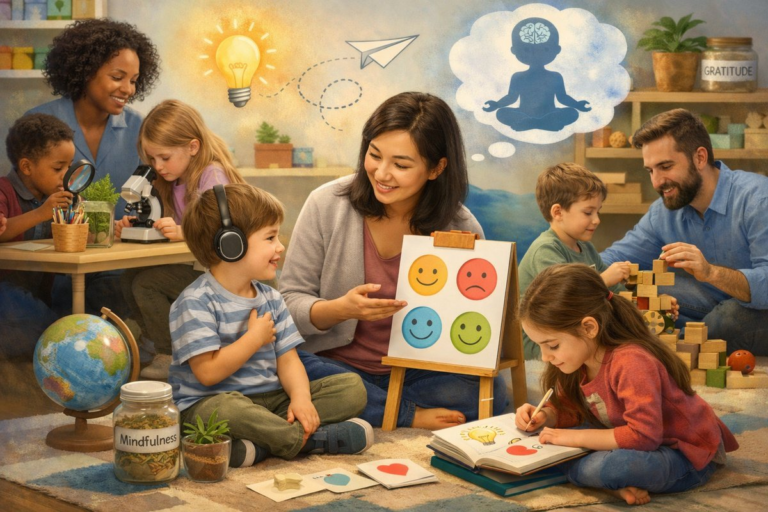
Integrating emotional learning tools at home can be simple and adaptable. Begin by selecting one tactile item-like a calm-down jar filled with glitter or a set of woven emotion bracelets-and introduce it during a routine transition, such as after school or before bedtime. Notice how the child interacts with it: Do they shake the jar to settle swirling glitter? Do they choose a blue bracelet to signify feeling calm? From there, layer in complementary items. Bring out story dice on a rainy afternoon, invite a sibling to join in building a “feelings fort,” or set up a rotating display of emotion flashcards on the fridge for quick check-ins throughout the day.
Challenges can arise when tools become too prescriptive or screen time escalates unchecked. To maintain balance, experts recommend a “one in, one out” rule: For every new digital app introduced, pair it with an analog counterpart. If a mood-tracking tablet widget is in use, accompany it with a physical emotion journal that the child can decorate and carry. Schedule tech-free emotion breaks-ten minutes of mindful movement or a nature walk-in the same way you would carve out time for homework or reading. By thoughtfully mixing formats, parents ensure that learning remains grounded in real-world experiences.
Cost and accessibility also factor into the equation. Not every family can afford a curated subscription box or a smart mood lamp. That’s why community libraries, makerspaces and neighborhood toy swaps are stepping forward to fill gaps. Some public libraries now offer “Emotions Explorer Kits” for home checkout, bundling sensory tools, board games and guided activity cards. Parent-led co-ops organize swap meets for gently used story cubes, tactile puzzles and children’s journals. These grassroots solutions ensure that the benefits of playful emotional learning reach a wider audience, reinforcing that agency and curiosity should never hinge on budget.
Looking ahead, educators and parents are exploring how data from mood lamps and apps might inform classroom practices and mental health resources. Pilot studies are testing anonymized emotion-tracking trends to tailor school-wide initiatives-like mindfulness breaks or art therapy sessions-based on collective needs. Privacy considerations remain paramount, so data collection is transparent, optional and encrypted. When families opt in, they contribute to a larger understanding of how emotional spikes and dips correlate with seasonal changes, academic workloads or social transitions.
In living rooms across the nation, something subtle is shifting. Play is no longer just a pastime-it’s a laboratory for feeling, expression and discovery. As tools evolve from simple craft kits to smart devices, the core principle remains unchanged: learning with heart. With each spin of the emotion dice or flick of a mood lamp’s color wheel, children gain insight into themselves and the world around them. And for parents like the Riveras, that journey is the greatest adventure of all.