Location
Mount Vernon, WA 98274

Location
Mount Vernon, WA 98274
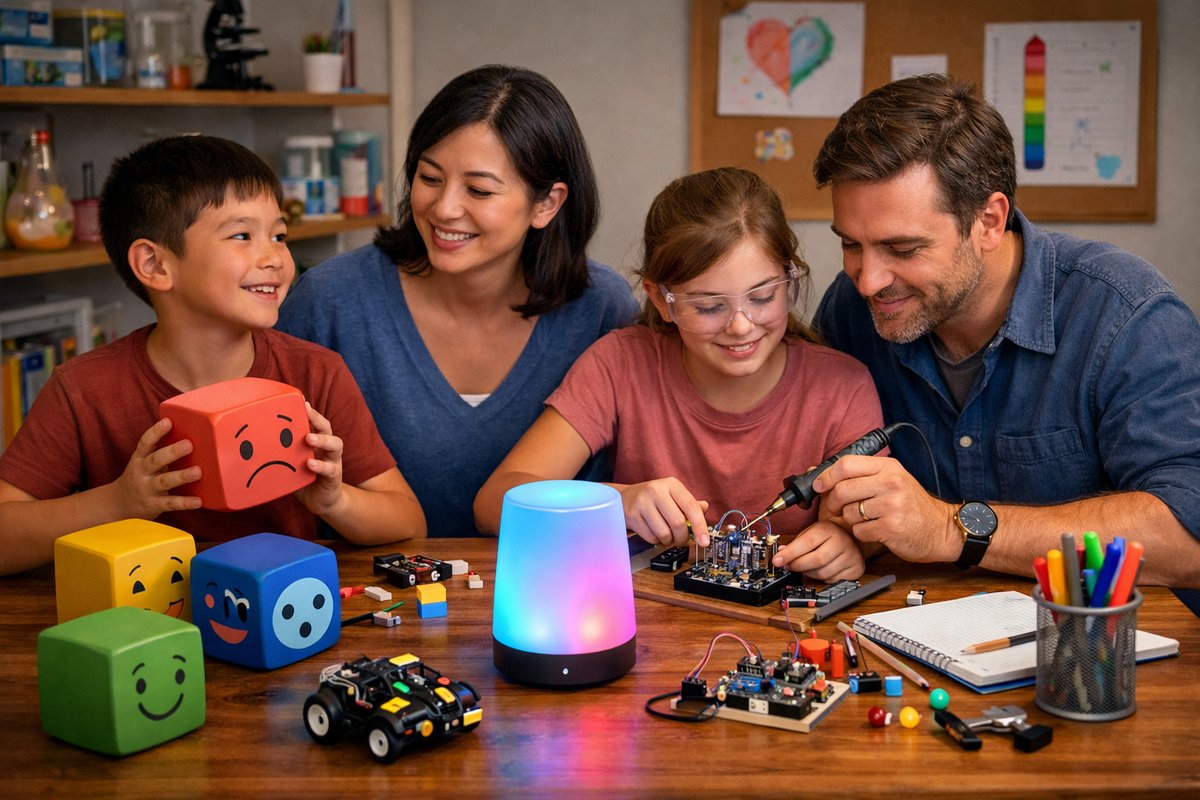
Parents are crafting living laboratories where empathy and engineering share the same workspace. From emotion dice to LED mood lamps, families worldwide are blending curious hands-on experiments with emotional check-ins that turn everyday moments into lessons in both heart and mind.
In living rooms from Vancouver to Amsterdam, a new kind of classroom is taking shape. It has no desks or blackboards, but rather colorful building blocks, tactile play dough, soft light panels and handheld tools designed not only to teach physics or coding, but also to nurture emotional awareness. Families have begun to view play as a bridge between gears and feelings, creating spaces where children learn how to build circuits and recognize their own moods in the same afternoon.
One evening in suburban Seattle, a family gathered around the coffee table. Scattered across its surface were magnetic building blocks, a handful of bright dice etched with simple faces showing surprise, sadness, joy and calm, and a small wooden stick wrapped in yarn. Each child rolled an emotion die, then built a structure that represented that feeling. When a roll showed ”surprise,” a nine-year-old daughter snapped together a tower that wobbled until she clipped on an arch to stabilize it. When ”calm” appeared, her brother molded a smooth circle of kinetic sand. Between breaths and laughter, the pair explained how each shape mirrored what went on in their heads.
Research at several universities has begun to back up this intuitive approach. A recent pilot at a Midwest elementary school showed that students who spent twenty minutes three times a week engaged in guided emotion-plus-STEM kits scored 30 percent higher on emotional vocabulary tests and demonstrated more persistence on open-ended science challenges. Educators observed that students who learned to identify and externalize fear or frustration through playful models were more willing to revise hypotheses instead of giving up at the first sign of trouble.
At home, some parents have taken cues from these findings by staging daily ”check-in sessions” at breakfast or before bed. In Toronto, one father set up a simple ritual: his two children choose a mood token-blue for thoughtful, yellow for energized, red for upset-and then spend ten minutes tinkering with a small snap-together circuit that lights up in different colors. If a token doesn’t match the way they feel, they swap it out and talk about what changed. This shared routine has become a cozy anchor point, helping siblings negotiate small conflicts and discover that dismantling and rebuilding a circuit can be as therapeutic as it is instructive.
The allure of combining emotional learning with engineering lies in the natural fit between experimentation and self-reflection. When a toy car won’t run or a tower won’t balance, a child has to name what they feel-frustration, curiosity or triumph-in order to decide whether to try another battery or reinforce the base. Parents describe moments when frustration gives way to ”Aha!” laughter as the child adds a spare wire or a fresh piece of clay. Those breakthroughs often translate off the play table, too, fostering resilience when homework feels daunting or social moments feel awkward.
Many families supplement blocks and dice with sensory materials like kinetic sand or modeling clay. When a child rolls a sadness face, they might press the dough until it flattens into a gentle pancake-an act of gentle release. When the joy face appears, they sculpt a smiling sun. The physical act of kneading, smoothing or shaping becomes a nonverbal expression of inner states, bridging motor skills and emotional vocabulary in one continuous flow.
Soft lighting and journaling also play starring roles. A compact LED color-changing lamp sits on a shelf, cycling through gentle hues that encourage calm focus or energize creative play. Some parents invite kids to spend two minutes before playtime writing down a sentence about how they feel, then choosing the lamp’s color to match that mood. A quick journaling prompt- ”Today I feel like a roaring wave because…” or ”I build confidence when…”-can spark conversations that deepen self-awareness and empathy between siblings or with caregivers.
Mindfulness prompt cards have found their way into toy bins alongside puzzle pieces and circuit components. Each card offers a simple exercise: ”Take three deep belly breaths,” ”Name three things you notice around you,” or ”Imagine your feelings as weather patterns.” Children have learned to incorporate these prompts into construction sessions, pausing to feel their heart rates slow before snapping a magnet into place or placing a sandalwood bead onto a string.
For families seeking a more structured journey, hands-on STEM circuit kits have emerged with built-in emotional modules. These kits include sensors that react to touch or sound, allowing children to build mood-sensitive circuits-a simple heart-rate sensor might trigger a calming chime when it detects rapid pulses, or a light sensor could flash brighter as the user relaxes their grip. Such configurations make abstract concepts like biofeedback tangible, granting young learners a direct window into the mind-body connection.
Educational consultants note that this holistic play transcends age. Preschoolers benefit from peg-board faces and soft blocks with velcro tabs for expression drills, while middle-schoolers dive into microcontroller projects that record and chart their mood data over a week. Teenagers experiment with wearable prototypes that buzz gently to remind them to breathe deeply or trigger a subtle flash when stress levels climb. Across generations, families report richer conversations and more sustained engagement compared to one-dimensional screen time.
Online communities have sprung up to support this movement. Parents share photos of ”emotion corners”-designated tabletop zones stocked with empathy dice, sensory bins and wiring diagrams. They trade tips on building DIY arc reactors from recycled materials, or how to adapt mindfulness protocols to fit dinnertime schedules. Local libraries host drop-in labs where kids can pair a compassion prompt with a soldering iron under supervision, blending social-emotional learning with real world tools.
For parents eager to bring this approach home, a few practical guidelines can help. Start small: introduce one emotion-focused prop alongside regular toys. Invite children to narrate what they build in emotional terms before adding another piece. Schedule short, consistent ”emotion and experiment” sessions, ideally at the same time each day, to create a soothing routine. Keep materials accessible and varied-paper journal, shaded lamp, play sand, snap circuits-so inspiration strikes at breakfast as well as bedtime. Finally, join a local or online support network to swap stories and troubleshoot challenges with other families walking the same path.
By weaving feelings into the very fabric of play and learning, parents are redefining what it means to educate the whole child. When a tear-shaped bead lights up to signal calm, or a tower of blocks mirrors a brave heart, children learn that inquiry and empathy are two sides of the same equation. They emerge not only as problem solvers, but as storytellers of their own emotional lives-prepared to face complex ideas and relationships with equal parts wonder and compassion.
In this evolving landscape of emotional STEM play, every child becomes both scientist and poet, mastering the mechanics of a circuit and the rhythms of the heart in tandem. Play tables transform into laboratories of self-discovery, where the equation of joy equals curiosity raised to the power of empathy.