Location
Mount Vernon, WA 98274

Location
Mount Vernon, WA 98274
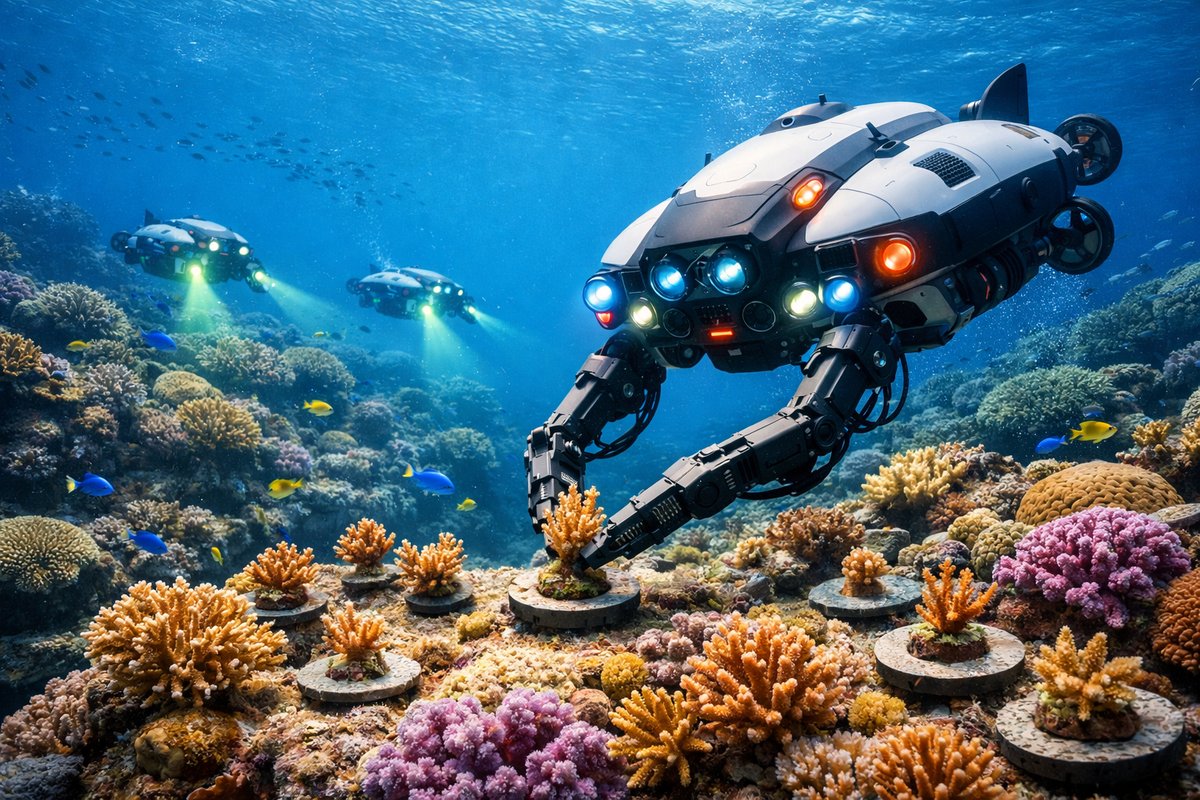
A fleet of autonomous underwater robots equipped with machine learning and multispectral cameras is restoring coral reefs at unprecedented speed. Field trials in the Pacific have shown a 40 percent increase in fragment survival compared to manual planting, opening new horizons for large-scale reef revival.
Across tropical coastlines, vibrant coral reefs have been dwindling under the combined stress of heatwaves, acidification, and pollution. In response, an interdisciplinary team of marine biologists, roboticists, and data scientists has unveiled a new generation of AI-driven restoration platforms designed to replant and monitor corals at scale. Deployed in a recent pilot off a remote atoll, these autonomous underwater vehicles (AUVs) demonstrated an ability to identify suitable substrates, select healthy coral fragments, and attach them with precision-tasks that once required hours of painstaking human labor.
Instead of relying solely on divers to manually transplant coral fragments into custom-grown nurseries, the robotic platforms harness computer vision algorithms trained on thousands of reef images. Multispectral cameras mounted on the AUVs scan the seafloor for ideal attachment sites, evaluating surface texture, light exposure, and local current patterns. Once a target is confirmed, a soft-gripper arm secures a nursery fragment, while a medical-grade adhesive dispenser applies a biodegradable gel to fasten the coral to the rock. Trials have recorded a 40 percent boost in early survival rates compared to traditional methods, likely because the robots choose microhabitats that diversify light and water flow around the new colony.
These “coral guardians” navigate using simultaneous localization and mapping (SLAM) techniques adapted from terrestrial robotics. Underwater sonar arrays feed positional data into path-planning software, allowing each unit to cover a designated reef sector autonomously. Onboard sensors continuously log temperature, pH, salinity, and dissolved oxygen, streaming real-time metrics back to a cloud dashboard. Scientists can visualize changes in reef health at meter-scale resolution, flagging hotspots of bleaching or disease for follow-up planting or intervention. The integration of analytics and robotics marks a shift from reactive monitoring to proactive restoration.
Perhaps the most striking feature is the system’s modular swarm architecture. Up to a dozen AUVs communicate locally via acoustic modems, coordinating planting patterns to avoid overcrowding and maintain genetic diversity. When one unit finishes its tasks, another arrives to pick up fresh nursery fragments from a floating depot station, refilling its gripper and adhesive cartridge before resuming work. This relay approach extends operational range, enabling continuous restoration for days at a time without diver support. The result is a self-sustaining restoration network that could scale to hundreds of square kilometers of reef.
Behind the scenes, machine learning engineers fine-tune object-recognition models using transfer learning. Early iterations struggled to differentiate between living tissue and algae encrustations, leading to wasted fragments. By augmenting training data with hyperlocal images and incorporating depth-sensor information, accuracy soared to over 95 percent. The system now reliably avoids dead zones and crowded patches that could impede growth. Going forward, developers plan to integrate acoustic coral health diagnostics, using ultrasonic pulses to detect early signs of stress deep within the skeleton.
Field biologists emphasize that technology is only one piece of the puzzle. Adaptive management strategies remain essential to protect restored areas from overfishing and coastal runoff. Local communities are partnering with research teams to establish marine protected zones around deployment sites. Early education programs are training citizen scientists to perform maintenance checks on the floating nurseries and to collect water-quality samples. This human-robot collaboration ensures that restored reefs not only survive but flourish alongside sustainable fisheries and tourism initiatives.
Economists have begun evaluating the cost-benefit trade-offs of robotic reef restoration versus manual approaches. Preliminary data suggest that, once operational infrastructure is in place, the per-fragment cost drops by as much as 30 percent. Savings come from reduced diver hours, lower boat fuel consumption, and streamlined data collection. With larger areas covered, restored reefs contribute to shoreline protection, fisheries recovery, and carbon sequestration at scales that were previously infeasible. While initial hardware investment remains significant, philanthropic organizations and environmental funds are already pledging support for regional rollouts.
Ethical considerations are woven into the project’s design ethos. All materials used in grippers and adhesives are certified biodegradable and non-toxic, minimizing any residual footprint. Open-source software licenses allow other labs to adapt the platform to local reef species and conditions. Early partnerships in Indonesia, the Philippines, and the Caribbean have begun translating code and hardware designs to support species-specific restoration. This global approach underscores the principle that reef conservation is a shared responsibility, transcending borders and budgets.
Beyond restoration, the robotic platforms hold promise for broader ocean research. Future iterations are slated to carry micro-remotely operated samplers for plankton, environmental DNA filters to map biodiversity shifts, and microplastic collection nets. By combining restoration with deep-sea exploration tools, these AUVs could unlock new insights into marine ecosystems that have long defied systematic study. Researchers are already planning to deploy prototypes near seamounts and cold-water coral banks, where restoration techniques must adapt to lower temperatures and slower growth cycles.
As climate change intensifies, resilient reefs will be critical refuges for marine life and shorelines. The AI-driven coral guardians offer a proactive strategy to rebuild these underwater cities before too many collapse. While no single solution can reverse decades of degradation overnight, this integrated approach-blending robotics, AI, and community stewardship-charts a hopeful path forward. The next decade may well see the blueprint of rehabilitation shift from nets and nurseries to fleets of intelligent machines working in harmony with human stewards.
In the warm shallows around the atoll where the pilot ran, tiny polyps have already begun filling the gaps between transplanted fragments. Within weeks they develop clusters of new tentacles, reaching for sunlight and opening the door for fish, crustaceans, and corals to return. What began as a proof-of-concept is blossoming into a living tapestry of regeneration. For coastal communities that rely on reefs for food security and storm protection, these futuristic guardians might soon become indispensable allies in preserving the blue heart of our planet.
This breakthrough underscores a broader truth: when technological ingenuity is guided by ecological wisdom and social equity, even the most daunting environmental challenges can inspire collective action. The story of robotic reef restoration is still unfolding, but its chapters are already rich with promise, innovation, and the elemental wonder of life beneath the waves.
With each coral guardian patrolling the reef, a new era of marine restoration takes shape-one where AI and human compassion converge to revive the ancient architects of ocean biodiversity.