Location
Mount Vernon, WA 98274

Location
Mount Vernon, WA 98274
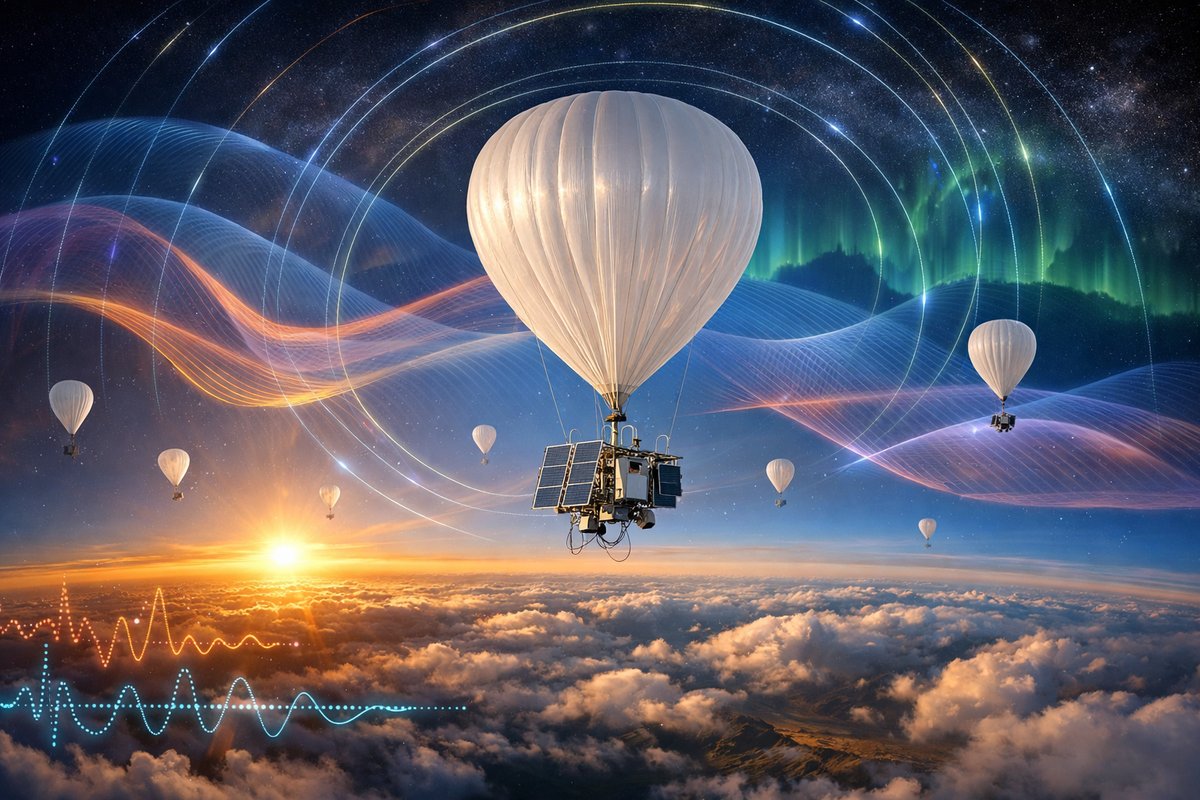
A fleet of solar-powered high-altitude balloons equipped with sensitive accelerometers and magnetometers is unveiling complex gravity-wave patterns and magnetic fluctuations in the lower stratosphere. This citizen-enabled network promises to refine weather forecasts and deepen our understanding of atmospheric dynamics.
Above the thin blue line of Earth’s horizon, a new network of solar-powered high-altitude balloons is decoding subtle undulations in the atmosphere that until now remained largely invisible. By capturing data on gravity waves and magnetic field fluctuations at altitudes between 18 and 30 kilometers, these stratospheric platforms are shedding light on how energy and momentum propagate far from storm systems. Driven by a constellation of researchers, hobbyists, and environmental enthusiasts, the initiative merges cutting-edge sensors with open-source telemetry to map atmospheric forces on a near-global scale.
Gravity waves-undulations that arise when air masses are displaced vertically and restored by buoyancy-play a vital role in transporting momentum from the troposphere into the stratosphere and mesosphere. Their influence extends to jet-stream dynamics, the formation of polar vortices, and even the distribution of ozone. Despite their significance, direct measurements of these waves at high altitudes have been sparse and limited to occasional research flights. Now, thanks to the proliferation of compact, low-power sensors, a distributed approach is filling in crucial gaps.
Each balloon carries a suite of miniaturized instruments: a high-sensitivity accelerometer for tracking vertical oscillations, a three-axis magnetometer to record geomagnetic perturbations, and a barometric sensor that pins down pressure variations. All of these feed data to a single-board computer that logs measurements at sub-second intervals. Solar panels power the payload, enabling flights that last weeks or even months. When telemetry is available, real-time updates stream down to ground stations; otherwise, on-board storage preserves the raw records until retrieval.
Rather than relying solely on professional agencies, the project embraces a hybrid model. Universities supply technical expertise and calibration facilities, while amateur radio operators and meteorological clubs launch the balloons from dozens of sites. Participants follow a standardized flight-planning protocol to ensure proper dispersion and minimize air-traffic conflicts. Within weeks of deployment, the collective data begin to reveal coherent wave trains stretching thousands of kilometers across latitudes.
Early results have uncovered gravity-wave packets generated by intense convection over tropical ocean regions. These waves propagate upward, break in the lower stratosphere, and deposit energy that modulates zonal wind speeds miles above the storm tops. The magnetometers, meanwhile, detected faint geomagnetic signatures associated with charged particle motions in disturbed solar wind conditions. By correlating wave amplitudes with magnetic fluctuations, researchers are probing electrodynamic coupling between neutral and ionized layers of the upper atmosphere.
One striking discovery emerged from a series of launches over mid-latitude plains: a persistent oscillation at six-minute intervals, consistent across multiple platforms, coinciding with sudden stratospheric warming events. Analysis suggests that small-scale gravity-wave resonances may precondition the stratosphere for rapid temperature shifts. If confirmed, this insight could improve the lead time for forecasting extreme winter anomalies that impact agriculture and energy demand.
The open-data ethos at the core of the initiative allows meteorologists and climate modelers to assimilate balloon observations directly into numerical weather-prediction systems. Preliminary runs integrating gravity-wave inputs have yielded modest improvements in forecast accuracy for high-altitude winds and temperature fields. Over the coming seasons, systematic validation against satellite limb-sounders and ground-based lidars will quantify the added value of these flying observatories.
Despite its promise, the balloon network faces engineering hurdles. Stratospheric winds can shear the balloons away from landing zones, making retrieval of onboard storage units challenging. Signal dropouts occur in polar regions where satellite relay coverage is sparse, leading to occasional data gaps. To address these issues, the team is experimenting with mesh-networked radios that allow balloons within range to relay packets to one another, effectively bypassing coverage blind spots.
Battery longevity under freezing conditions and solar-panel efficiency at low sun angles are also under continuous improvement. Lightweight thermal insulation and maximum-efficiency photovoltaic cells help maintain power budgets during long polar nights. At the same time, modular payload bays mean that new sensor types-infrared radiometers, ultraviolet spectrometers, or neon tracer injection systems-can be integrated in months rather than years.
Beyond gravity waves and magnetic fluctuations, the network holds potential for monitoring atmospheric tides, volcanic plumes, and even the dispersion of aerosolized pollutants. High-altitude balloons equipped with trace-gas detectors could pinpoint emissions from remote industrial sites or track the transport of wildfire smoke. By combining multiple physical measurements, the platforms are poised to become multipurpose flying laboratories free from the constraints of orbital revisit times.
The citizen-science element has spurred unexpected educational dividends. Students at regional colleges have programmed machine-learning algorithms to classify wave events, while amateur hobbyists have built custom ground stations from repurposed satellite-dish parts. Online workshops walk newcomers through flight-permit applications, sensor calibration, and data-visualization pipelines, democratizing access to high-altitude research in a way once reserved for government programs.
Financial support comes from a patchwork of small grants, philanthropic donations, and crowdfunding campaigns. Even modest contributions help cover costs of helium or hydrogen gas, custom circuit boards, and logistics. The modular design ensures that each launch teaches lessons for the next iteration, refining hardware footprints and software toolchains in agile cycles. Incremental improvements, iterated by a distributed community, have accelerated innovation far beyond the pace of monolithic projects.
Looking ahead, organizers aim to expand the network into the Southern Hemisphere and over oceanic regions. Partnerships with marine institutes could deploy balloons from research vessels, filling blind spots over the Pacific and Atlantic. A proposed satellite downlink upgrade would deliver near-real-time monitoring of planetary-scale wave patterns, enriching long-term climate studies.
As balloon silhouettes drift across sunlit skies, they trace invisible rivers of energy coursing through our atmosphere. By mapping these hidden currents, researchers are not only advancing fundamental science-they are equipping society with better forecasts, climate insights, and environmental monitoring tools. In the interplay of gravity, magnetism, and buoyant forces, a new chorus of discovery is rising, carried aloft on the breath of the stratosphere.