Location
Mount Vernon, WA 98274

Location
Mount Vernon, WA 98274
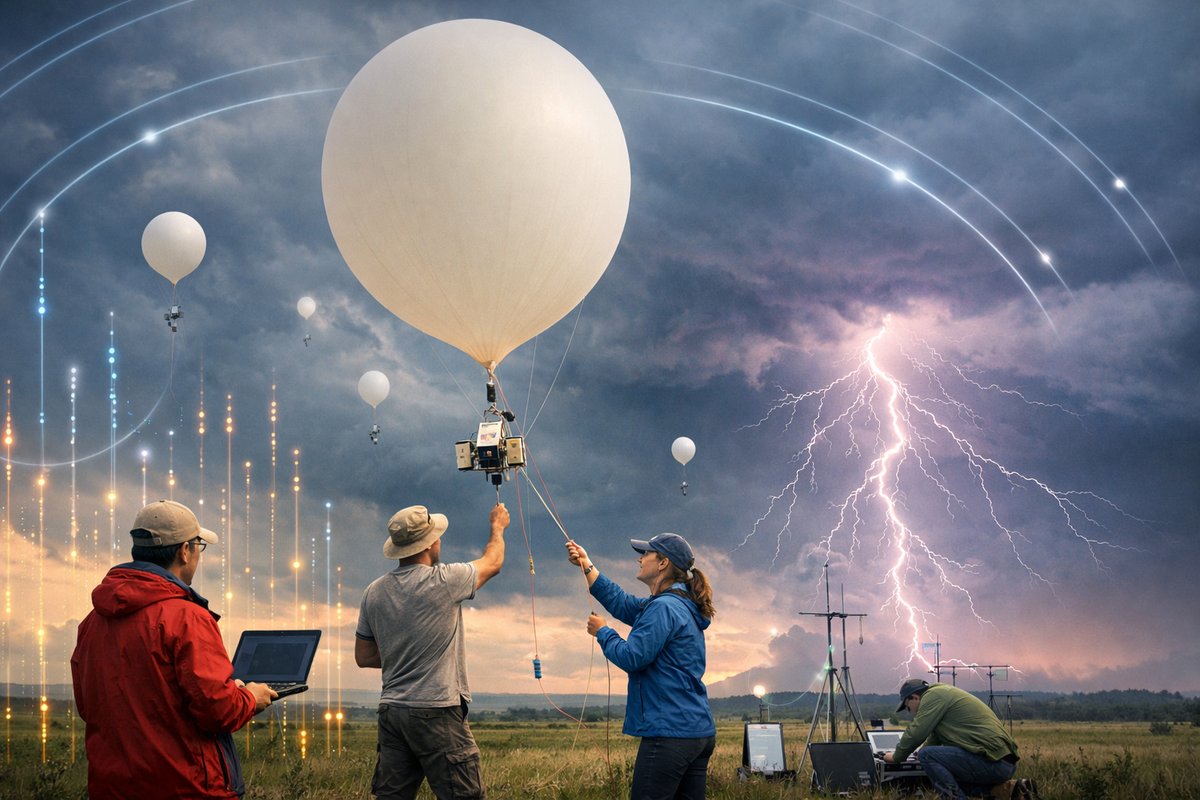
A grassroots alliance of weather enthusiasts and researchers has launched hundreds of custom weather balloons worldwide to record atmospheric electric fields ahead of storms. Their open‐source network is revealing subtle charge patterns that could advance storm forecasting and deepen our understanding of the planet's global electric circuit.
Before dawn, a fleet of small, pastel-colored balloons drifts silently above quiet neighborhoods, carrying lightweight sensor arrays tuned to the whisper of electric charges that gather in the lower atmosphere. No formal institution orchestrates this daily ritual alone. Instead, a loose coalition of hobbyists, school science clubs, and independent researchers operates an open-source network called Sky Sparks.
Sky Sparks began two years ago when a handful of engineers and thunderstorm aficionados realized that no widely available system existed to track the vertical electric potential gradient ahead of severe weather. Weather balloons and ground stations measure temperature, pressure, humidity, even wind speed-but electric field observations remained the domain of costly research campaigns. The founders decided to democratize the process by designing a simple, modular sensor package that anyone could build from off-the-shelf electronics.
The heart of the payload is an electric field mill-a small rotating vane assembly that alternately shields and exposes a sensing electrode to the ambient field, creating a measurable AC signal. The onboard microcontroller samples this signal along with GPS coordinates, altitude, and temperature data before transmitting each record via a low-power radio to local ground stations. Volunteers gather in parks or backyards to launch these balloons at scheduled intervals, synchronizing across thousands of kilometers to build a coherent picture of the atmospheric electric field in near real time.
Data flows into a centralized dashboard maintained by a core volunteer team. Visualizations show rising positive or negative gradients over farmland in the American Midwest, mountain valleys in Europe, and coastal plains in Southeast Asia. One striking pattern emerged last autumn during a cluster of strong convective storms: a sharp shift in the field gradient at altitudes between 2,000 and 4,000 meters, detectable nearly six hours before the first pulse of lightning. Forecasters are now exploring whether this signal could improve early warnings for hail or tornado outbreaks.
“This network turns a classical physics lecture demonstration into a planetary observatory,” says one researcher collaborating with Sky Sparks. While commercial electric field mills can cost tens of thousands of dollars, each DIY payload runs under a few hundred-making widespread deployment feasible. Schools have embraced the project as a hands-on STEM initiative, equipping entire classrooms to build sensors and participate in data analysis. For many students, the thrill of launching a balloon that soars into the clouds transforms abstract equations about Coulomb’s law into palpable wonder.
Beyond storm forecasting, the network is shedding light on the global electric circuit-the continuous flow of charge between the ionosphere and the Earth’s surface that regulates long-distance charge transport. The traditional view held that thunderstorms and fair-weather regions maintained a steady exchange to keep the ionosphere about 250,000 volts above ground potential. But regional variations, influenced by industrial pollution, aerosol layers, and even forest fires, can modulate the circuit in ways researchers are only beginning to chart.
In March, Sky Sparks volunteers launched simultaneous flights from three continents on World Meteorological Day. Though separated by thousands of miles, the data sets revealed synchronized oscillations in the field gradient at dawn. Researchers suspect these may stem from global atmospheric tides driven by solar heating-ripples in pressure and temperature that subtly shift charge distributions. Such findings may prompt revisions to climate models that currently omit these electrical effects.
Challenges remain. Recovering sensors after flights often demands lengthy treks into rural areas or tracking down beach-bound gondolas carried offshore. Radio range limits in dense urban environments produce data gaps. And calibrating each electric field mill to account for manufacturing tolerances requires careful in-field testing. The core Sky Sparks team publishes open documentation on monthly calibration workshops and repair guides, but securing sustained funding for components and radio repeaters has proven an uphill battle.
Several regional meteorological agencies have expressed interest in integrating Sky Sparks feeds into their forecasting suites. In one pilot program, a state weather service in southern Europe began fusing balloon-derived electric field data with radar scans to pinpoint the early growth of supercell storms. Preliminary results suggest up to a 10 percent improvement in lead times for severe thunderstorm warnings. If these gains hold across longer seasons, they could translate into saved lives and reduced property damage.
The network’s success hinges on emotional engagement as much as technical prowess. When a launch crew in South Africa spotted their balloon caught on a remote koppie after two days, a local hiking group rallied to retrieve it. A student in Brazil who tasted her first thunder at age twelve felt empowered to build her own field mill and share discoveries online. These stories circulate in the project’s newsletter and fuel a sense of global scientific camaraderie.
Emerging plans call for coupling electric field observations with infrasound microphones and microbarographs to capture the full tapestry of storm precursors. Some teams are experimenting with biodegradable balloons and packaging to minimize environmental impact as the number of launches climbs into the thousands annually. Others are testing collaborative flight paths between high-altitude gliders and fixed-wing drones to extend monitoring into the lower stratosphere.
Sky Sparks’ broader ambition is to make atmospheric electricity a routine datum in weather services worldwide-no longer an esoteric curiosity but a pillar of forecasting. As climate change alters storm patterns and intensifies convective events in many regions, every minute of advance notice becomes more critical. The network illustrates how grassroots ingenuity can fill gaps left by satellite sensors and centralized observatories, uniting wonder, community, and cutting-edge science in a single mission.
The sky at dawn now seems to vibrate with more than bird calls and shifting winds. It hums with hidden currents of charge, mapped by a legion of citizen scientists lifting their gaze-and their sensors-toward the charged frontier above.