Location
Mount Vernon, WA 98274

Location
Mount Vernon, WA 98274
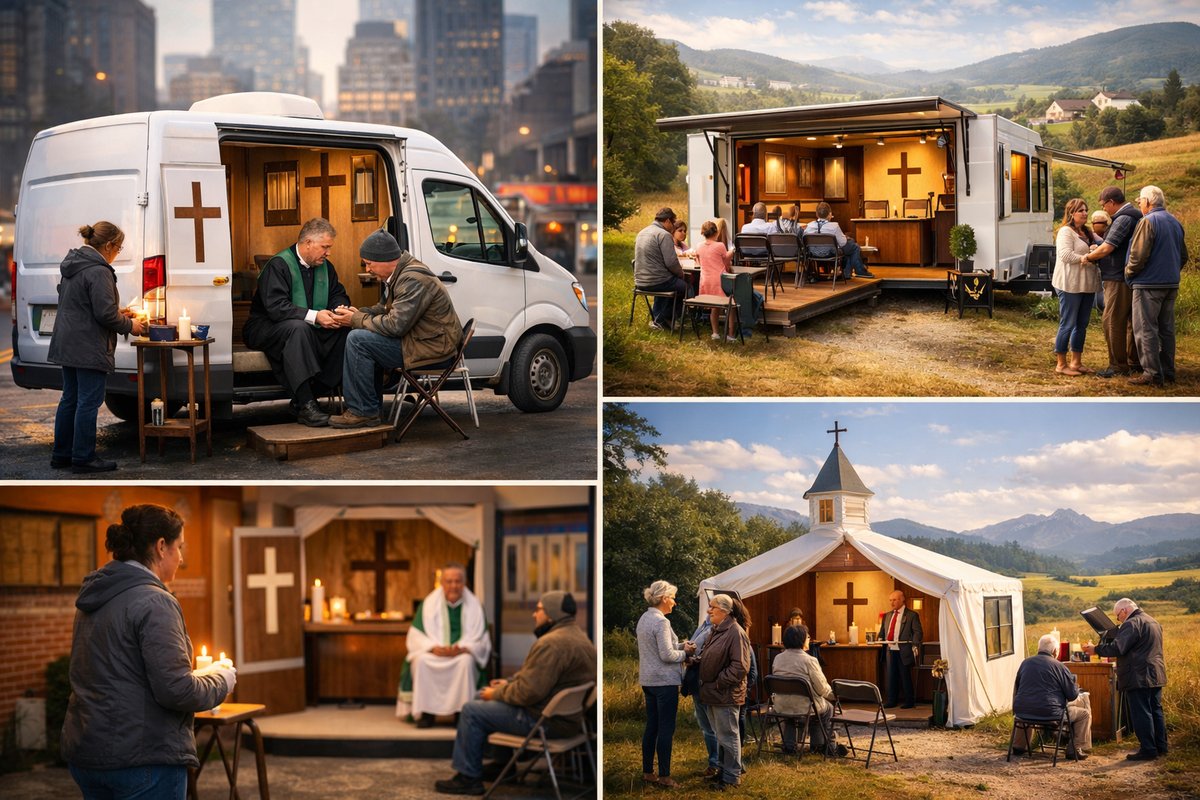
Across cities and rural landscapes, churches are rolling out mobile chapels to bring worship, pastoral care, and community services directly to people on the margins. From converted vans in urban centers to pop-up sanctuaries in remote hamlets, these initiatives are blending innovation with tradition to forge new paths for faith in action.
Churches have long served as anchors of spiritual life, but in recent years a growing number of congregations are sending their sanctuaries onto the road. Mobile chapels-vehicles outfitted for worship, prayer, and pastoral care-are expanding the reach of Christian ministry to homeless encampments, underserved neighborhoods, college campuses, and disaster zones. By meeting people where they live, work, or struggle, these rolling sanctuaries are reshaping the very concept of church.
In Detroit, a repurposed school bus dubbed the “Mission Mobile” now glides through neighborhoods with high rates of food insecurity. Inside, rows of portable pews and soft LED lighting welcome visitors to share coffee, Bible study, and a moment of silence. Pastoral counselor Jamal Rivers reports that in its first year, Mission Mobile recorded nearly 1,200 individual consultations-many from residents who had never stepped inside a traditional church. “We’re not waiting for people to cross the threshold,” he explains. “We’re crossing it for them.”
Similar efforts have taken root in London, where the Anglican Diocese launched the “Chapel in a Van” project. A former postal vehicle was retrofitted with a simple altar, bench seating, and a small instrument rack. Volunteers park near busy transit hubs and office districts, offering midday prayer services, pamphlets on mental health resources, and a listening ear. Priest Ayodele Ogunleye notes that commuter stress has skyrocketed since major transit disruptions made headlines. “People are craving a quiet moment,” he says. “Our van gives them fifteen minutes of calm amid the hustle.”
Statistics from a recent Christian social ministries report show a 35 percent increase in mobile ministry initiatives over the past five years, highlighting growing interest across denominations. Catholic, Protestant, and Orthodox communities alike are testing a range of vehicle types-from compact cargo vans to full-sized RVs-tailoring each design to local needs. In the Appalachian foothills, a motorcycle-pull trailer dubbed the “Worship Wagon” carries folding chairs and a small sound system into areas with sparse cell coverage. Meanwhile, on the coast of Kerala, India, a converted ambulance brings both worship services and emergency medical checks to fishing villages vulnerable to extreme weather.
The appeal of mobile chapels extends beyond novelty. In urban areas, rising real estate costs and declining church attendance have forced some congregations to shutter brick-and-mortar buildings. Mobile outreach becomes a way to stay agile and budget-friendly. Modular seating, lightweight altars, and solar-powered lighting can all be stored indoors when weather changes. As Pastor Leah Martinez of a small Denver congregation puts it, “We’ve traded square footage for square miles. Our membership might be smaller, but our mission field is vast.”
Beyond sermon delivery, many mobile chapels double as community resource centers. Stations stocked with nonperishable food, hygiene kits, blankets, and Bibles line the walls. On Sundays, families gather for worship; on weekdays, they collect diapers or recharge at a portable power station. Volunteers offer resume workshops, legal clinics, and mental health counseling. A recent survey of participants in a Midwest bus-based ministry revealed that 62 percent of attendees used at least one support service, from food assistance to job coaching.
Innovations in technology are fueling the next wave of mobile faith tools. One initiative in Melbourne, Australia, showcases a solar-panel roof that powers both interior LED lights and an onboard Wi-Fi hotspot. Congregants attending outdoor services livestream sermons to friends at home, or access online devotionals during quiet moments. Another program in São Paulo utilizes a tablet-based kiosk to distribute digital hymnals and prayer guides in multiple languages, helping migrant workers overcome literacy barriers.
Critics question whether wheels can truly replicate the sense of rooted community found in a permanent church building. “There’s a sacramental significance to consecrated ground,” argues theologian Dr. Helena Weiss. “Mobile chapels may serve as stopgaps, but they can’t replace parochial identity.” Yet many pastors counter that spiritual belonging is less about walls and steeples than about relationships. When a visitor to the Chapel in a Van kneels for prayer between marathon-commuters, that moment of grace can crystallize into a deeper church connection down the line.
Case studies suggest that mobile chapels often act as gateways. In Philadelphia, a converted utility truck named the “Faith Truck” networked with three local congregations. Over six months, nearly 40 percent of first-time visitors to the Faith Truck attended a subsequent Sunday service at one of the partner churches. In rural Colorado, a pop-up “Trail Chapel” parked at winter ski resorts has inspired a seasonal group of volunteers to start a permanent fellowship in a nearby mountain town.
Funding these initiatives takes creativity. Grant writing, crowdfunding campaigns, and denominational support each play a role. Some congregations secure partnerships with local businesses-coffee shops donate bulk grounds; construction firms provide off-hours labor to customize interiors; solar-equipment companies offer discounts on panels and batteries. Others sell branded merchandise-t-shirts, prayer journals, reusable water bottles-to cover maintenance costs. Nonprofit churches are also exploring low-interest loans designed for faith-based social enterprises.
As mobile chapels gain traction, best practices are emerging:
• Community Assessment: Survey neighborhoods to understand unmet needs-be it homelessness, language barriers, or public transit gaps.
• Vehicle Selection: Choose a platform that balances capacity, fuel efficiency, and maneuverability for targeted outreach areas.
• Modular Design: Invest in fold-away furniture, self-contained power systems, and weather-proof storage to adapt to diverse climates.
• Partnerships: Collaborate with local nonprofits, health clinics, and social services to amplify impact and share resources.
• Staff Training: Equip volunteers with pastoral care techniques, basic first-aid skills, and cultural competency to serve diverse populations effectively.
Stories of transformation are multiplying. In Nashville, a mother of three spoke tearfully when the mobile chapel handed her a prepaid grocery card and prayed with her through eviction. In Cape Town, a recovering addict credited a van-based support group with sparking his journey to sobriety. Overseas, Korean missionaries have dispatched mobile chapels into remote villages of Southeast Asia, linking isolated believers to global prayer networks via satellite uplinks.
As churches explore the road ahead, the concept of mobile ministry raises broader questions about the future of faith communities. Will digital worship platforms and pop-up sanctuaries eclipse traditional parishes? Or will they complement one another, forging a hybrid model that blends stability with flexibility? For now, the sight of a chapel rolling down the highway challenges assumptions about where and how spiritual life unfolds.
The growing roster of mobile chapels reveals a pragmatic theology at work-one that meets people in crisis, in transition, and in everyday routines. Wheels of faith are turning, and with them comes a promise: that the church need not be confined by walls or pews, but can weave mercy, meaning, and fellowship wherever the road leads. In an age of displacement and digital distraction, these rolling sanctuaries embody a simple yet profound message: God’s reach extends beyond any edifice, straight into the heart of every journey.
May this new era of mobile ministry inspire other congregations to innovate, collaborate, and embrace the open road-carrying the light of hope, one mile at a time.