Location
Mount Vernon, WA 98274

Location
Mount Vernon, WA 98274
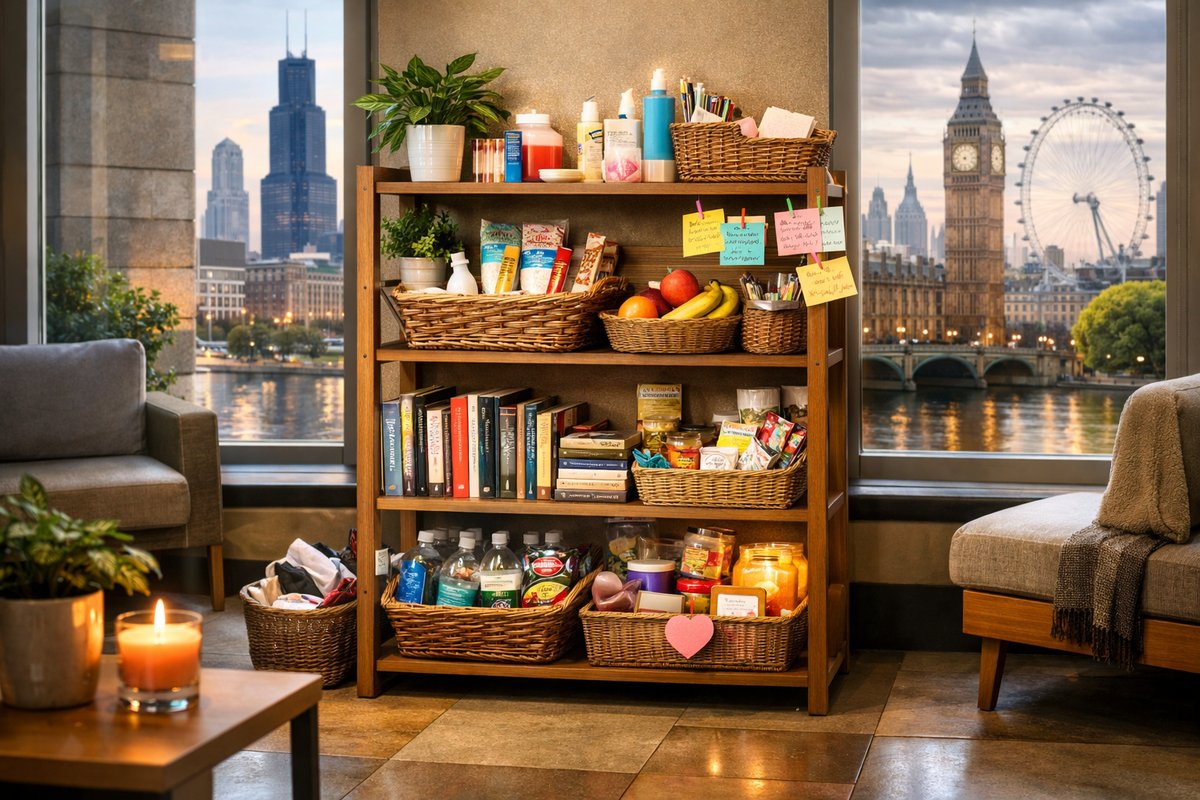
In apartments and condo lobbies from Chicago to London, small self-service "Care Corners" are sprouting, stocked with toiletries, snacks, books and handwritten notes. What started as a single shelving unit to help a neighbor in need has evolved into a global mutual-aid movement that celebrates everyday resilience, trust and interdependence.
On a damp spring evening in a mid-rise block on the north side of Chicago, Maria Santos arrives home after a long shift. Before unlocking her door, she pauses at a low wooden shelf tucked into the corner of the lobby. A hand-lettered sign reads “Take What You Need, Leave What You Can.” She slides a small carton of milk into her tote and tucks a bar of soap into her coat pocket. Above the shelf, a handful of laminated notes – one in Spanish, another in Arabic – offers encouragement: “You matter,” “You are not alone,” “One day at a time.”
What Maria is encountering is known locally as a “Care Corner” – a mini-mutual-aid station where neighbors share essentials and kind words. The first Care Corner opened less than a year ago in an Oak Park condominium, stocked with noodles and tampons for a single mom down the hall. Word spread through online forums and hallway chatter, and soon pop-up shelving units began appearing in apartment buildings across the city. Today, dozens of neighborhoods nationwide have adopted the concept.
At its core, the Care Corner is a reflection of the human impulse to support one another, even when city life often feels anonymous. Volunteers recruit donated shelving units, curate stock from local stores, and coordinate drop-off schedules using group chats. Some buildings treat the shelves like a free library for basics: toothpaste, snacks, wipes, soap, bandages and pre-paid transit cards. Others add extras like paperback novels, puzzle books and crayons, sparking small moments of joy amid financial stress.
“It started as a way to help my neighbor who’d lost her job,” says Jordan Lee, 28, an architect who launched the original shelf in his lobby. “But it turned into so much more. People started leaving oatmeal for others, homemade scarves for winter, handwritten messages. I realized we weren’t just exchanging items – we were exchanging hope.”
Mutual aid pantries aren’t new. They date back decades in activist communities, relief networks and informal church initiatives. Yet embedding them into everyday apartment hallways marks a novel twist. These Care Corners are intentionally low-key and horizontally organized: there’s no central nonprofit, no formal application and no eligibility criteria. Whatever you find, you take. Whatever you can spare, you give. The simplicity preserves dignity and encourages privacy.
Research from the American Public Health Association indicates that neighborhood solidarity projects like these can reduce social isolation and improve mental well-being. A community health survey in Detroit found that residents living near mutual aid stations reported a 15 percent increase in perceived social support. In Toronto, urban planners are monitoring several dozen corridor micro-pantries to study their design impact on surveillance cameras, foot traffic and building maintenance costs.
“These aren’t just self-serve pantries,” explains Dr. Aisha Patel, a sociologist studying urban resilience. “They’re symbolic infrastructures of trust. When people see a stranger’s kind note or share extra supplies, they’re reminded that community still exists beyond market transactions. That can shift how we view our city and each other.”
Not every Care Corner endures without hiccups. In a high-rise on London’s south side, one shelf was vandalized within weeks – empty cans strewn across the tiles. In another block in San Francisco, management demanded removal citing liability fears. Yet in most cases, neighbors rallied, petitioning building committees, pooling funds for insurance waivers and even installing low-energy motion-sensor lights to discourage misuse.
“We hung a small solar-powered lamp above the shelf,” recalls Maya Thompson, a resident coordinator in Seattle. “Suddenly people weren’t just dumping old cans or trash. The light made it feel cared for. It sends a message: this corner belongs to all of us.”
As the network of Care Corners grows, so do creative offshoots. Some communities hold quarterly “swap meets” where participants can trade books or handmade knit hats. Others host “note-writing parties,” gathering with colored markers to craft messages of encouragement that remain at the shelf for weeks. In Miami, a group launched a bilingual pantry to address linguistic barriers, while in Berlin, an architectural student group prototyped a collapsible shelf that can be wheeled into a lobby and folded back against the wall when not in use.
Beyond practical aid, these micro-installations catalyze shared stories. Elderly immigrants leave recipes for tamales or dumplings; displaced renters offer tips for navigating tenant rights. Young parents tuck in doodles for neighborhood children. As items disappear and reappear, so do traces of lives that might otherwise pass unnoticed.
On a busy Tuesday morning, Maria Santos finds a new post-it one floor above her Care Corner. It reads, “Your next smile could be someone else’s lifeline.” She smiles, thinking how something so small can ripple through a hallway. That day, she drops off a bag of granola bars and scribbles her own note: “We rise together.”
For urban planners and social innovators, the lesson is clear: fostering connection often means creating humble platforms for everyday kindness. In buildings where neighbors once kept to themselves, a simple shelf has sparked conversations in elevators, impromptu potlucks in stairwells and a renewed sense of belonging. The Care Corner reminds us that solidarity isn’t a grand gesture – it’s the sum of small acts delivered with compassion.
Whether winter brings chill and scarcity or summer stretches into languid days, these neighborhood havens continue to offer refuge. The Care Corner movement may have begun as a single wooden unit in a Chicago lobby, but its heartbeat echoes across city blocks worldwide. In the soft glow of a motion-sensor lamp, amid libraries of toothpaste and hopeful post-its, residents find something deeper than supplies: the quiet courage to believe that none of us stands alone.
And as new communities set up their own shelves, each jar of soup and sticky note becomes a testament to human resilience. The hallways may be concrete, but the bonds they foster are anything but cold.