Location
Mount Vernon, WA 98274

Location
Mount Vernon, WA 98274
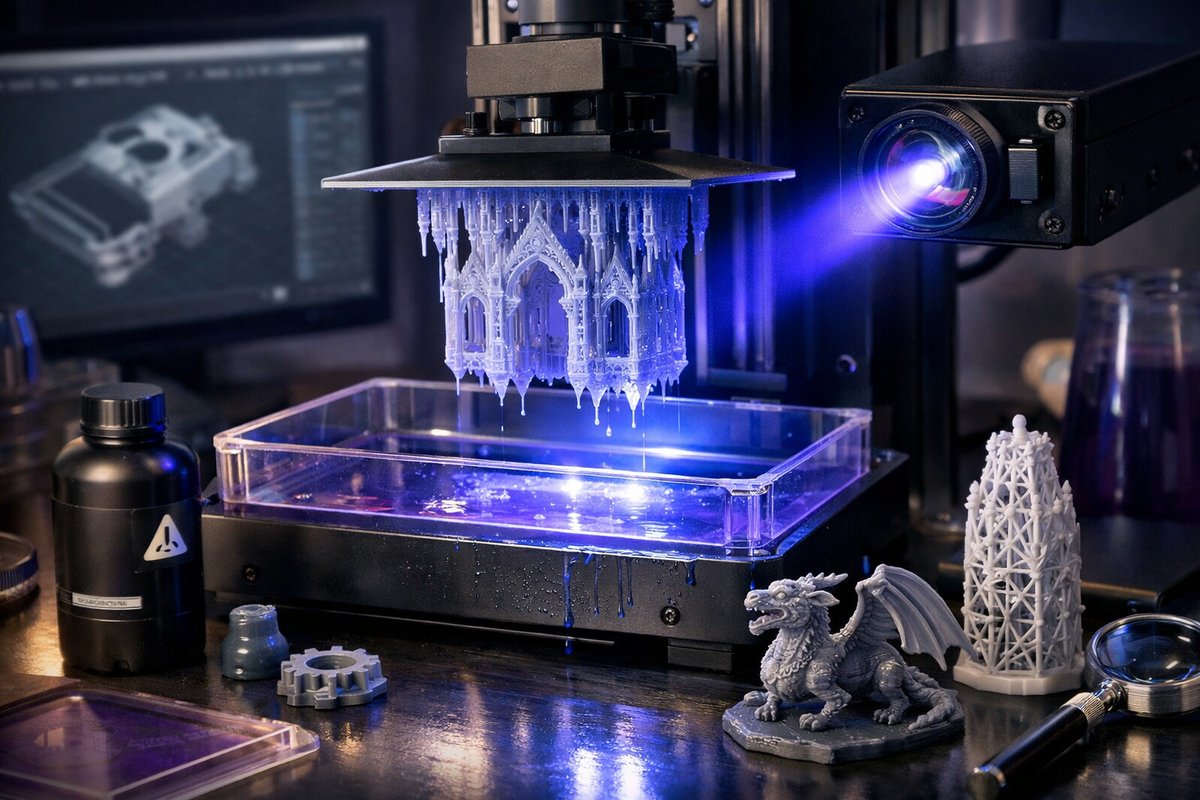
Vat photopolymerization is an additive manufacturing technique that leverages light to cure liquid resin into intricate solid forms. This guide explores the process, key components like resin vats and UV light sources, and practical tips to help you create high-resolution, durable parts. Discover how this method blends artistry and engineering to bring your designs to life with remarkable detail.
Additive manufacturing has revolutionized how we approach fabrication, shifting from traditional subtractive methods to building objects layer by layer. Among the diverse techniques available, vat photopolymerization stands out for its ability to produce finely detailed parts with smooth surfaces, making it invaluable for applications ranging from jewelry prototyping to dental modeling and complex engineering components.
Vat photopolymerization works by selectively curing a liquid photopolymer resin using a light source-typically ultraviolet (UV) or visible light. This process involves a vat filled with the resin, a build platform, and a controlled light projection system that solidifies the resin layer by layer according to a digital 3D model. The result is a precise, high-resolution object that often requires minimal post-processing.
To get started with vat photopolymerization, understanding the core components and workflow is essential. First, the resin vat holds the liquid polymer, and its quality directly influences print accuracy and ease of use. High-quality vats feature non-stick coatings and durable transparent bottoms to allow efficient light transmission while resisting damage from repeated curing cycles.
The light source is another critical element. Modern machines employ UV LEDs or laser projectors to cure resin with pinpoint accuracy. The wavelength and intensity of the light must match the resin’s photoinitiators to ensure consistent polymerization. Some advanced systems use digital light processing (DLP) or stereolithography (SLA) technologies to project entire layers at once or trace precise paths with a laser beam, respectively.
The build platform moves vertically, lowering into the resin vat to allow each new layer to form on top of the previous one. Precision in this movement is vital to maintain layer thickness and prevent defects. Common layer thickness ranges from 25 to 100 microns, enabling smooth surfaces and fine detail.
One of the biggest advantages of vat photopolymerization is its ability to create parts with exceptional resolution and surface finish compared to other additive methods like fused filament fabrication (FFF). However, it also demands careful material handling and post-processing. Resins can be sensitive to ambient light and require proper storage. After printing, parts typically need rinsing in isopropyl alcohol to remove uncured resin, followed by additional UV curing to enhance mechanical properties.
When selecting resin, consider the intended application. Standard photopolymer resins are suitable for general prototyping, offering good detail and moderate strength. Engineering resins provide enhanced toughness, heat resistance, or flexibility, expanding the range of functional uses. Biocompatible resins are used in medical and dental fields, adhering to strict safety standards.
To optimize your vat photopolymerization experience, invest in a well-calibrated machine with a reliable light source and a user-friendly interface. Many desktop SLA and DLP printers now offer intuitive software that simplifies slicing and supports generation, making it accessible for beginners and professionals alike.
Additional tools can elevate your workflow: precision tweezers for delicate part removal, silicone mats for safe post-processing, and curing stations with controlled UV light to ensure thorough hardening. Safety gear such as nitrile gloves and protective eyewear is essential when handling resins and solvents.
Experimentation is key to mastering this technique. Adjusting exposure times, layer thickness, and print orientation can significantly affect the final quality. For instance, orienting parts to minimize support structures reduces surface blemishes and post-processing time. Understanding the interplay between resin chemistry and light exposure helps avoid common issues like warping or incomplete curing.
Vat photopolymerization’s precision and versatility open doors to creative and technical possibilities. Whether crafting intricate jewelry pieces, producing dental molds, or fabricating lightweight aerospace components, this additive manufacturing method transforms digital designs into tangible realities with remarkable fidelity.
As you explore vat photopolymerization, embrace the balance of patience and curiosity it demands. The process embodies a dialogue between material resistance and light’s transformative power-echoing the subtractive craft’s respect for revealing form through careful removal, but here achieved by building up, layer by luminous layer.