Location
Mount Vernon, WA 98274

Location
Mount Vernon, WA 98274
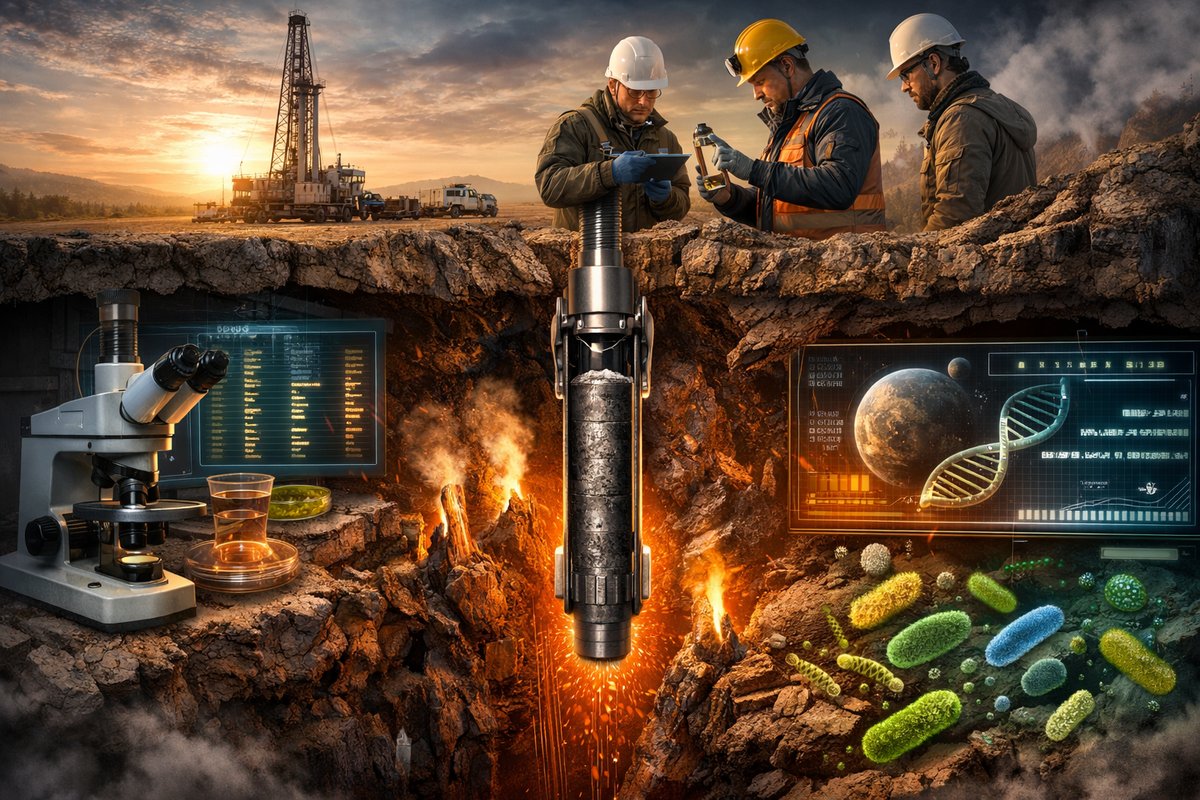
A recent deep drilling expedition has revealed thriving microbial communities far beneath Earth's surface, reshaping our understanding of the planet's hidden biosphere. Cutting-edge sampling techniques and genomic analysis are uncovering how life endures under extreme heat and pressure-and what that might mean for searching for life on other worlds.
In a remote desert basin, a team of geobiologists and engineers has completed what may be one of the most ambitious drilling projects ever undertaken to explore Earth’s deep subsurface biosphere. Pushing drills hundreds of meters below the arid landscape, researchers have retrieved rock cores, fracture fluids, and sediment layers teeming with previously unknown microorganisms. These findings challenge long-held assumptions about the limits of life, offer fresh clues to Earth’s biogeochemical cycles, and sharpen the tools we’ll need in the hunt for life beyond our planet.
The drilling site, chosen for its stable geology and minimal contamination risk, lies in a basin where sedimentary rock layers preserve a record of ancient climates. Beneath sun-baked alluvial deposits, steel casing gave way to fractured sandstone and igneous intrusions. It was here, at depths ranging from 200 to 500 meters, that scientists detected low-diversity microbial communities-populations that thrive in darkness, under high pressure, and with scant nutrients.
Collecting pristine samples from such depths posed daunting technical challenges. Traditional drilling fluids can introduce surface microbes or chemical contaminants that obscure true subsurface biota. To avoid this, the team used a sterilized drilling system that circulates filtered, DNA-free water to cool the bit and carry cuttings to the surface. Each core segment was immediately sealed in nitrogen-flushed chambers to prevent exposure to oxygen.
Once in the on-site laboratory, cores were processed within a mobile clean room. Rock interiors were fractured open under UV-sterilized hoods, and fluid inclusions were extracted through microcapillary tubes. These samples underwent cell counts using fluorescent stains that differentiate live cells from detrital particles. Early microscopy revealed filamentous microorganisms clustering around mineral grains, hinting at metabolic strategies that exploit rock-encased nutrients.
But the real breakthrough came with high-throughput DNA sequencing. By targeting ribosomal RNA genes, the team reconstructed phylogenetic trees populated with novel bacterial and archaeal lineages. Many of these microbes belong to phyla rarely seen in surface environments-organisms adapted to metabolize carbon dioxide, hydrogen gas, and iron. Genomic analysis suggests pathways for chemosynthesis, where energy is harvested from chemical reactions rather than sunlight.
Understanding these metabolisms helps explain how subsurface microbes contribute to global biogeochemical cycles. Deep communities can fix carbon over geological timescales, influencing the carbon budget long after surface ecosystems have changed. They also transform sulfur and nitrogen compounds, potentially affecting groundwater quality in ways that intersect with human water use.
These insights have concrete implications for industry and environmental management. For example, engineered subsurface injections for carbon sequestration must account for microbial activity that could consume stored CO2 or convert it to methane. Likewise, geothermal energy projects tapping deep aquifers may alter microbial habitats, with unforeseen consequences for heat transfer and fluid chemistry.
Beyond Earth, the study reinvigorates astrobiological exploration. Bodies like Mars and Jupiter’s moon Europa may harbor subsurface water-rock interfaces where chemosynthetic life could exist. Drill missions that sample below icy shells or sediment layers will need the same contamination controls and molecular tools refined in this expedition. By demonstrating that life thrives under extreme heat-temperatures nearing 80 degrees Celsius at the deepest sampling points-researchers are refining the thermal limits they’ll search for on other worlds.
Yet many questions remain. What is the true extent of metabolic diversity in the deep biosphere? How do microbial communities interact across mineral surfaces and fractures to form stable ecosystems? And how rapidly can these deep populations respond to changes in fluid flow or temperature imposed by natural or human activities?
To answer these, scientists are planning follow-up studies that combine laboratory incubations with in situ monitoring. By deploying downhole sensors to measure pressure, temperature, pH, and dissolved gases in real time, they hope to capture dynamic shifts in microbial activity. Parallel experiments will expose cores to isotopically labeled substrates, tracing how different groups incorporate carbon or nitrogen under controlled conditions.
In the broader scientific community, these discoveries are fueling interdisciplinary dialogues. Geologists are rethinking models of porosity and permeability, now seen as life-supporting habitats rather than mere fluid conduits. Chemists are exploring mineral-minimizing reactions that generate energy in the absence of sunlight. And modelers are integrating subsurface processes into Earth system simulations, bridging deep time to the modern carbon cycle.
Public fascination with life’s resilience underlies much of the excitement. Outreach programs have brought virtual reality tours of the drilling platform to high schools and museums, letting students “descend” into boreholes and visualize microbial colonies clinging to rock pores. Online platforms host interactive maps showing sampling depths, fluid compositions, and genomic “heat maps” of microbial abundance.
The achievements of this expedition also underscore the importance of collaboration-among universities, national laboratories, and private sector engineers. Funding from both public grants and philanthropic foundations supported the development of sterile drilling technologies and rapid DNA analysis tools. In return, commercial partners gain insights into subsurface processes that can improve resource management and environmental stewardship.
Looking ahead, the research community is mobilizing for an even more ambitious goal: exploring the oceanic subsurface beneath mid-ocean ridges. Hydrothermal vents along these submerged mountain ranges may host ecosystems driven by heat and chemical fluxes far more intense than those in continental settings. Underwater drilling rigs and remotely operated vehicles will extend the lessons learned on land into the high-pressure, corrosive environment of the deep sea.
As humanity probes ever deeper-into bedrock, permafrost, and under ice-covered seas-it will discover new forms of life and novel biochemistries. Each revelation will reshape our understanding of Earth as a living planet, interconnected from surface forests to hidden rock-formations miles below. And each new technique-whether a sterile downhole sampler or a portable DNA sequencer-becomes a key instrument in science’s growing toolkit.
In the end, the deep biosphere reminds us of life’s tenacity and diversity. Even without sunlight, creatures find ways to harness the energy locked within minerals and gases. For a species that once believed life depended exclusively on the warmth of the sun, the discovery of subsurface communities expands our sense of possibility-for Earth, for other planets, and for the future of exploration itself.