Location
Mount Vernon, WA 98274

Location
Mount Vernon, WA 98274

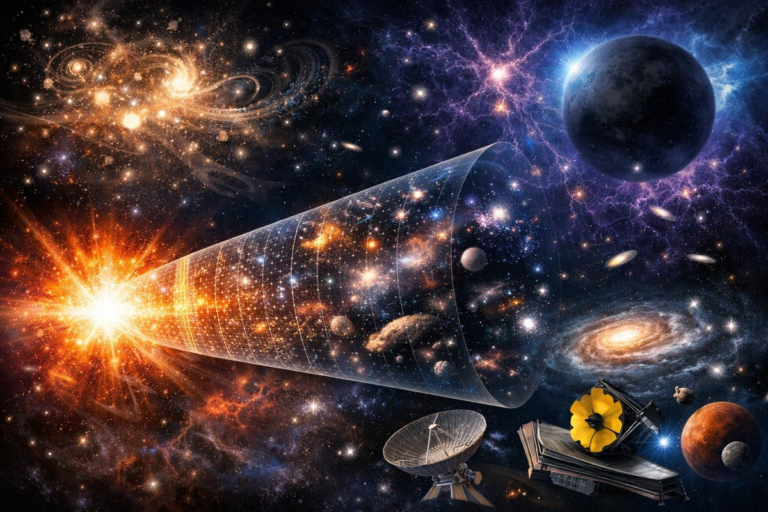
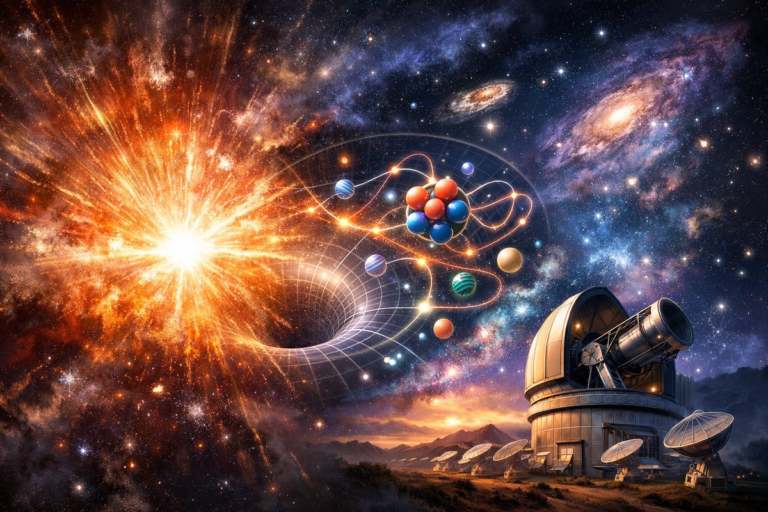
A convergence of breakthroughs-from refined polarization maps of the cosmic microwave background to underground neutrino detectors and quantum simulators-has begun to peel back the veil on the universe's origin. Researchers are piecing together signals from gravity waves, subatomic relics, and simulated quantum fields to reconstruct the first instants after cosmic birth.
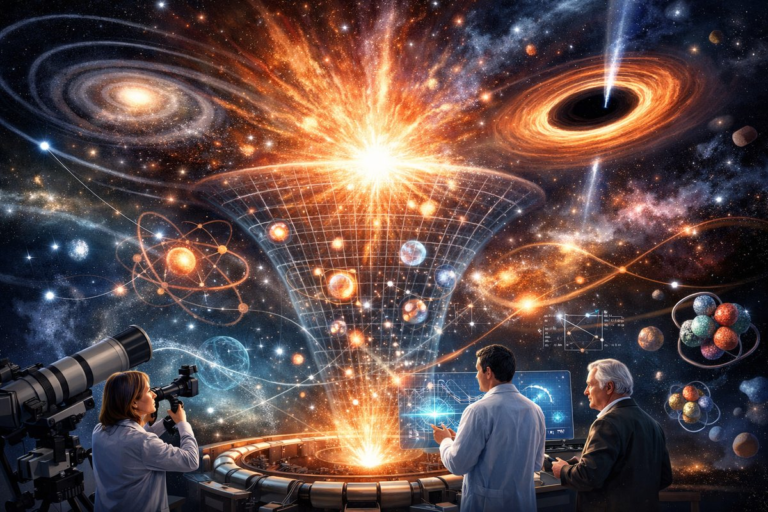
Scientists are standing at a pivotal moment in understanding the universe’s earliest heartbeat. Over the past year, collaborative efforts across cosmology, particle physics, and quantum information science have sharpened our view of what transpired in the first trillionths of a second after the Big Bang. Key data streams now converge from sky surveys that map faint ripples in the cosmic microwave background, subterranean detectors that catch fleeting neutrino interactions, and laboratory quantum simulators that recreate exotic states of matter once thought exclusive to the infant cosmos.
At the summit of these achievements are the latest B-mode polarization measurements of the cosmic microwave background (CMB). Ground-based telescopes located in the high deserts have deployed advanced detector arrays cooled to near absolute zero, delivering the most precise mapping yet of minute twisting patterns in relic photons. These patterns arise when primordial gravitational waves-hypothesized to have been generated by a rapid inflationary expansion-imprint a subtle swirled signature on the CMB’s polarization. Early results show hints of these B-mode patterns emerging above the level expected from galactic dust, though teams remain cautious. Should these signals hold up under cross-checking by complementary observatories, they could offer direct evidence of cosmic inflation and pin down its energy scale with unprecedented precision.
Meanwhile, the global network of gravitational wave observatories has extended its listening range, probing not only black hole and neutron star mergers but also searching for a stochastic background of primordial gravity waves. Upgrades in sensitivity-driven by deeper vacuum chambers, squeezed light injection, and improved mirror coatings-have reduced noise floors, enabling investigators to set new upper limits on gravity wave amplitudes at frequencies that correspond directly to processes in the first microseconds of cosmic time. Though a definitive detection remains elusive, these constraints already inform models of the universe’s expansion history and guide theoretical refinements of inflationary scenarios.
Neutrino physics has stepped into the limelight as well. Massive underground detectors designed to capture neutrino oscillations are now homing in on relic neutrinos from the early universe. Through the use of ultra-low-background instrumentation and enriched detection media, experiments have tightened bounds on the cosmic neutrino background’s temperature and density. These results carry profound ramifications for understanding how neutrino masses influenced the formation of large-scale structures and for determining whether unknown particle species contributed extra radiation in the primordial soup.
While observatories look outward, tabletop quantum experiments are replicating conditions that prevailed shortly after cosmic birth. Cold-atom arrays, photon-based quantum simulators, and superconducting circuits have begun emulating phase transitions expected in the early universe-such as the breaking of grand unified symmetries and the formation of topological defects. By adjusting control parameters, researchers simulate rapid quenches analogous to cosmic cooling and observe emergent vortex lines or domain walls, drawing parallels to hypothetical cosmic strings and magnetic monopoles. Insights gleaned from these analog models provide valuable constraints on when and how the fundamental forces may have separated from a unified state.
Theoretical physics continues to grapple with paradoxes at the heart of cosmic origins. The horizon problem-why distant regions of the CMB exhibit nearly identical temperatures despite seemingly never being in causal contact-drives inflationary proposals but raises new questions about pre-inflationary initial conditions. The flatness problem, which asks why the universe’s geometry appears so finely balanced between open and closed states, also leans on inflationary models for answers. Yet the idea of eternal inflation spawns its own perplexing multiverse implications, with universes branching off endlessly in a vast cosmic landscape. Some researchers are exploring alternatives, such as bouncing cosmologies or quantum gravity-inspired scenarios in which a contracting phase precedes the bounce that sparked expansion.
Another deep puzzle lies in the reconciliation of general relativity and quantum mechanics. The singularity at the Big Bang represents a point where curvature becomes infinite and the known laws of physics cease to apply. Many theoretical efforts now aim to formulate a quantum theory of gravity that resolves this singularity and delivers a finite description of the universe’s birth. Approaches range from loop quantum gravity, which quantizes spacetime itself and predicts a “quantum bounce,” to string theory frameworks that propose extra dimensions and brane collisions as the catalyst for cosmic initiation. Each framework carries testable predictions, whether in the form of distinct gravitational wave spectra or particular patterns in high-energy cosmic ray distributions.
Observers are also searching for signals of dark matter produced during the earliest moments. Weakly interacting massive particles, axionlike fields, or even more exotic entities might have frozen out of equilibrium as the universe cooled, leaving relic abundances detectable today. New direct-detection experiments featuring liquid noble gases and crystal detectors are pushing sensitivity into parameter regions predicted by leading theories. Above ground, space-based telescopes scan for indirect signatures, such as gamma rays or antiparticle excesses, that might arise from ongoing dark matter interactions.
Looking ahead, the scientific community anticipates several next-generation instruments that could revolutionize our grasp of cosmic origins. The Simons Observatory and CMB-Stage 4 project will deploy hundreds of thousands of superconducting detectors to map polarization across multiple frequency bands with unrivaled clarity. The Square Kilometre Array will survey neutral hydrogen across cosmic time, charting the so-called dark ages before the first stars ignited. Third-generation gravitational wave facilities, potentially sited underground or in space, aim to access lower frequency bands, targeting signals from inflationary epochs. Planned neutrino detectors reaching megaton scales will sharpen our view of the cosmic neutrino background and probe proton decay, potentially bridging particle physics and cosmology.
Bridging these observational strides is the growing integration of computational power and artificial intelligence. Machine-learning algorithms assist in cleaning foreground contamination from CMB maps, while advanced simulations trace the non-linear growth of structure from quantum seeds to galaxies. Quantum computers themselves, though nascent, promise the ability to model quantum field dynamics at energy and length scales unreachable by classical supercomputers.
The convergence of diverse methods-optical, radio, gravitational, particle, and quantum-has ushered in a new era where cross-disciplinary collaboration becomes essential. No single experiment can unravel the complex tapestry of cosmic genesis. Instead, the interplay of data from the tiniest subatomic fluctuations to the largest cosmic structures will chart a coherent narrative of creation.
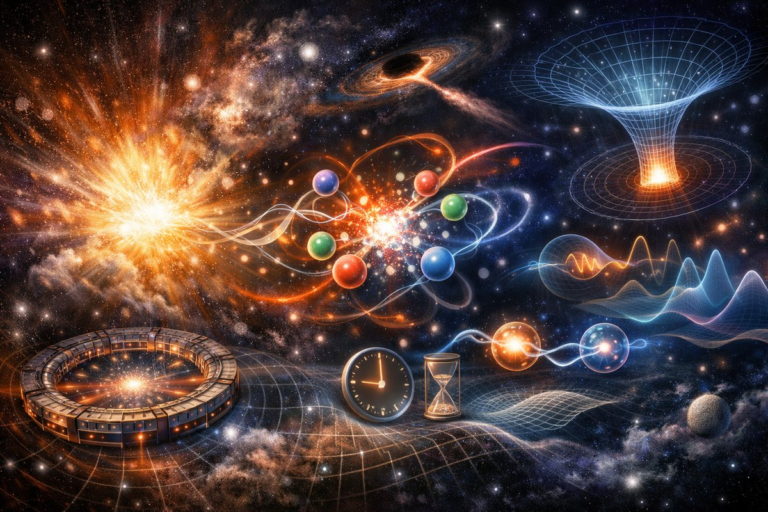
As this narrative unfolds, the universe’s first breath seems less like an inscrutable flash and more like a symphony of interwoven signals: the echo of inflation in CMB polarization, the faint tremor of gravity waves through space-time, the whisper of neutrinos that once threaded through the early plasma, and the quantum transitions reproduced at human scales in cutting-edge laboratories. With each new measurement, the moment of cosmic birth comes into sharper relief, transforming the unknown frontier into a map we can explore and understand. And yet, just as the horizon of knowledge expands, fresh paradoxes and mysteries appear, ensuring that the journey to the beginning remains an endless invitation to wonder and discovery.