Location
Mount Vernon, WA 98274

Location
Mount Vernon, WA 98274
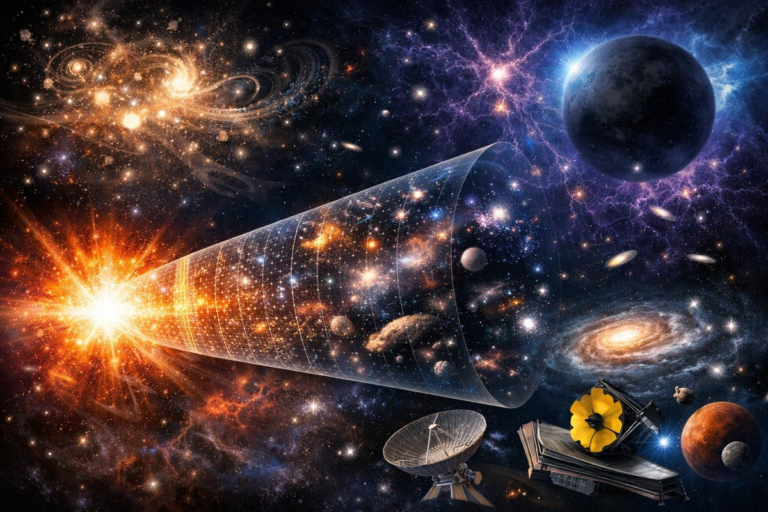
Groundbreaking observations of ancient light have revealed subtle anomalies that could reshape our understanding of cosmic inflation and what preceded the Big Bang. As scientists combine data from cutting-edge telescopes and experiments, they're piecing together an origin story more mysterious-and more compelling-than ever imagined.
The cosmos has always been a grand puzzle, but recent measurements of the cosmic microwave background (CMB) have uncovered a whisper of structure that wasn’t predicted by standard inflation theory. Over the past year, teams operating telescopes in the high deserts of Chile and the polar plateaus of Antarctica have cataloged faint twists in the CMB’s polarization patterns. These twists, known as B-mode distortions, may carry the signature of primordial gravitational waves-the ripples in spacetime created a fraction of a second after the universe burst into existence. If confirmed, these subtle fingerprints provide a direct portal into the inflationary era and suggest that the energy scales involved were far more extreme than previous models allowed.
To appreciate the significance of this discovery, it helps to revisit the CMB itself. Discovered in the 1960s, this sea of microwave radiation is the afterglow of the Big Bang, now cooled to just 2.7 kelvin above absolute zero. In the 1980s, the inflation proposal swept aside simpler expansion theories by suggesting that an exponential growth spurt smoothed out any primordial wrinkles. But until now, direct evidence for the quantum fluctuations that inflation inflated into full-blown galaxies has remained elusive. What researchers are seeing today is the faint imprint of those fluctuations, magnified by the explosive growth that occurred within the first trillionths of a second.
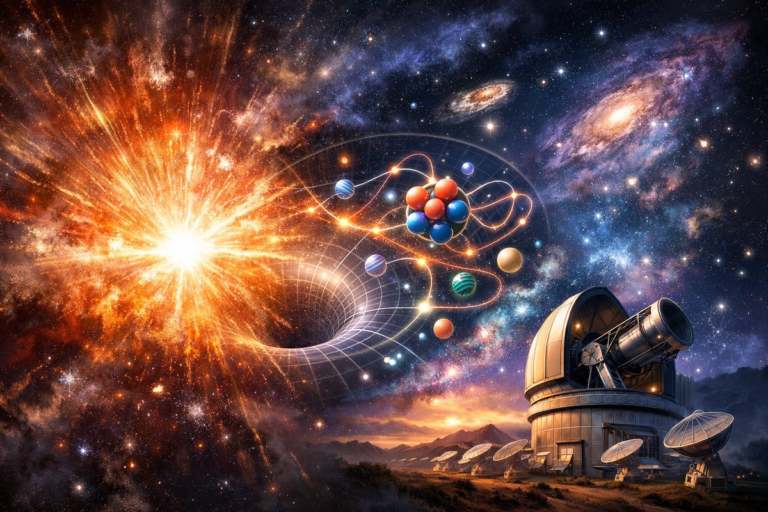
The multi-observatory effort behind these measurements has been extraordinary in scope. Ground-based instruments like the Atacama Cosmology Telescope and the South Pole Telescope have mapped vast swaths of the southern sky with unprecedented sensitivity to polarization. Meanwhile, archival data from a European space observatory provided a broad baseline against which the ground-based teams calibrated their readings. By cross-referencing maps and applying new statistical techniques, analysts have peeled back foreground noise-dust and galactic emissions-to isolate the cosmological signal. Preliminary results hint at a slight excess in B-mode power at angular scales of around one degree, a feature that could be the smoking gun of early-universe gravitational waves.
Still, these findings raise more questions than they answer. The observed signal appears stronger than what vanilla models of inflation predict, pointing to novel physics or fields that drove the universe’s rapid growth. Some theorists propose that multiple scalar fields may have cooperated during inflation, weaving a more intricate tapestry of quantum fluctuations. Others suggest that new symmetries-once thought to manifest only at the highest particle accelerators-played a role. The idea of a multiverse, born from eternal inflation, has regained traction as a way to explain why our corner of the cosmos exhibits the properties we observe. In this deep-time detective story, every clue about the energy levels and field interactions carries enormous weight.
Beyond the math and the data lies a profound paradox: if inflation can be probed in this way, are we glimpsing the edge of science’s reach or merely encountering its next frontier? To probe earlier epochs would require detectors tuned to even fainter distortions, and possibly entirely new messengers-primordial neutrinos or axionic fields. Plans are already in motion for next-generation experiments, marrying superconducting sensor arrays with ultra-cold cryogenics and lunar-surface observatories that exploit the radio-quiet farside of the Moon. These ambitious projects aim not only to refine the current measurements but to extend the view deeper, toward that uncharted pre-inflationary era.
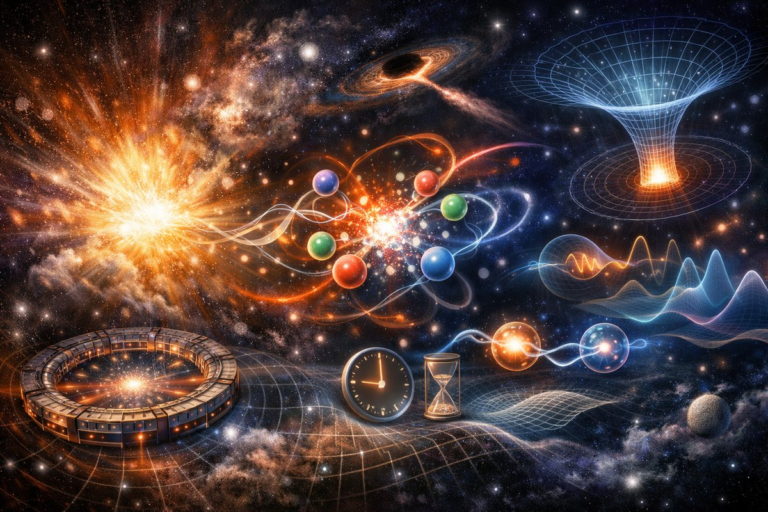
While experimentalists push hardware to its limits, theoretical physicists are racing to craft narratives that accommodate the latest anomalies. Some modelers have turned to quantum gravity frameworks, which seek to unify general relativity and quantum mechanics. Loop quantum gravity offers a picture in which spacetime is granular, and inflation emerges from a bounce rather than a singularity. String theory proponents counter with scenarios involving extra dimensions that influence cosmic expansion at the smallest scales. In both camps, the emerging data are invaluable, serving as beacons that guide abstract equations toward physical reality.
For amateur astronomers and curious citizens, the unfolding story of cosmic origins brings new opportunities to engage. Public star-gazing nights now often feature live feeds from robotic telescopes tuned to deep-sky objects, accompanied by expert commentary on how galaxy clusters and cosmic voids trace back to those earliest quantum ripples. Online citizen-science platforms allow participants to classify subtle features in sky maps, helping research teams vet signals more quickly than ever before. Educational initiatives are also introducing interactive simulations of inflation dynamics, letting students tweak parameters and watch virtual universes bloom.
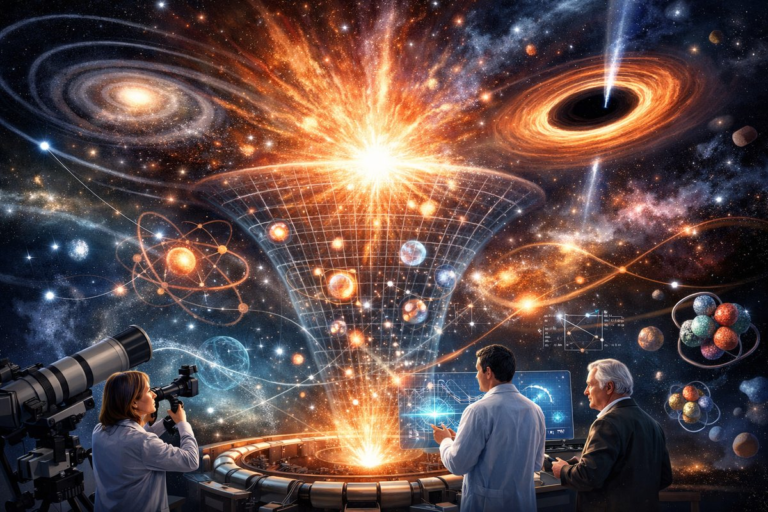
In the end, each discovery about the universe’s first moments rekindles a sense of wonder that stretches across cultures and generations. Whether we stand on a mountaintop with a pair of binoculars or at a control room surrounded by superconducting sensors, our gaze is fixed on the same ultimate horizon. The story of cosmic dawn is far from complete, but today’s anomalies light the way forward-beckoning us to imagine the forces, particles, and paradoxes yet to be revealed. As new telescopes come online and theories evolve, we are reminded that the universe is both our greatest archive and our most thrilling invitation to explore the unknown.