Location
Mount Vernon, WA 98274

Location
Mount Vernon, WA 98274
An international array of telescopes, particle detectors, and theoretical models is rewriting our understanding of the universe's first instants. From fresh anomalies in the cosmic microwave background to the hunt for primordial gravitational waves, researchers are confronting paradoxes that challenge long-held models and spark new questions about the dawn of time.
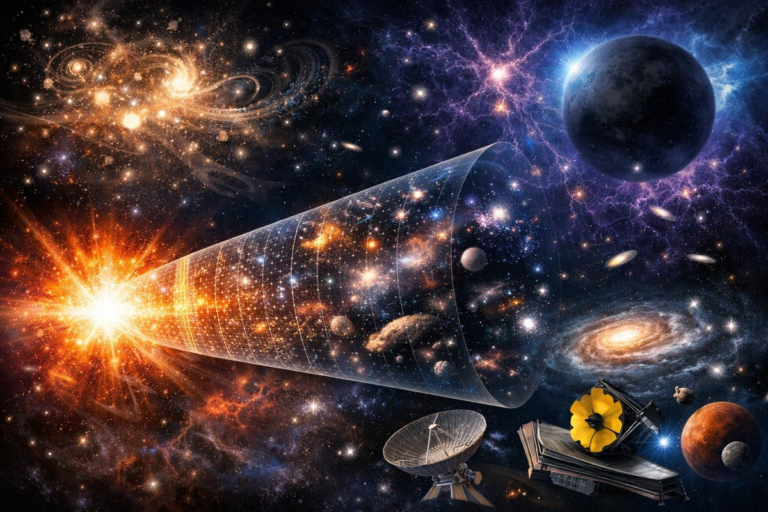
A global coalition of observatories and detectors has entered an unprecedented era of synergy in the quest to trace the universe back to its earliest fractions of a second. In the months since the latest deep-field campaign by a spaceborne infrared telescope, signals once buried beneath cosmic dust have begun to resolve. Meanwhile, ground-based gravitational-wave observatories are tuning their instruments for whispers from the inflationary era. Together, these projects are revealing puzzles that force a rethink of textbook cosmology even as they hint at physics beyond the standard model.
The most dramatic strides have come from the union of infrared and submillimeter surveys. When the spaceborne infrared eye scanned a patch of sky near the galactic poles, it recorded faint emissions dating to less than 200 million years after the Big Bang. Spectral lines attributed to primordial galaxies and nascent black holes emerged from archival data with surprising regularity. This challenges previous simulations, which predicted a sparser distribution of star-forming regions at that epoch. Computational cosmologists are now incorporating new feedback mechanisms into their models, attempting to reconcile the overabundance of heavy elements inferred from these early structures.
On a parallel track, gravitational-wave observatories in both hemispheres are calibrating for potential signals from cosmic inflation. Until recently, detections were limited to collisions of black holes and neutron stars in the local universe. But theoretical work suggests that the rapid expansion of space itself should have left a background of ultra-low-frequency ripples. Indirect hints of these primordial waves have surfaced in the polarization patterns of the cosmic microwave background as measured by balloon-borne and satellite experiments. Confirming them directly would provide the most definitive proof of inflation theory-but the signal is expected to be 10 orders of magnitude fainter than anything detected so far.
Meanwhile, the cosmic microwave background (CMB) remains a fertile ground for surprises. The latest full-sky map, released by a collaboration that combined data from multiple platforms, reveals an unexpected hemispherical difference in temperature fluctuations. The irregularity persists even after accounting for foreground emissions and instrumental noise. Some researchers argue that this “dipole asymmetry” could be a statistical fluke, but others suggest it may point to exotic physics, such as a pre-inflationary remnant or a partner universe that influenced the early cosmos through quantum entanglement.
Neutrino observatories buried deep in polar ice are also reporting tantalizing results. IceCube, the kilometer-scale array of sensors designed to capture high-energy neutrinos, has detected events with energies that exceed predictions from known cosmic accelerators. If a fraction of these neutrinos originated during the first seconds after the Big Bang, they would offer a direct probe of conditions when temperatures reached trillions of degrees. To confirm this, theorists are refining estimates of the neutrino background and its interactions with dark matter candidates. The synergy between neutrino physics and cosmology may soon yield constraints on the number of light particles that populated the primordial plasma.
Yet one of the most stubborn puzzles remains the so-called Hubble tension. Measurements of the current expansion rate of the universe based on nearby supernovae differ by eight percent from values inferred from the CMB. This gap has held steady even as each side hones its methodology. Some scientists propose that an additional form of energy, dubbed “early dark energy,” briefly accelerated expansion before decaying. Others look to modifications of gravity at large scales, or undiscovered neutrino properties. If resolved, the tension could require rewriting major chapters in cosmic history.
In underground laboratories shielded by rock and water, experiments are closing in on dark matter candidates. The latest generation of xenon-based detectors has pushed sensitivity to interaction cross-sections previously believed unreachable. Although no definitive dark matter signal has emerged, null results are already ruling out large swaths of parameter space for weakly interacting massive particles (WIMPs). At the same time, axion search experiments using resonant cavities and strong magnetic fields have set new limits that constrain hypothetical particle masses. The race to detect or eliminate leading candidates is tightening, with next-generation detectors expected to come online within the next two years.
On the theoretical front, string theory and loop quantum gravity continue to offer frameworks for a quantum theory of spacetime. Recent work on “holographic cosmology” proposes that the entire early universe could be described by information encoded on a lower-dimensional boundary. If correct, this would reshape our understanding of locality and causality at the Planck scale. While the mathematical structures are elegant, connecting them to observable signatures remains a challenge. Researchers are investigating whether subtle imprints of holographic behavior might appear in high-precision CMB data or in correlations between neutrinos and gravitational-wave backgrounds.
An undercurrent running through many of these efforts is the growing role of artificial intelligence. Machine-learning algorithms are being trained to sift through petabytes of survey data, isolating rare events that human analysts might miss. In one pilot project, a neural network identified candidate primordial galaxies by recognizing morphological patterns in noisy infrared images. Elsewhere, genetic-programming techniques are exploring vast spaces of theoretical models, seeking sets of parameters that best fit the full suite of observations. While AI accelerates discovery, it also raises questions about interpretability and bias in scientific inference.
Looking ahead, several flagship missions and experiments promise to deepen the cosmic origin story. A network of ground-based telescopes will begin a decade-long survey of the southern sky, mapping the distribution of galaxies to trace the imprint of primordial ripples in the matter density. A space mission designed to detect the polarization of the CMB at longer wavelengths is slated for launch within five years. Large underground facilities are preparing to house even larger dark matter detectors and neutrino observatories. Each advance brings the potential to resolve longstanding paradoxes-or to uncover new ones.
These coordinated efforts underscore a broader transformation in cosmic origin research. Rather than relying on isolated instruments or single observations, scientists are weaving together data streams from photons, neutrinos, and gravitational waves. The interdisciplinary fusion of observational astronomy, particle physics, and theoretical cosmology is creating a more integrated picture of the first moments of existence. But as the map grows in resolution, rare anomalies and conflicting signals multiply.
For curious readers and those new to the field, these developments highlight both the power and the uncertainty that drive science forward. The universe’s origin story is not a fixed narrative but a dynamic tapestry woven from experiments and equations. Each unexpected result pushes the frontier, inviting fresh ideas and collaborations. While the search for definitive proof of inflation or dark matter particles continues, the very act of probing the uncharted territory of the early cosmos is reshaping fundamental concepts of space, time, and matter.
In the end, the journey to the beginning may offer more mysteries than answers. But it is in the tension between expectation and observation that breakthroughs emerge. As observatories, detectors, and theorists converge on the cosmic dawn, they are not only illuminating the past-they are expanding the realm of what we can imagine about the universe’s future and our place within it.