Location
Mount Vernon, WA 98274

Location
Mount Vernon, WA 98274
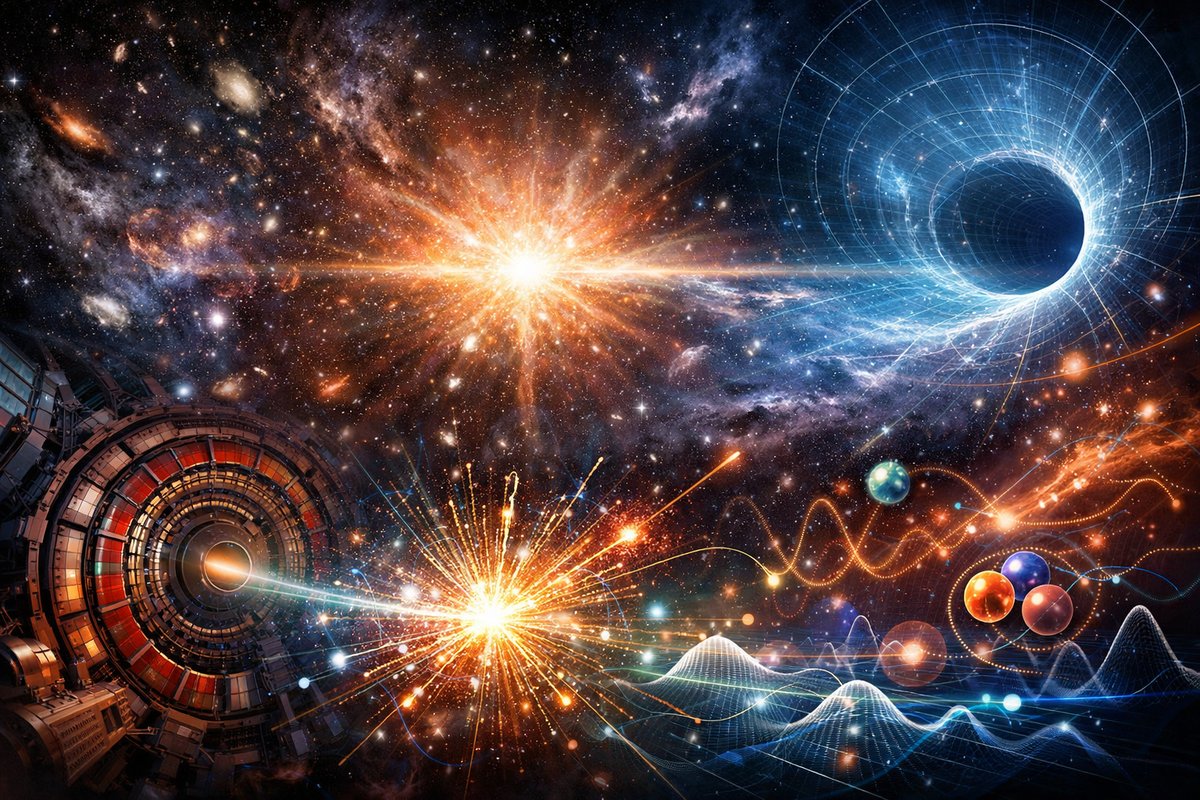
Scientists are turning deep-field images and particle detectors toward questions that date back to the first fractions of a second after the universe began. This exploration probes forces, paradoxes, and hidden realms that shaped everything we experience-and points the way to mysteries yet unsolved.
The night sky has long been a canvas for human wonder, but recent deep-field observations from powerful space telescopes have offered an unprecedented glimpse into the universe’s earliest chapters. When these new images revealed faint galaxies forming just a few hundred million years after the beginning, they sent ripples through the scientific community. Suddenly, concepts that once belonged to abstract theory are coming into view as tangible targets for exploration. As researchers refine measurements of the first light to cross intergalactic distances, we edge closer to understanding the forces and particles that set the cosmic stage.
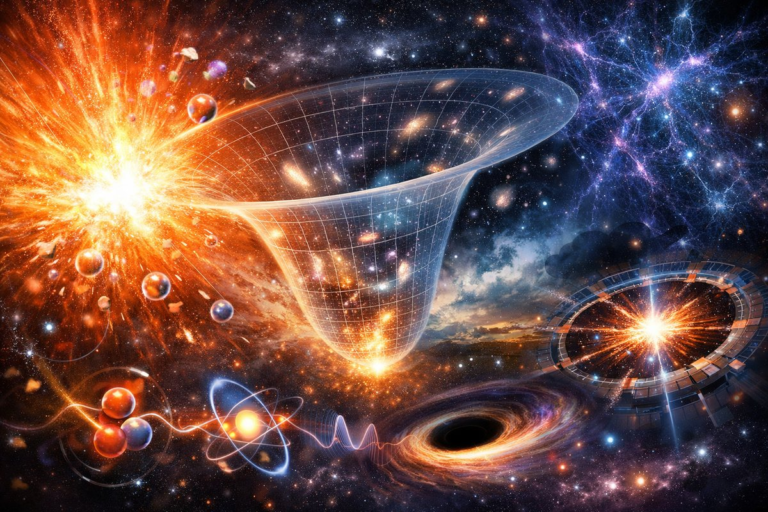
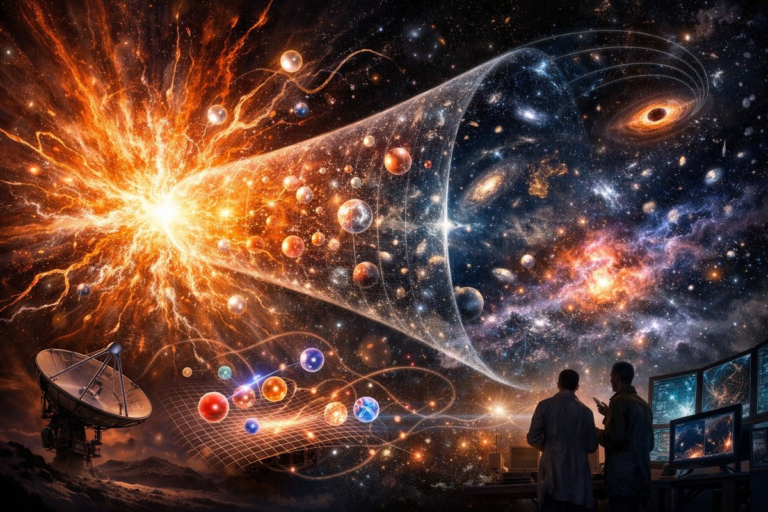
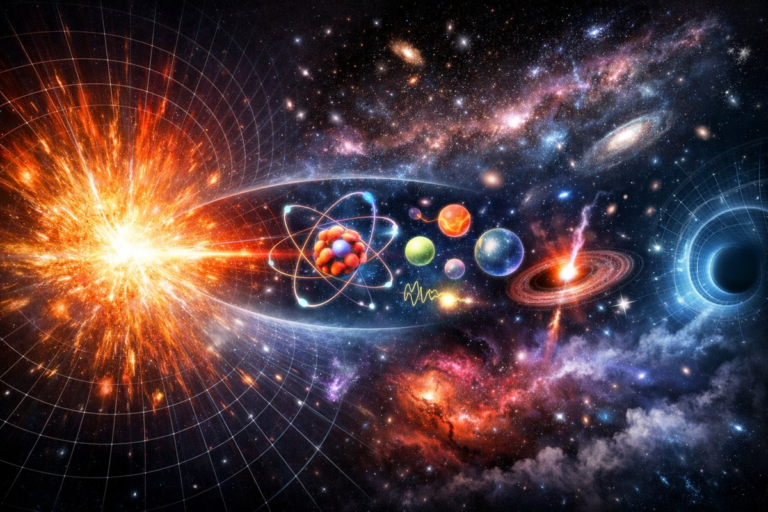
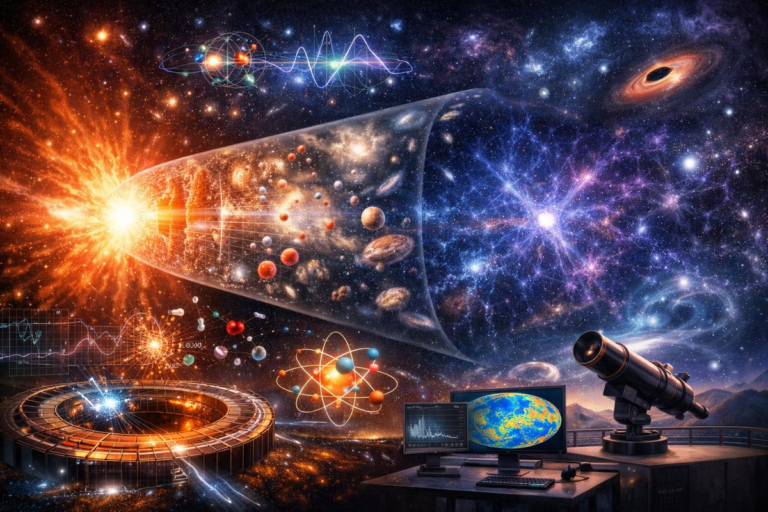
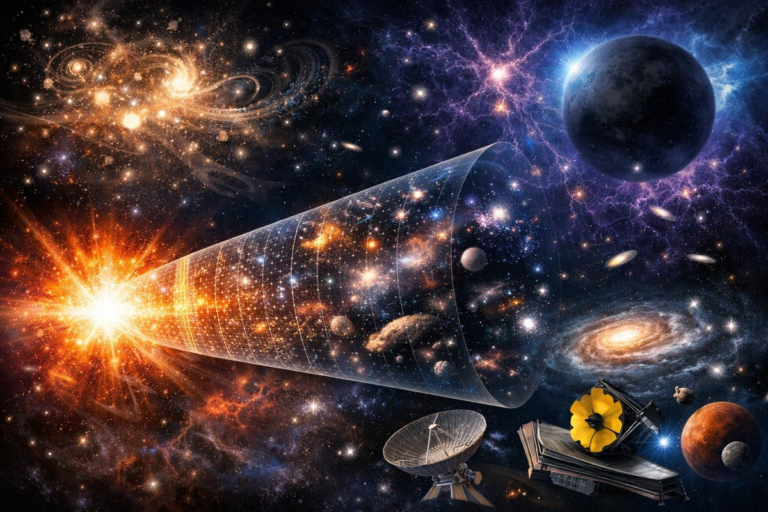
At the heart of the quest lies the Big Bang, a singular event that marks the known beginning of space, time, and energy. In the instants that followed, the universe underwent a blistering expansion known as cosmic inflation. During inflation, microscopic fluctuations were stretched to astronomical scales, seeding regions of higher and lower density that would later collapse into galaxies, stars, and planets. That dramatic burst of growth remains one of the most powerful phenomena in physics, yet its underlying driver is still a matter of intense study. By analyzing the faint glow left over from those early moments, modern instruments aim to reveal the fingerprints of inflation and test competing theories about the mechanism behind it.
Four fundamental forces govern the cosmic drama. Gravity shapes the large-scale structure of the cosmos, drawing matter into clusters that span millions of light-years. Electromagnetism binds electrons to nuclei, forging the chemistry that makes life possible. The strong nuclear force holds protons and neutrons together in atomic cores, while the weak force governs radioactive decay and fusion processes in stars. Physicists seek a unified description that weaves these forces into a single framework, and each new experimental result offers a clue. Advances in particle accelerators and underground laboratories continue to push sensitivity toward energies and interactions that could reveal cracks in the current model.
Beneath the surface of matter lies a zoo of elementary particles. Quarks, leptons, bosons and other entities flicker into and out of existence according to quantum rules. The discovery of the Higgs field gave mass to certain particles, yet questions remain about the nature of neutrinos-ghostly, nearly massless particles that pass through the Earth unimpeded. Recent measurements suggest neutrinos might hold the key to why our universe is filled with matter rather than antimatter, a profound asymmetry that allowed galaxies and stars to form instead of mutual annihilation. As detectors deep underground and in Antarctic ice capture fleeting neutrino interactions, scientists inch closer to an answer.
One of the richest archives of cosmic history is the cosmic microwave background, a nearly uniform glow of microwaves that permeates the sky. Discovered in the mid-20th century, this ancient radiation provides a snapshot of the universe when it was just 380,000 years old-old enough for matter and radiation to decouple and allow photons to travel freely. Tiny temperature irregularities in this afterglow map reveal the seeds of future structure. By measuring these fluctuations at finer scales, researchers refine estimates of the universe’s composition, expansion rate, and geometry. The cosmic microwave background remains a cornerstone of cosmology, guiding theoretical models and anchoring the timeline of cosmic history.
Yet 95 percent of the universe’s content remains hidden from direct view. Dark matter, an invisible mass that exerts gravity without emitting light, appears crucial for the formation of galaxies and clusters. Dark energy, a mysterious force driving the accelerating expansion of space, dominates the universe’s fate. Efforts to detect dark matter particles in shielded underground labs and to map dark energy’s influence through galaxy surveys are in full swing. Each non-detection narrows the field of possibilities, while tentative signals hint at new physics beyond the familiar particles cataloged by the Standard Model.
Around the birth of the universe lies a profound paradox: the horizon problem. Distant regions of the cosmos appear in thermal equilibrium despite being too far apart ever to have exchanged information at the speed of light. Cosmic inflation elegantly resolves this puzzle by positing that those regions were once much closer together before being flung apart. Similarly vexing is the singularity at time zero, where densities and temperatures reach infinity and the laws of physics break down. Quantum gravity theories, including string-inspired ideas and loop quantum cosmology, attempt to describe that boundary moment without infinities. Experimentally probing such extremes may demand new approaches in gravitational wave astronomy or hypothetical detectors sensitive to Planck-scale phenomena.
Quantum fluctuations during inflation also invite speculation about a multiverse-an ensemble of universes in which physical constants and laws might vary. While direct evidence for such realms is elusive, the possibility challenges our notions of uniqueness and cosmic destiny. Philosophers and physicists debate whether a multiverse is a scientific hypothesis or a metaphysical leap. Regardless, this idea has reshaped the language of cosmology, encouraging researchers to think beyond the observable patch and consider how the totality of existence might be structured.
In recent years, gravitational wave observatories have opened a new window onto the cosmos. By detecting ripples in spacetime generated by cataclysmic events such as black hole mergers, these instruments confirm predictions from general relativity and offer insights into objects born in the universe’s first billion years. Planned upgrades and new detectors will expand sensitivity to lower frequencies, potentially capturing signatures from inflation itself. Each confirmed gravitational wave signal enriches our understanding of extreme astrophysical processes and brings us closer to a complete history of the cosmos.
Neutrino observatories stationed deep within ice or water have similarly advanced our knowledge. These massive detectors register the faint flash of light produced when neutrinos interact with atomic nuclei. By correlating neutrino bursts with electromagnetic and gravitational wave signals, scientists are establishing the era of multi-messenger astronomy. This holistic approach enables the study of cosmic events across different carriers of information, revealing a more nuanced portrait of processes that shaped the early universe-from the first stars to the colossal black holes that anchor galaxies.
Beyond technical achievements, exploring the universe’s origin resonates on a human level. It inspires a sense of humility and connection, reminding us that every atom in our bodies was forged in stellar furnaces or formed in the primordial fireball. The narrative of cosmic evolution offers perspective on our place in space and time, while the drive to answer “why did anything emerge at all?” speaks to the deepest corners of curiosity and existential thought. Public engagement with these questions fuels support for research and encourages young minds to pursue careers in science and engineering.
Looking ahead, the next generation of observatories promises to revolutionize cosmology. Proposed missions to map the distribution of galaxies across cosmic time will chart how structure emerged under the influence of dark matter and dark energy. Advanced particle detectors may finally isolate dark matter candidates or reveal unexpected forces. Innovative concepts for space-based interferometers could directly probe gravitational waves from the inflation era. Together, these efforts form a coordinated campaign to peel back successive layers of cosmic history, approaching the moment when time itself began.
Our journey to the beginning is far from over. Each new data point sketches a broader outline of the universe’s story, but the richest details await discovery. As researchers refine theories and build ever more sensitive instruments, the frontier of knowledge expands. The mysteries of dark matter, the nature of singularity, and the true architecture of reality await their turn under the spotlight. In pursuing these questions, we not only illuminate the past-we also shape the future of how humanity perceives its place in the grand tapestry of existence.