Location
Mount Vernon, WA 98274

Location
Mount Vernon, WA 98274
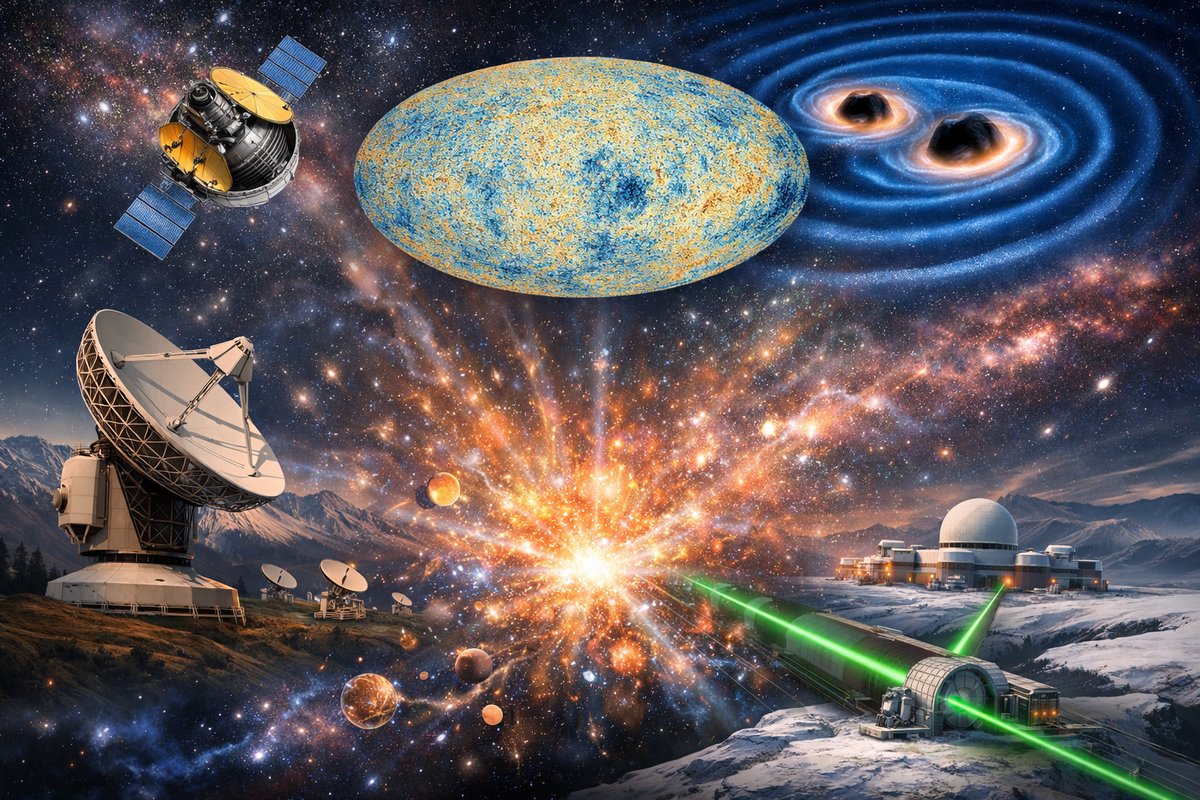
Fresh observations from advanced microwave and gravitational-wave observatories are offering unprecedented insight into how space, time and matter emerged from the cosmic void. Cutting-edge instruments and international collaborations are now converging to illuminate the forces and paradoxes that governed the universe's birth.
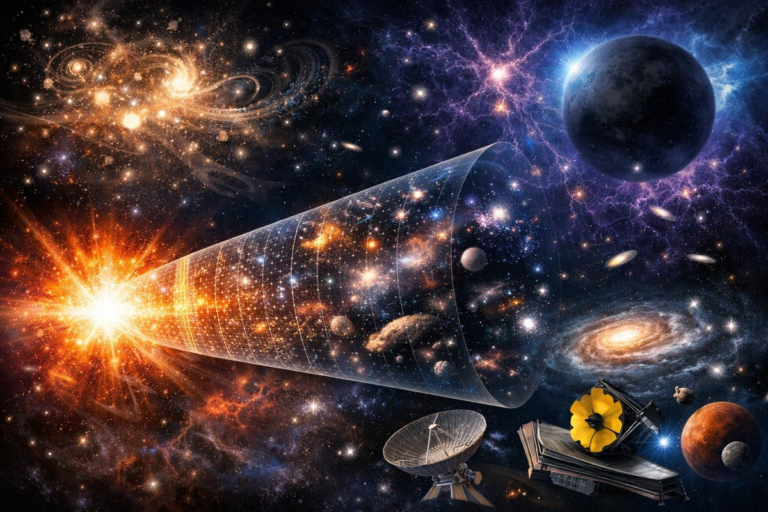
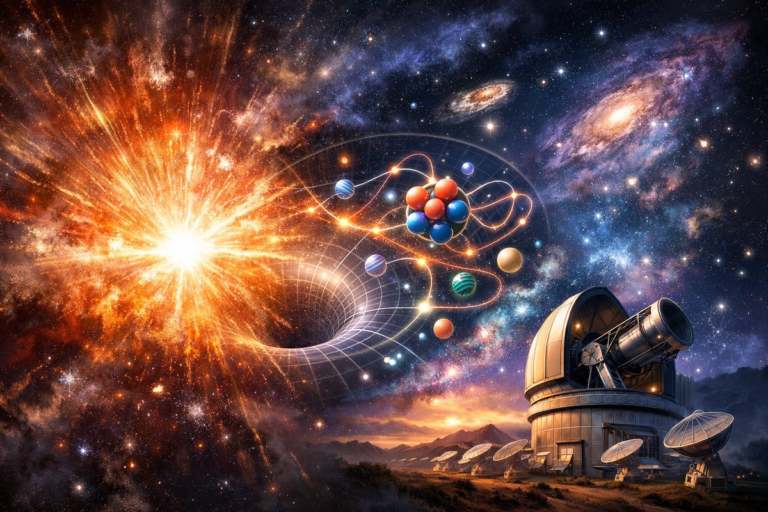
In a flurry of recent announcements, physicists and astronomers have unveiled data that push the boundaries of our knowledge about the universe’s infancy. A new terrestrial microwave observatory has mapped subtle fluctuations in the ancient radiation field with record precision, while a global network of gravitational-wave detectors has placed tighter limits on primordial ripples from the cosmos’s explosive birth. Together, these breakthroughs are revealing the interplay between quantum phenomena and cosmic-scale evolution.
Rather than working in isolation, teams operating at the South Pole and in subterranean tunnels are coordinating their findings. The microwave telescope array published a detailed power spectrum of temperature and polarization anisotropies, teasing out minuscule imprints left by sound waves that once roared through a hot primordial plasma. At the same time, upgraded laser interferometers in Europe, North America and Asia have refined searches for a stochastic gravitational-wave background sourced by high-energy processes during inflation.
Data from the interferometers have not yet confirmed a direct detection of primordial gravitational waves, but they have set the most stringent upper limits to date on their amplitude. This constrains models that predict violent phenomena such as phase transitions in the first fraction of a second after the big bang. By excluding certain parameter ranges, researchers can rule out exotic scenarios where hypothetical fields triggered bursts of gravitational radiation at ultra-high frequencies.
Meanwhile, tabletop quantum sensors-employing arrays of entangled atoms cooled to near absolute zero-have begun to probe vacuum fluctuations on length scales far smaller than a human hair. These devices detect shifts in atomic energy levels induced by passing gravitational disturbances or dark sector interactions. Early results hint at new physics, though researchers emphasize that more data and cross-validation with cosmic surveys are needed to draw firm conclusions.
High above Earth, a recently launched space infrared observatory has completed its first deep-field survey. Peering back to when the universe was only a few hundred million years old, the telescope spotted nascent galaxies forming amid tenuous clouds of hydrogen. Although these objects lie at the edge of detectability, their starlight has been redshifted into the mid-infrared, providing a complementary window on reionization and the first generation of massive stars.
These observations also inform the search for dark matter particles. If dark matter decayed or annihilated into ordinary radiation in the early universe, it would leave distinct signatures on the radiation background and on the formation history of proto-galaxies. By comparing the infrared survey with microwave maps, scientists can narrow the allowed properties of candidate particles, from weakly interacting massive particles to more exotic axion-like fields.
Another frontier involves the matter-antimatter asymmetry. Although theory predicts that the big bang created equal amounts of matter and antimatter, our current universe is overwhelmingly composed of matter. High-precision measurements of rare decays in particle accelerators are shedding light on tiny violations of charge-parity symmetry. When combined with cosmological constraints on primordial baryon density, these laboratory results are helping to explain why antimatter nearly vanished in the first microseconds of cosmic history.
Probing cosmic inflation remains a prime goal. Several models posit that a rapid exponential expansion smoothed out irregularities and generated the seeds of large-scale structure. The latest microwave maps have detected subtle non-Gaussian features in the anisotropy distribution, tentatively hinting at interactions beyond simple scalar field dynamics. If confirmed, such patterns could distinguish between single-field and multifield inflationary scenarios.
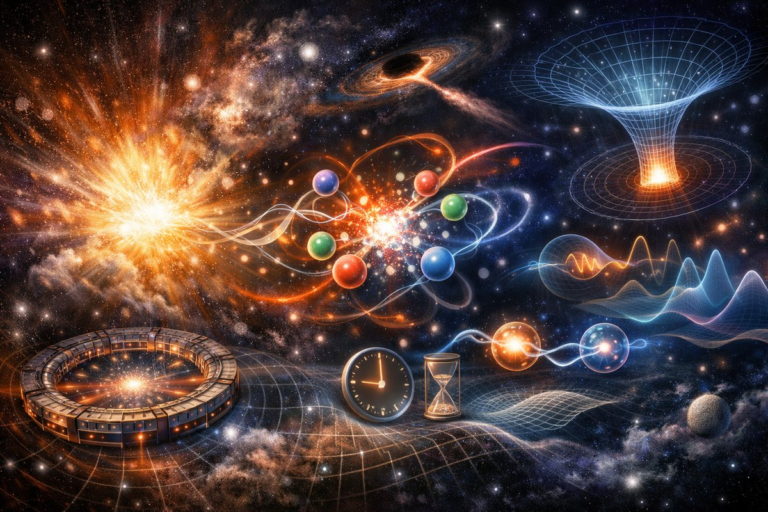
Yet these advances bring theoretical puzzles to the fore. How does unitarity survive when inflationary energies approach the Planck scale? Can quantum entanglement between regions separated by cosmic horizons resolve information paradoxes? Scholars are revisiting foundational questions about space-time emergence, borrowing ideas from condensed matter, quantum errors correcting codes, and holographic dualities.
In laboratories around the world, theorists are crafting solvable toy models that emulate aspects of quantum gravity. By simulating discretized universes on large-scale quantum computers and analog platforms, they test hypotheses about horizon thermodynamics and the microscopic origin of entropy. While these systems remain far from capturing full general relativity, they offer valuable clues about the interplay between geometry and information.
Looking ahead, next-generation observatories will push sensitivity further. A planned all-sky microwave survey promises tenfold improvements in angular resolution and lower noise floors. Concurrently, proposals for space-based gravitational-wave detectors aim to explore lower-frequency bands where primordial signals may be buried. Quantum-enhanced measurement techniques are expected to boost interferometer performance and accelerate the hunt for new physics.
International partnerships are crucial for these ambitious projects. Funding agencies are coordinating call schedules, sharing design blueprints, and establishing unified data releases. A common data-analysis framework will allow researchers to interleave microwave, infrared and gravitational-wave datasets, maximizing the scientific return and reducing redundant efforts.
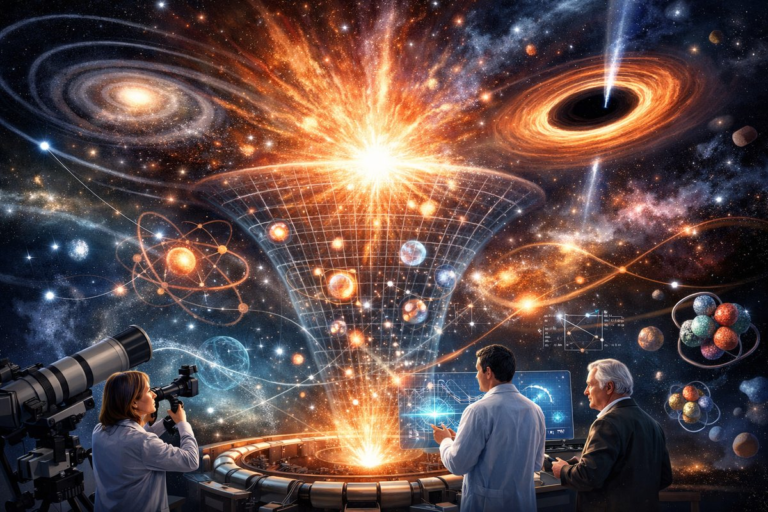
These multi-messenger campaigns are reshaping our understanding of fundamental physics. By uniting disparate probes, scientists can cross-check findings and mitigate systematic uncertainties. This holistic approach is essential for resolving controversies, such as the precise value of the Hubble parameter or the nature of dark energy shaping cosmic acceleration.
Beyond technical advances, the new discoveries foster philosophical reflection. What does it mean for space and time to emerge from a quantum substrate? How do causality and locality operate at Planckian scales? By confronting these questions, researchers are bridging the gap between mathematical abstraction and empirical evidence, enriching both physics and metaphysics.
The coming decade promises a burst of activity. As data pour in, conferences and workshops will grapple with surprising anomalies and unexpected cross-correlations. All the while, educators and science communicators are preparing to share these insights with the public, inspiring a new generation of curious minds eager to explore the cosmos’s origins.
Amid these endeavors, one principle unites the community: a spirit of open inquiry. Whether designing ultra-sensitive detectors or crafting elegant theoretical frameworks, scientists are driven by wonder at the cosmos’s complexity and simplicity. In charting the uncharted, they remind us that the greatest discoveries often emerge at the intersection of daring ideas and precise measurement.