Location
Mount Vernon, WA 98274

Location
Mount Vernon, WA 98274
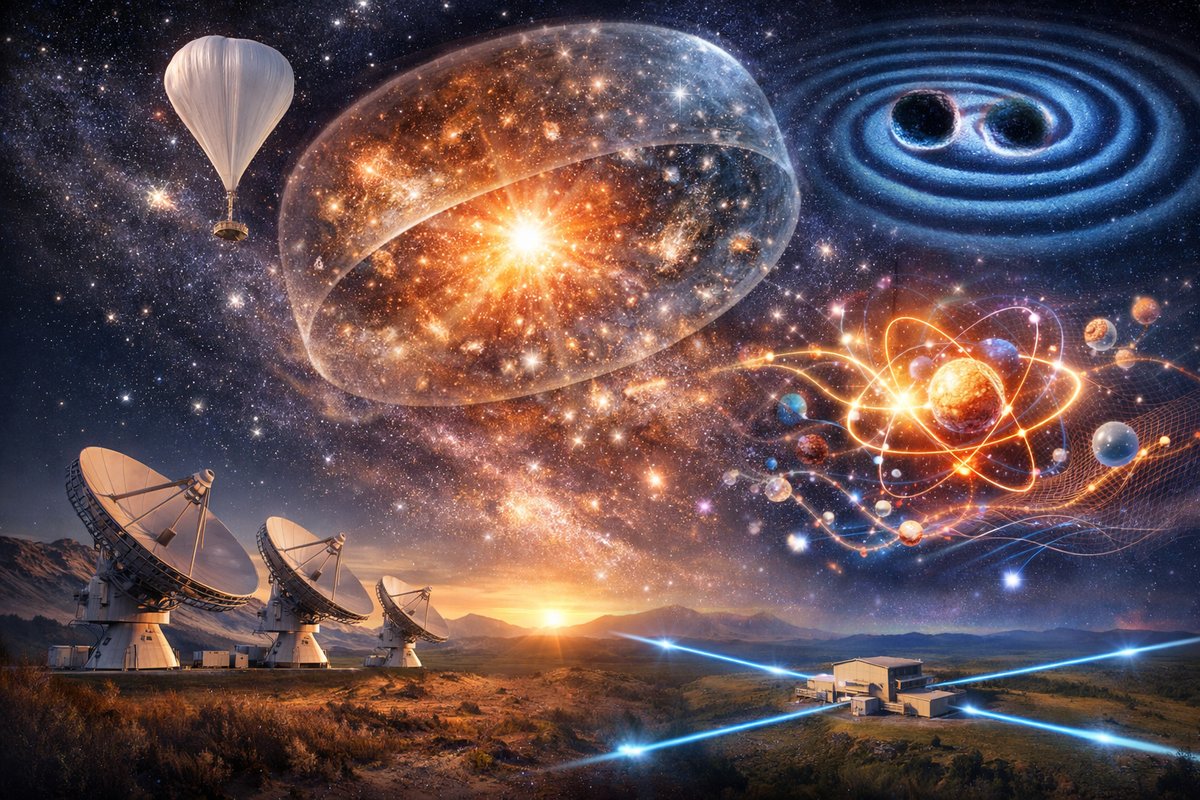
A suite of cutting-edge observations from ground-based arrays, balloon-borne detectors, and gravitational-wave observatories is rewriting our understanding of the cosmos's opening chapters. Scientists are untangling paradoxes like the horizon problem and seeking the first whispers of matter, energy, and the quantum forces that forged everything we know.
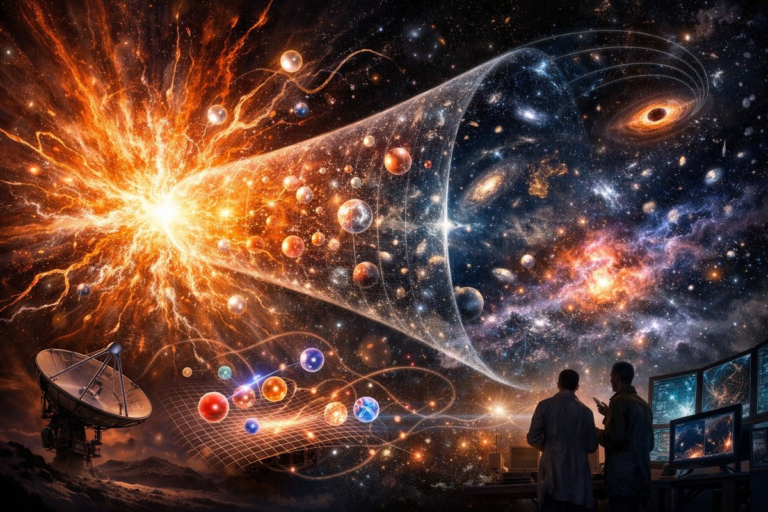
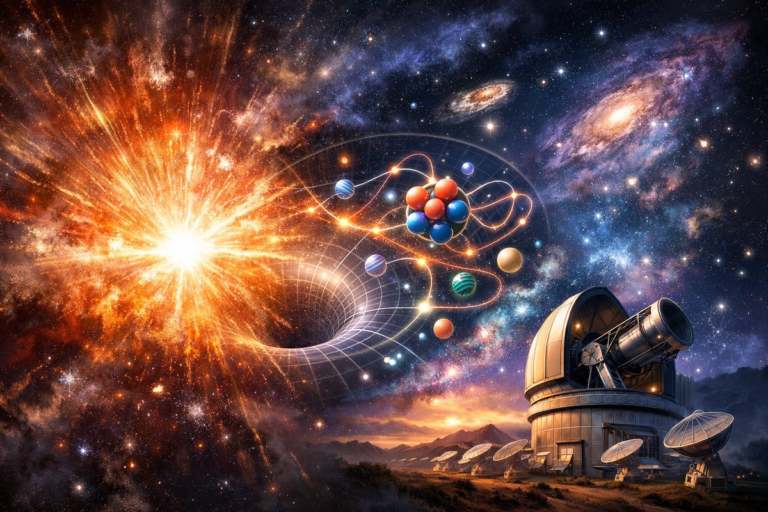
At an isolated observatory high in the Atacama Desert, an array of radio antennas has just picked up a subtle signature that may trace back to the first fractions of a second after the Big Bang. This signal, buried beneath layers of cosmic noise, hints at the high-energy particles and quantum fluctuations that seeded the large-scale structure of the Universe. Meanwhile, specialized balloon-borne detectors floating above Antarctica are sampling the faint polarization patterns of the cosmic microwave background, searching for the imprints of primordial gravitational waves. Together, these international collaborations are peeling back the veil on the Universe’s infancy, offering a real-time glimpse into the forces and paradoxes that shaped every star, galaxy, and atom.
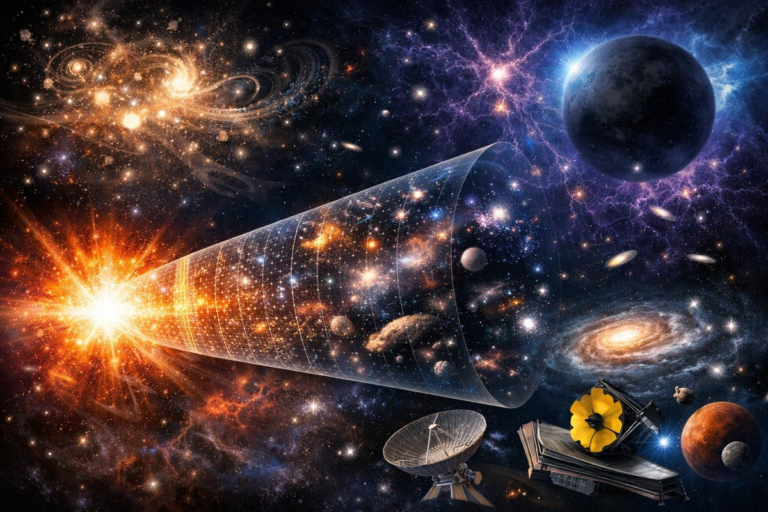
For decades, the cosmic microwave background has served as a time capsule from roughly 380,000 years after the Big Bang. Satellites like COBE, WMAP, and Planck have captured its uniform glow and subtle temperature variations, but new ground-based experiments are aiming for ever-higher resolution. By combining data from multiple observatories-including a recently upgraded radio telescope network in Chile-researchers are mapping tiny anomalies in the background radiation. These hot and cold spots encode information about inflation, the rapid expansion that is believed to have occurred within trillionths of a second after the Universe’s birth.
The inflationary model solves long-standing paradoxes, such as why regions of the Universe millions of light-years apart have nearly identical properties (the horizon problem) and why space appears so flat on cosmic scales. Yet the precise mechanism that drove inflation remains elusive. Competing theories propose exotic fields or quantum sensors known as inflatons, while others explore the possibility of multiple inflationary epochs triggered by different quantum fluctuations. New data from cryogenically cooled detectors promises to constrain these models by looking for the infinitesimal B-mode polarization patterns that would reveal primordial gravitational waves.
Beyond the cosmic microwave background, neutrino observatories are entering the race to probe the Universe’s origin. Deep below the ice sheets of Antarctica and under the Mediterranean, vast detectors studded with photomultipliers are listening for flashes of Cherenkov light produced by ghostly neutrinos. These nearly massless particles stream unimpeded from the earliest cosmic furnaces-supermassive primordial stars and black holes-offering a unique messenger from epochs inaccessible to traditional telescopes. Preliminary detections of ultra-high-energy neutrinos suggest that the first generations of stars might have ended in cataclysmic collapses much sooner than expected, seeding the Universe with heavy elements.
Back on Earth, high-performance computing clusters are running cosmological simulations that stitch together the roles of dark matter, dark energy, and visible matter. These simulations must bridge an enormous range of scales, from quantum fluctuations smaller than an atom to the vast cosmic web spanning billions of light-years. Researchers are refining algorithms that incorporate quantum chromodynamics, general relativity, and fluid dynamics to reconstruct how primordial density perturbations grew into the galaxy clusters we see today. Recent breakthroughs in GPU-accelerated computing have cut simulation times by orders of magnitude, enabling teams to explore hundreds of inflationary scenarios in parallel.
But the Universe still holds mysteries. Dark matter, which accounts for roughly 85 percent of all matter, remains undetected by any laboratory experiment. Deep underground facilities equipped with ultra-sensitive detectors are hunting for rare interactions between dark-matter particles and ordinary matter. At the same time, astronomers are mapping its distribution through gravitational lensing surveys, looking for minute distortions in the light from distant galaxies. Any tension between lensing data, cosmic microwave background measurements, and local galaxy counts could signal new physics beyond the standard model.
Dark energy, the mysterious force driving cosmic acceleration, is equally confounding. Its tiny measured value clashes with quantum field theory’s vacuum energy predictions by a factor of 10^120-one of the greatest mismatches between theory and observation in physics. New wide-field surveys, employing both ground-based telescopes and space-borne instruments, aim to chart the Universe’s expansion history with unprecedented precision. By studying the clustering of galaxies, supernova distances, and baryon acoustic oscillations, cosmologists hope to discern whether dark energy is a true constant or a dynamic field evolving over cosmic time.
Amid these efforts, a growing cadre of multidisciplinary teams is exploring the philosophical implications of a quantum-driven origin. Could our Universe be just one bubble in a vast multiverse, each governed by different physical laws? If so, the conditions that allowed for our existence might be an outcome of cosmic selection, not necessity. While direct evidence for other universes remains speculative, advanced statistical analyses of cosmic microwave background anomalies are beginning to test the multiverse hypothesis in earnest.
Despite the enormity of these challenges, progress is accelerating thanks to cutting-edge instrumentation. Next-generation telescopes equipped with kinetic inductance detectors and superconducting transition-edge sensors are pushing detection thresholds to new lows. Balloon missions like SPIDER and ground arrays such as the Simons Observatory are poised to capture polarization signals that were previously undetectable. Meanwhile, gravitational-wave facilities are targeting the stochastic background of primordial ripples in spacetime, complementing electromagnetic observations and neutrino detections.
One of the most exciting developments is the planned launch of a space-based interferometer designed to detect gravitational waves from the earliest cosmic epochs. By flying millions of kilometers apart, spacecraft equipped with laser interferometers could measure spacetime distortions caused by inflationary gravitational waves at frequencies inaccessible from Earth. If successful, this mission could provide the first direct window into the inflationary era, confirming the quantum nature of gravity and revealing the energy scale at which it occurred.
In parallel, laboratory experiments using ultracold atoms and quantum sensors are recreating tiny patches of early Universe physics under controlled conditions. By cooling atoms to near absolute zero and manipulating them with lasers, physicists can simulate inflationary-like expansions and measure analogues of cosmic particle production. These tabletop analogues complement astronomical observations and offer insights into fundamental questions about vacuum states, entanglement, and the interplay between quantum mechanics and general relativity.
The cumulative effect of these diverse efforts is a new era of convergence between theory, observation, and experiment. Instruments scanning the skies, detectors listening for neutrinos and gravitational waves, high-powered simulations, and tabletop quantum analogues are all contributing to a more coherent picture of the cosmos’s birth. While many questions remain unanswered-especially regarding dark matter and dark energy-the pace of discovery suggests that the next decade may finally deliver a unified account of the forces, particles, and paradoxes that forged our Universe.
For curious readers, aspiring astronomers, and lifelong learners, this unfolding narrative offers both intellectual challenge and emotional resonance. The pursuit of our cosmic origins reminds us that humanity’s capacity for wonder and exploration extends from the smallest quantum fluctuations to the grand tapestry of galaxies. As new instruments come online and theories are refined, each breakthrough brings us closer to that first instant when space, time, and matter emerged from the primordial darkness.