Location
Mount Vernon, WA 98274

Location
Mount Vernon, WA 98274
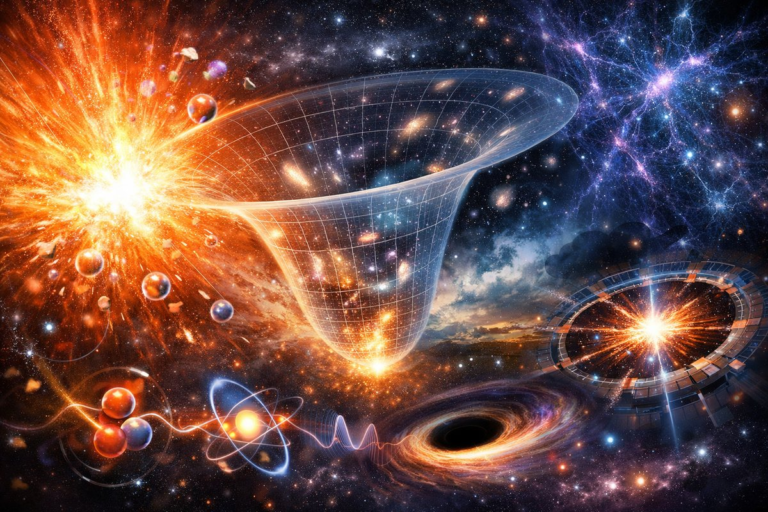
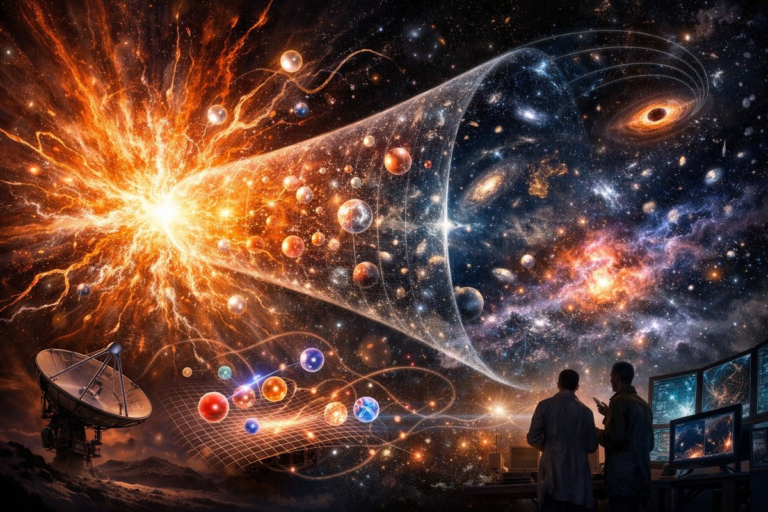
New data from gravitational-wave observatories, space-based infrared telescopes, and underground particle detectors are converging to illuminate the universe's birth pangs. Scientists are piecing together how ripples in spacetime, nascent galaxies, and elusive dark particles set the stage for everything we know-and everything we have yet to envision.
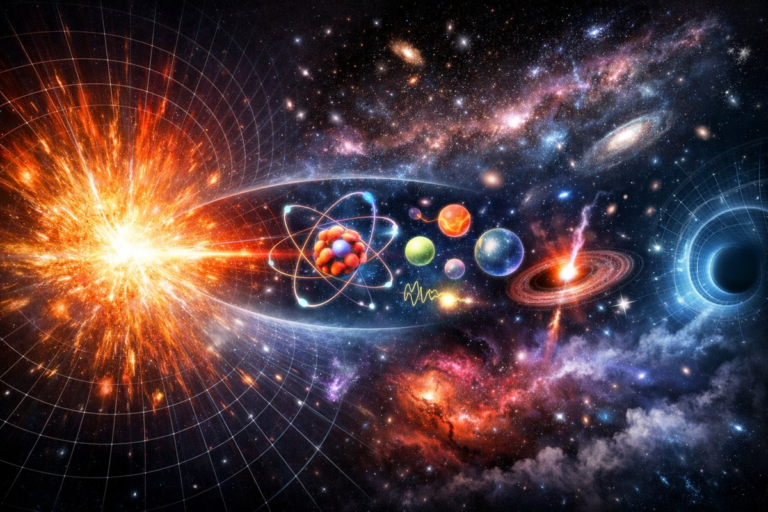
The long-standing quest to trace the universe back to its infancy has entered a data-rich era. In the past year alone, gravitational-wave detectors have captured signals from collisions of black holes that may date back to a time when the cosmos was barely a fraction of a second old. Meanwhile, space telescopes peering deep into the infrared have begun to resolve galaxies forming just a few hundred million years after the primordial fireball. Underground laboratories refined their hunt for dark matter particles. And theoretical advances in quantum gravity are challenging the notion of a singular beginning.
At the frontlines of this exploration are the global gravitational-wave observatories. A recent analysis by the LIGO-Virgo-KAGRA collaboration uncovered low-frequency ripples that could originate from mergers of primordial black holes. Unlike the stellar remnants born in dying stars, these black holes could have condensed directly from extreme density fluctuations in the first instants after cosmic inflation. If confirmed, the finding would offer a direct window onto the physics of the Planck epoch-when quantum effects of gravity reigned supreme. Researchers caution that distinguishing primordial sources from later-time astrophysical events remains challenging, but the statistical signal is growing stronger with each observing run.
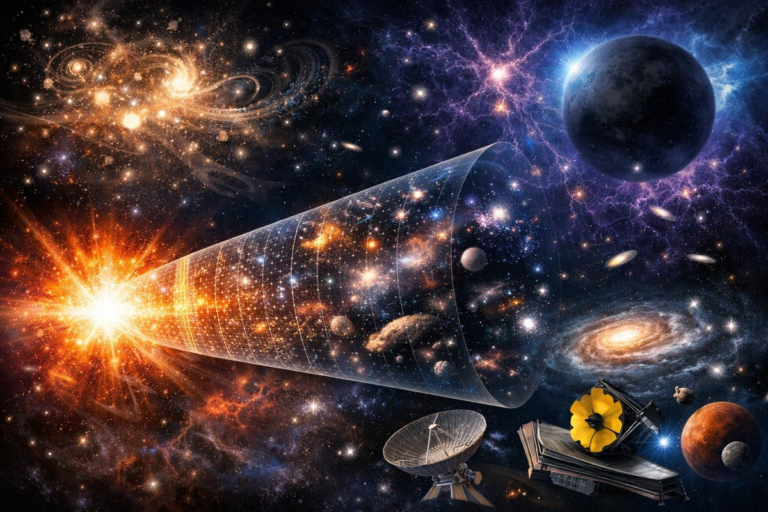
Meanwhile, infrared observatories beyond Earth have delivered complementary insights. A recent survey resolved dozens of faint galaxy candidates at redshifts beyond 15, a region of cosmic history previously in the realm of theoretical speculation. These galaxies, each forming just 200 to 300 million years after the Big Bang, appear unusually compact yet intensely star-forming. Spectroscopic follow-up suggests that heavy elements like carbon and oxygen were already in circulation, hinting at a first generation of stars that lived fast and died young. Researchers are now debating whether such rapid enrichment was driven by massive stars exploding as supernovae, or whether an unseen population of micro-galaxies contributed significantly to the early chemical factory.
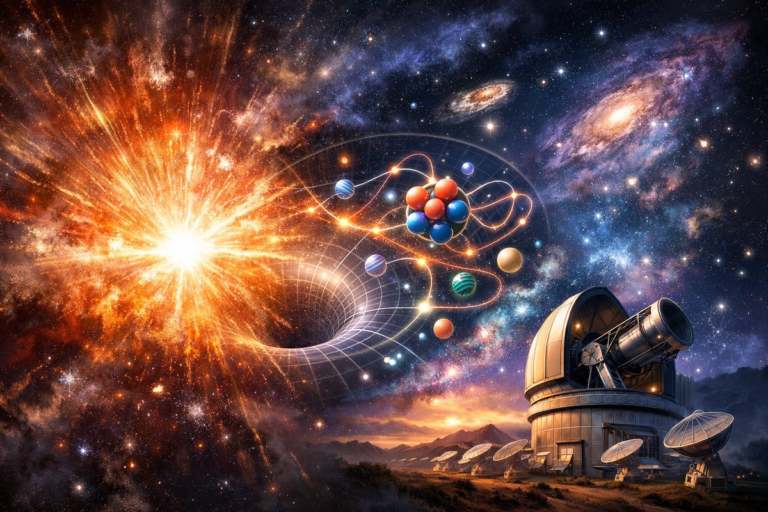
Deep beneath the Earth’s surface, dark matter experiments are tightening the screws on one of cosmology’s greatest mysteries. The latest results from the XENONnT detector in Italy’s Gran Sasso laboratory have pushed the exclusion limits for weakly interacting massive particles (WIMPs) to new lows. Although the team did not confirm a WIMP signal, the absence of detections across an ever-widening mass range is already reshaping theoretical models. Some theorists are shifting focus to lighter particles such as axions or to more exotic scenarios like dark sectors that interact predominantly via hidden forces. Each null result narrows the playground of possibilities but also raises fresh questions about how dark matter shaped the formation of galaxies.
In parallel, cosmic microwave background (CMB) studies are preparing for a renaissance. Instruments like the South Pole’s BICEP Array and the upcoming CMB-S4 network are honing in on the faint polarization patterns imprinted by primordial gravitational waves. Detecting those swirling B-modes in the CMB would provide smoking-gun evidence for inflation-a brief epoch of exponential expansion that smoothed and stretched the universe at the dawn of time. So far, constraints have ruled out several simple inflationary models, nudging theorists toward more intricate scenarios involving multiple fields or non-standard reheating processes. The next generation of telescopes could either catch that elusive signal or push the inflationary epoch into even more exotic territory.
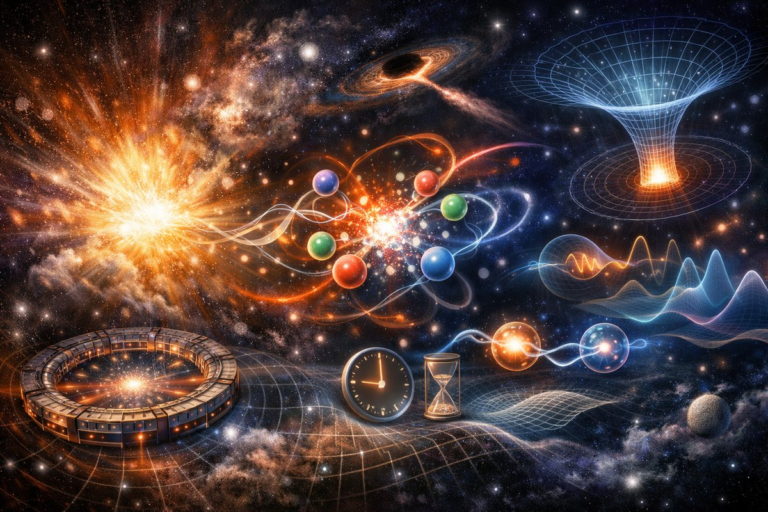
These empirical strides coincide with rapid theoretical progress in quantum cosmology. Loop quantum gravity, string-inspired approaches, and holographic frameworks are all wrestling with the nature of the initial singularity. In some models, a “quantum bounce” replaces the classical Big Bang, turning a prior contracting phase into our current expanding universe. Other proposals explore a multiverse of inflating regions, each with its own physical constants. While these ideas remain speculative, they are being tested against observational data-such as the distribution of galaxies on large scales and subtle anomalies in the CMB. The interplay between abstract mathematics and empirical constraints is more dynamic than ever.
Even the notion of information loss in black hole evaporation has found echoes in cosmology. If Hawking radiation ultimately preserves quantum information, as unitarity demands, then the birth of the universe itself might obey a similar bookkeeping. Some researchers posit that our observable cosmos is part of a quantum wave function encoding a vast tapestry of possible histories. While this interpretation challenges classical intuition, it galvanizes experimentalists to refine their measurements of cosmic relics in search of tell-tale interference patterns.
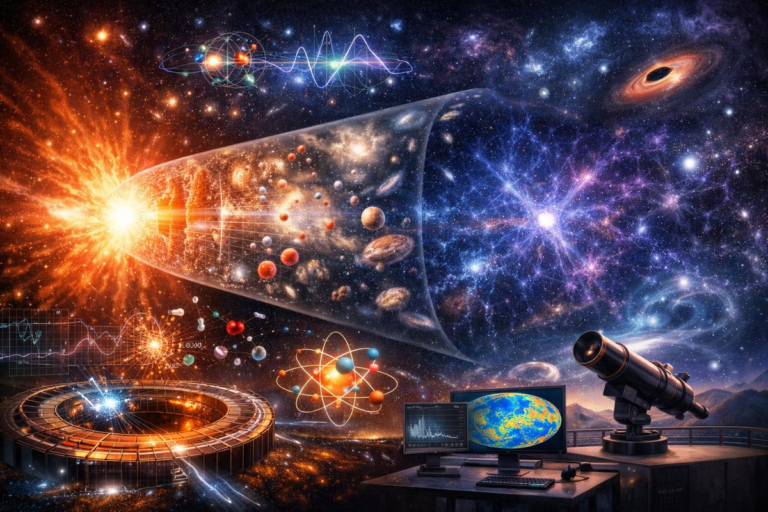
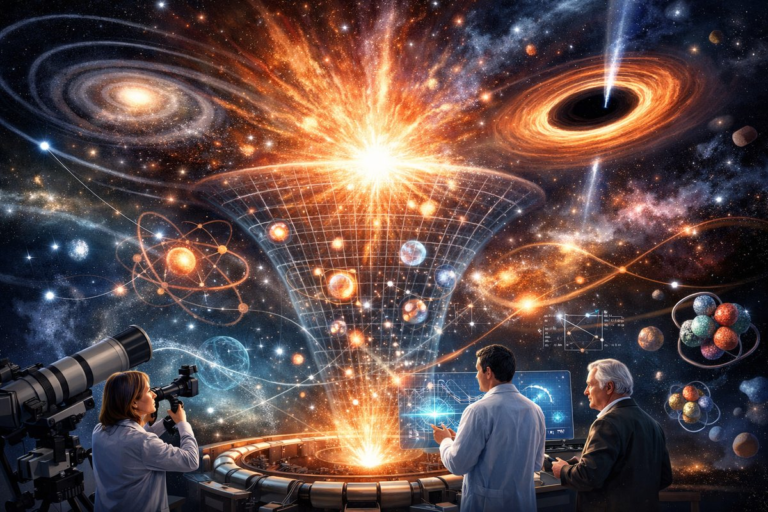
Taken together, these developments are reshaping our origin story. No longer is the Big Bang simply an intriguing boundary condition; it has become a living laboratory, with data streaming in from a web of detectors spanning the electromagnetic, gravitational, and particle realms. Each discovery peels back a layer of uncertainty, but also reveals deeper puzzles. How did inflation start and stop? What mechanism seeded the first black holes? Could dark matter interactions have sparked an early generation of stars? Answering these questions may require collaborations of unprecedented scale-and the invention of detectors we have not yet imagined.
Looking ahead, the next decade promises to be transformative. Proposed observatories like the Einstein Telescope aim to detect gravitational waves down to even lower frequencies, potentially capturing mergers that occurred when the universe was only milliseconds old. The Square Kilometre Array will map the distribution of neutral hydrogen across cosmic time, charting the “cosmic dawn” in unprecedented detail. And tabletop experiments in quantum optics may simulate the dynamics of spacetime under extreme conditions, offering laboratory analogs of the early universe.
Beyond the technical frontier, there is a profound human dimension to this exploration. Every step toward understanding cosmic origins reshapes our sense of place in the grand scheme. The knowledge that the atoms in our bodies emerged from star-forging furnaces and that spacetime itself once quivered with quantum uncertainty evokes a sense of wonder that transcends cultures and disciplines. As science presses forward, it also invites philosophical and ethical reflection on the use of knowledge, the stewardship of our planet, and the future of exploration.
In a time when rapid technological change can feel fragmenting, the endeavor to trace the universe to its first heartbeat offers a unifying narrative. It reminds us that we are participants in a vast story that began billions of years before our Sun ignited and will continue long after the Earth cools. The questions are monumental, but so is our capacity for curiosity, collaboration, and creativity. From the ripples in spacetime to the particles still lurking in the shadows, the universe’s origin remains our greatest mystery-and our most compelling invitation to wonder.