Location
Mount Vernon, WA 98274

Location
Mount Vernon, WA 98274
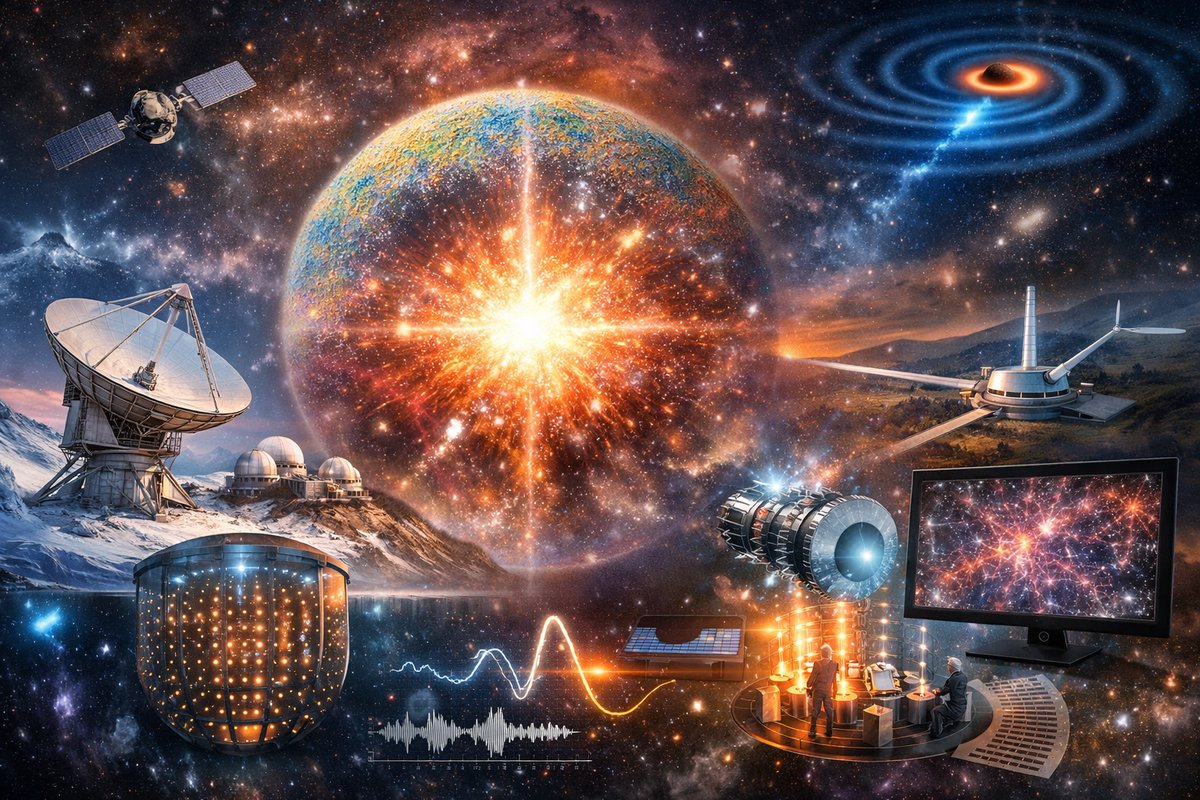
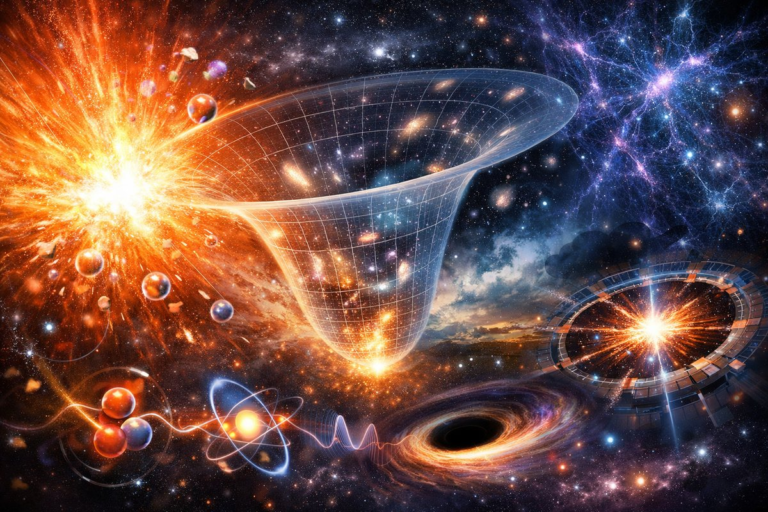
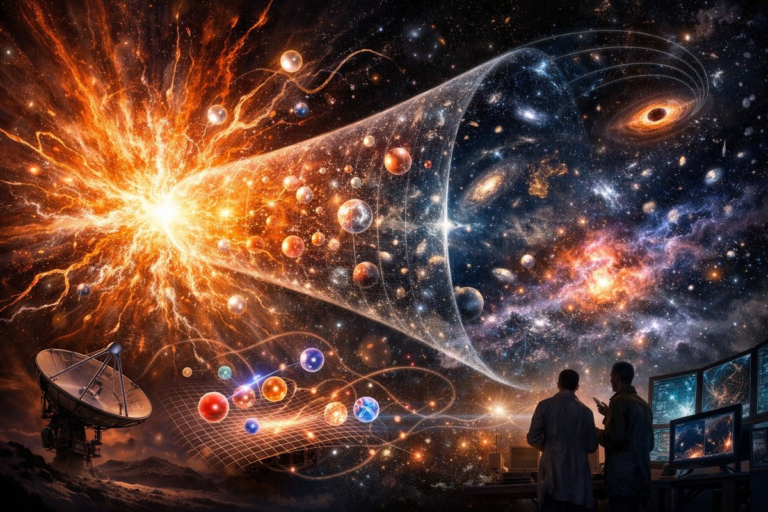
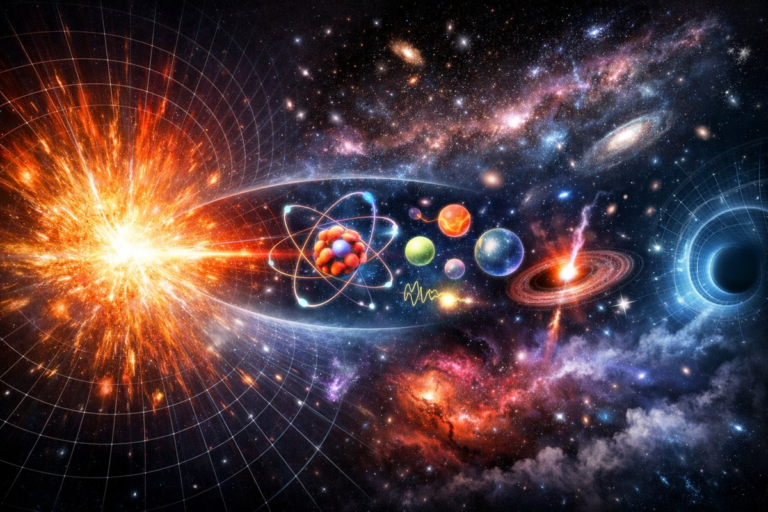
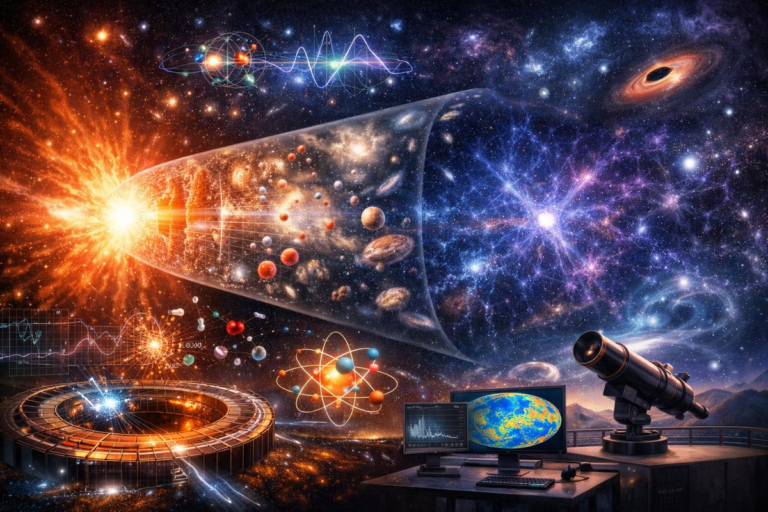
A suite of new experiments and observatories is closing in on the universe's most elusive signals, from the cosmic neutrino background to faint gravitational whispers. By combining cutting-edge data and advanced simulations, researchers are rewriting our picture of the Big Bang's first instants-and charting a path toward the ultimate origin story.
The quest to understand the universe’s birth has entered a golden era. In the past year, teams across the globe have reported tantalizing hints of signals from epochs never before probed. Instruments are now sensitive enough to seek out relic neutrinos, primordial gravitational waves, and the faintest imprints of quantum ripples on the cosmic microwave background. Each new data point offers a peek behind the veil of the Big Bang, revealing how space, time, matter, and energy emerged from a seething plasma and a font of vacuum energy.
On the South Pole plateau, a neutrino observatory has begun chasing the cosmic neutrino background-the fog of nearly massless particles that decoupled from matter mere seconds after the Big Bang. Unlike the well-studied microwave photons, these primordial neutrinos have evaded direct detection for decades. By embedding ultra-ultra-pure detectors deep in the ice and deploying electromagnetically shielded arrays, researchers have set the world’s tightest limits on low-energy neutrino interactions. While a definitive signal remains elusive, the latest upper bounds already constrain competing models of how the first leptons and quarks emerged.
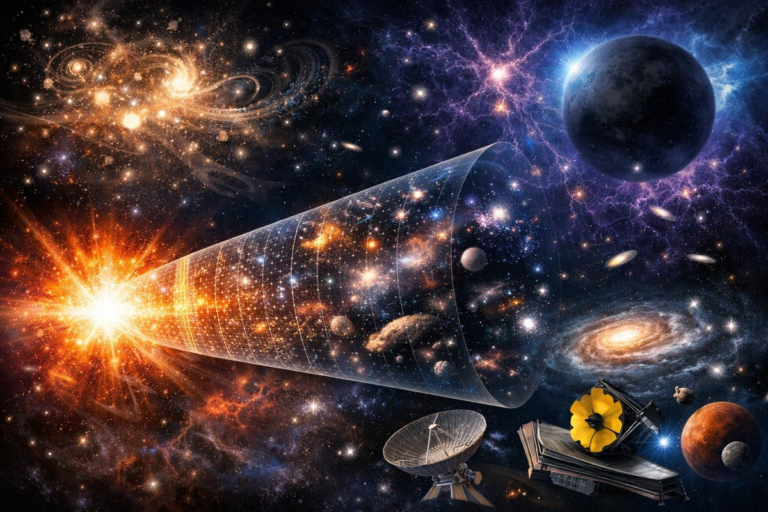
High above Earth, a space telescope has delivered the deepest views of faint galaxies shining at cosmic dawn. By analyzing the infrared glow of star clusters forming just a few hundred million years after the Big Bang, astronomers can trace the seeds of structure that inflation planted. Those seeds-tiny quantum fluctuations in spacetime-grew under gravity to become galaxy clusters, filaments, and voids. The telescope’s unprecedented sensitivity has uncovered dozens of ultra-faint galaxies, offering new tests of how fast the universe expanded and when the first heavy elements began to form.
Meanwhile, a network of detectors in Europe and the United States is listening for the hum of primordial gravitational waves. These ripples in spacetime, set in motion during cosmic inflation, carry information about energy scales far beyond those accessible by terrestrial accelerators. Although ground-based interferometers have yet to isolate a clear inflationary signal, upgrades in mirror coatings, vibration isolation, and laser stability are pushing sensitivity ever closer to the target. Observations of B-mode polarization in the cosmic microwave background by balloon-borne and ground experiments are also tightening the noose around competing inflation scenarios.
Theoretical physicists are racing to interpret these emerging constraints. The classic puzzles-the horizon and flatness problems-underpin most inflationary models, yet each variation predicts a slightly different spectrum of primordial perturbations. One leading idea posits a brief ultra-rapid expansion driven by a metastable vacuum state; another explores a bounce cosmology in which a contracting universe rebounds instead of reaching a singularity. Data from the latest microwave background maps have begun to rule out the simplest versions of each, steering theorists toward hybrid models that blend quantum gravity effects with conventional field theory.
A persistent mystery is the universe’s matter-antimatter asymmetry. Standard cosmology predicts equal amounts of matter and antimatter in its early stages, yet our observable cosmos is overwhelmingly matter dominated. New measurements of rare decay processes in particle accelerators are shedding light on subtle violations of charge-parity symmetry. Incorporating these findings into early-universe simulations helps explain how a tiny surplus of matter over antimatter could have been amplified during reheating, setting the stage for galaxies, stars, planets, and ultimately life.
Simulations are essential to connect theory and observation, and high-performance computing centers are rising to the challenge. Exascale supercomputers now model billions of particles with quantum corrections, incorporating neutrino transport and gravitational wave generation in a single run. Researchers are also exploring machine-learning techniques to identify faint patterns buried in the noise, speeding up the analysis of petabytes of sky maps and detector readouts.
Several paradoxes remain unresolved. The information paradox-how information might escape a primordial horizon-has sparked fresh debate about the quantum structure of spacetime. New proposals suggest that subtle correlations in Hawking‐like radiation released during early cosmic expansion could preserve information without violating known physics. Meanwhile, the singularity at the Big Bang’s heart may be tamed by loop quantum cosmology, which replaces an infinite density point with a finite quantum bridge to a prior contracting phase.
On the observational front, the European Space Agency’s wide-field mission is mapping the dark energy that drives cosmic acceleration. By surveying millions of galaxies, it aims to pin down whether dark energy is a cosmological constant or the signature of a dynamic field evolving over time. These measurements feed back into early-universe models, since any late-time modifications of gravity must align with what inflation and reheating predict.
The cosmic frontier is not limited to professional labs and telescopes. Citizen scientists are contributing by classifying galaxy shapes, identifying supernova candidates, and even building small-scale cosmic ray and cloud chamber detectors in their homes. Open-source electronics platforms have made it possible to detect secondary particles from high-energy cosmic rays striking Earth’s atmosphere. These grassroots projects spark curiosity and bridge the gap between educational outreach and front-line research.
As new facilities come online and data pours in, the boundaries of our understanding will continue to expand. Each experimental advance and theoretical insight rewrites part of the origin story: from the microscopic genesis of particles to the cosmic vista of galaxies and dark energy. While fundamental questions endure, the current wave of discoveries is charting a course toward a unified narrative of creation-one that may finally reveal whether the universe sprang from a unique event, cyclic phases, or an even deeper multiversal reality.
For now, scientists remain driven by the same impulse that ignited this quest centuries ago: wonder. Wonder at the smallest flicker of a neutrino detector, wonder at the faint polarization patterns in an ancient light, wonder at the universe’s boundless capacity to surprise. In the interplay of measurement, computation, and imagination, we edge closer to the very moment when space and time first emerged. And that shared journey, crossing disciplines and spanning scales, reminds us that the story of origins is also a story of human curiosity and collaboration. Something new waits just beyond the horizon of the known-and with it, the next chapter in understanding everything we’ve yet to imagine.