Location
Mount Vernon, WA 98274

Location
Mount Vernon, WA 98274
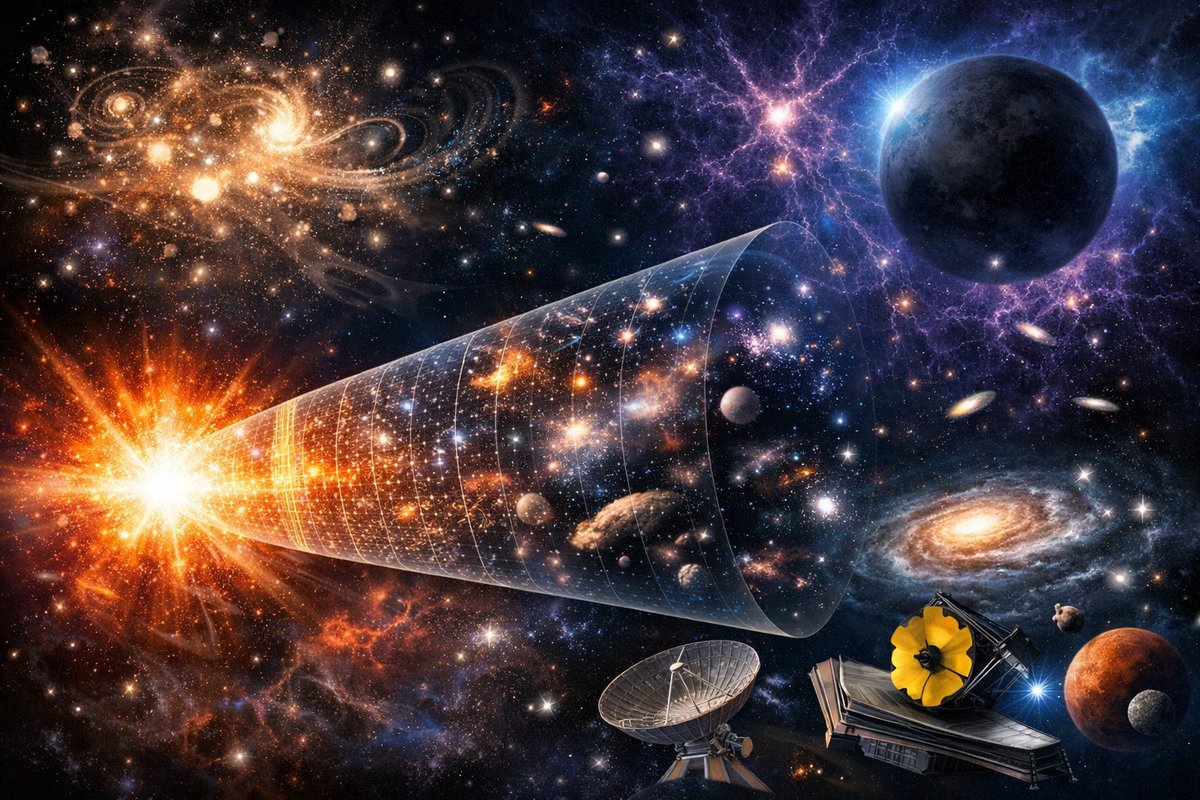
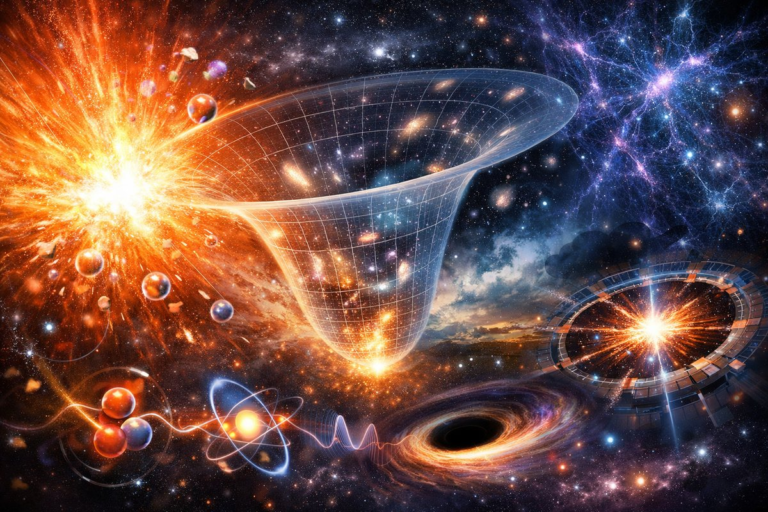
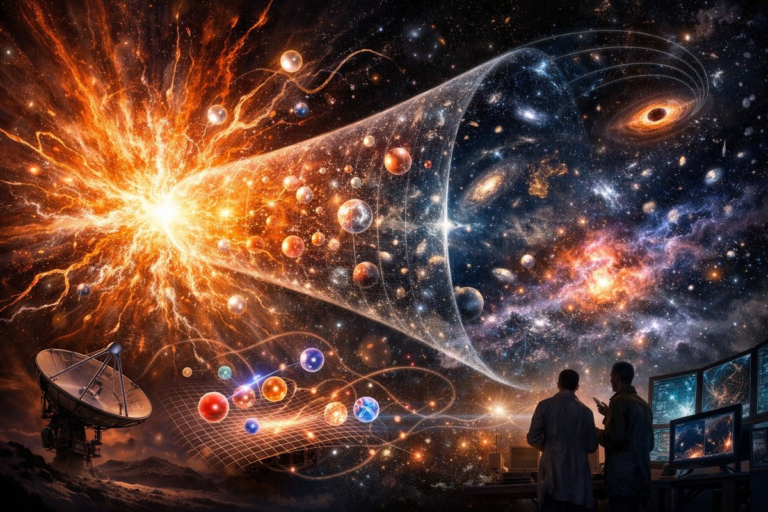
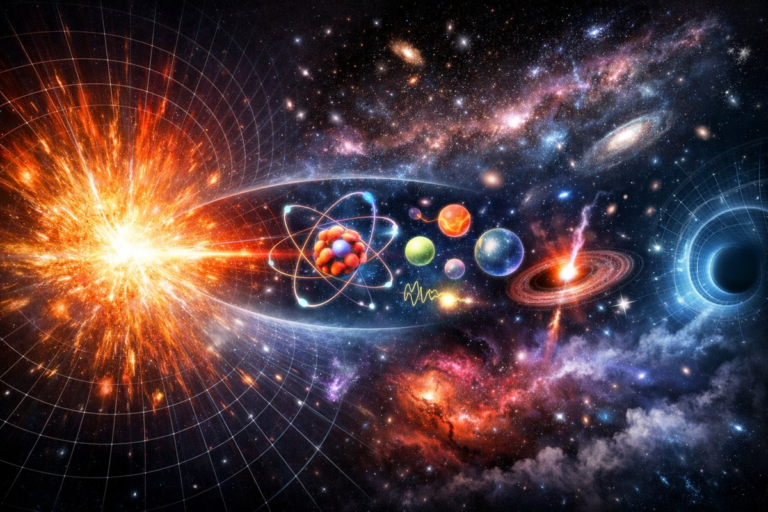
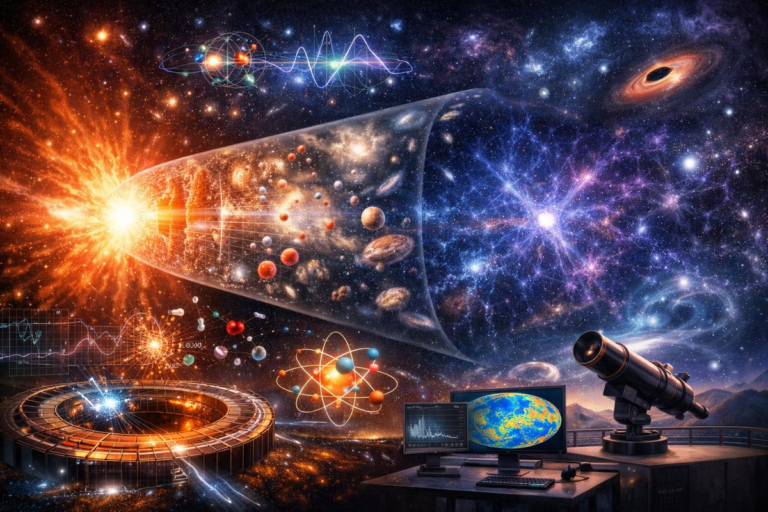
Modern astrophysics continues to peel back the layers of cosmic history, revealing intricate details about the universe's birth and its fundamental forces. From the quantum fluctuations that seeded galaxies to the enigmatic dark components shaping cosmic evolution, the quest to understand our origins remains as profound as ever.
The universe’s origin story is a tapestry woven from the threads of physics, cosmology, and philosophy. While the Big Bang theory remains the cornerstone of our understanding, recent advances in observational technology and theoretical frameworks are expanding the narrative, challenging assumptions and opening new avenues of inquiry. At the heart of this exploration lies a profound question: how did everything we know – matter, energy, space, and time – emerge from an initial state that defies classical description?
In the earliest fractions of a second after the universe’s inception, the laws of physics as we know them were in a state of flux. This epoch, known as the Planck era, is where quantum gravity effects dominated, and the smooth fabric of spacetime itself was subject to intense fluctuations. Contemporary efforts to reconcile general relativity with quantum mechanics, such as approaches involving string theory and loop quantum gravity, seek to describe this primordial phase. Although these theories are mathematically intricate and experimentally elusive, they offer glimpses into the universe’s nascent moments where space and time may have been discrete or emergent properties rather than continuous backgrounds.
One of the most compelling insights into the universe’s infancy comes from the cosmic microwave background (CMB) radiation – the faint afterglow of the Big Bang. Detailed measurements of the CMB’s temperature fluctuations, achieved through missions like the Planck satellite and ground-based observatories, have revealed a wealth of information about the universe’s composition and geometry. These fluctuations are understood as quantum ripples stretched to cosmic scales during an inflationary epoch – a brief period of exponential expansion that smoothed and flattened the universe while amplifying microscopic perturbations into the seeds of galaxies and large-scale structures.
Yet inflation itself is a theory with open questions. What mechanism triggered this rapid expansion? How did it end, and what determined its energy scale? Some models propose the existence of a scalar field, dubbed the inflaton, whose dynamics drove inflation. Others explore alternatives, such as bouncing cosmologies or emergent universe scenarios, which avoid singularities and propose a cyclical or eternal cosmos. These hypotheses are not mere academic exercises; they have testable predictions that upcoming observations aim to verify or refute, including the search for primordial gravitational waves – ripples in spacetime generated during inflation.
Dark matter and dark energy, which together constitute about 95% of the universe’s total energy budget, remain enigmatic. Their discovery has revolutionized cosmology, revealing that the visible matter composing stars and galaxies is but a minor component. Dark matter’s gravitational influence shapes galaxy formation and clustering, while dark energy drives the accelerated expansion of the cosmos. Understanding their nature is crucial for a comprehensive picture of cosmic origins and fate. Experiments in particle physics, astrophysical surveys, and gravitational wave detectors are converging to shed light on these mysterious constituents.
The interplay between quantum mechanics and gravity also raises profound paradoxes, such as those related to black holes and information loss. These paradoxes hint that our current frameworks are incomplete and that a deeper theory may unify all fundamental forces. Concepts like holography, which propose that the information contained within a volume of space can be represented on its boundary, challenge traditional notions of locality and dimensionality. Such ideas could reshape our understanding of spacetime itself, suggesting that the universe’s fabric is more intricate and interconnected than previously imagined.
Beyond the physical sciences, the universe’s origin story touches on philosophical and existential questions. How does the emergence of complexity and consciousness fit within cosmic evolution? Are there multiple universes, each with different physical laws, arising from a multiverse landscape? These contemplations invite us to reflect on the nature of reality and our place within it.
As telescopes and detectors become ever more sensitive, and as theoretical models grow in sophistication, humanity stands at the threshold of unprecedented discovery. From mapping the faintest signals of the early universe to probing the quantum structure of spacetime, the journey to the beginning is both a scientific and a human endeavor – one that continuously reshapes our understanding of existence itself.
In embracing the mysteries of the cosmos, we not only uncover the mechanisms that forged the stars and galaxies but also deepen our appreciation for the delicate balance of forces and phenomena that make life possible. The quest to unravel the universe’s origins is ongoing, propelled by curiosity, ingenuity, and the timeless desire to know where we come from and what lies beyond the horizon of current knowledge.