Location
Mount Vernon, WA 98274

Location
Mount Vernon, WA 98274
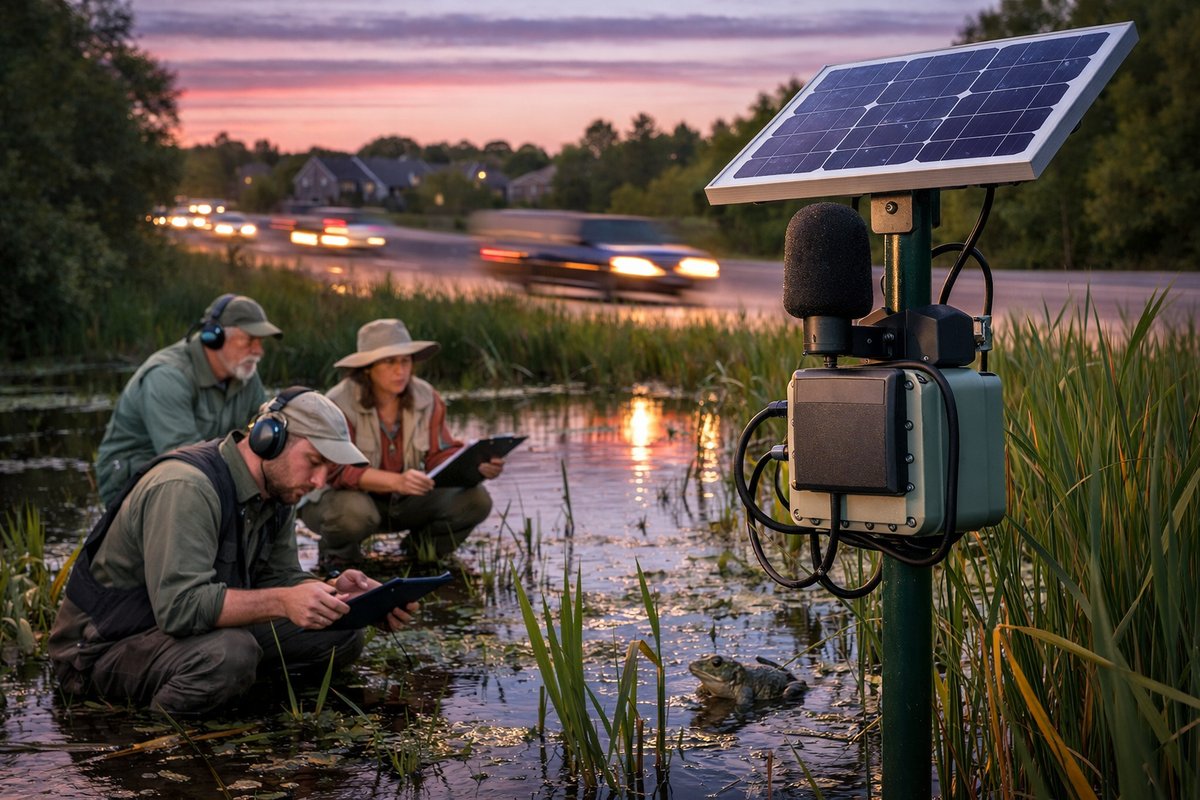
A team of ecologists and citizen scientists deployed a network of solar-powered acoustic sensors across suburban wetlands to record amphibian calls. Their findings show that elevated traffic noise can suppress breeding choruses by up to 30 percent, with implications for road planning and wildlife conservation.
Scientists have long suspected that human-generated noise interferes with wildlife communication, but a new grassroots project has provided some of the clearest data yet on how suburban road noise impacts amphibian breeding behavior. Across six months, researchers from a regional university partnered with high school science clubs to deploy 50 solar-powered acoustic sensor units at ponds and marshes located within 100 meters of busy roads. The result: frogs and toads reduce or shift their breeding calls when road noise exceeds 60 decibels, a level easily reached during daytime traffic.
Drawing on advances in low-power electronics and machine-learning analysis, the team developed purpose-built sensor nodes capable of recording high-fidelity audio, filtering out wind and rain noise, and classifying calls from multiple amphibian species. Each unit ran autonomously, harvesting solar energy to recharge a small battery pack that supported up to six months of continuous monitoring. Data were timestamped and geotagged before being transmitted via a low-bandwidth radio link to a central server for processing.
Mapping the Noise Gradient
Instead of traditional single-site studies, this project took a landscape-level approach. Sensor sites formed transects extending from major suburban thoroughfares into quieter green spaces. By quantifying background noise levels alongside amphibian vocal activity, the team created fine-scale maps showing how noise from morning and evening commutes propagates into adjacent habitats. Noise levels at ponds closest to roads often peaked above 70 decibels-comparable to a vacuum cleaner-while sites 200 meters away registered below 40 decibels, similar to a whisper.
Recording over five million individual audio clips, the network captured breeding calls from eight frog and toad species, including spring peepers, green frogs, and American toads. Machine-learning algorithms, trained on labeled examples, automatically identified call events. Analysis showed that at high-noise sites, call frequency dropped by an average of 30 percent compared to quieter locations. Moreover, some species shifted their calling to later at night when traffic subsided.
Citizen Science Meets Cutting-Edge Tech
High school students played an integral role. They assisted in assembling sensor units from off-the-shelf components-microphones, microcontrollers, solar panels, and battery cells-and wrote code for initial call identification. Workshops taught basics of acoustics, signal processing, and field deployment techniques. Students plotted sensor positions, logged environmental metadata (temperature, humidity, vegetation cover), and shared observations via an open-access platform.
“Bringing students into the process not only accelerates data collection but also builds scientific literacy,” says the lead researcher. “They learn hands-on how technology and ecology intersect, and they become ambassadors for conservation in their communities.”
Unexpected Findings
Beyond the anticipated drop in call volume, the study uncovered subtler behavioral shifts. At some sites, spring peepers began calling at frequencies slightly higher than in quiet areas-likely compensating for masking by low-frequency road noise. In a few instances, researchers noted that toads delayed the onset of their chorus, waiting until ambient noise levels dipped below a threshold.
These findings suggest amphibians may incur energetic costs when altering call patterns, potentially affecting reproductive success. Extended or shifted calling periods require additional energy, while lower overall calling may reduce mate attraction. Over multiple breeding seasons, such disruptions could contribute to population declines in noise-exposed areas.
Implications for Conservation and Infrastructure Planning
The project’s results have already informed local transportation authorities. Planning departments are evaluating road-side noise barriers, vegetative buffers, and adaptive speed limits during peak breeding periods. By integrating ecological data with traffic models, agencies can target mitigation measures where they yield the greatest benefit for amphibian populations.
In one pilot effort, a noise wall installed adjacent to a wetland reduced decibel levels by 10 to 15 dB, and follow-up monitoring indicated a partial recovery of breeding chorus intensity. Researchers hope to see more such measures adopted as municipalities update suburban development guidelines.
Toward a Quieter Future
This study demonstrates the power of combining low-cost hardware, community engagement, and automated analysis to tackle complex environmental challenges. As sensor technologies continue to shrink in size and cost, similar networks could monitor other noise-sensitive species-songbirds, insects, or marine mammals. Real-time acoustic monitoring may become a standard tool in environmental impact assessments and conservation planning.
Looking ahead, the team plans to enhance sensor nodes with additional environmental sensors-temperature, humidity, and even water quality probes-to build a more holistic picture of wetland health. Partnerships with civic groups and local governments will expand monitoring across urban and rural gradients, informing policies that balance development with biodiversity protection.
By illuminating hidden effects of road noise on amphibian breeding, this work underscores the importance of soundscapes in ecology. Preserving natural acoustic environments might be as crucial as protecting physical habitats. Through innovative technology and public participation, researchers are finding new ways to ensure that the croaks and peeps of frogs and toads continue to resonate at night in suburbs around the world.
A New Wave of Acoustic Ecology
The suburban soundscape study marks a milestone in the emerging field of acoustic ecology. It illustrates how humans can leverage technology to listen more closely to the nonhuman voices that share our environment. As sensors become ubiquitous and open-source analysis tools evolve, communities everywhere can map their own soundscapes-tracking biodiversity, monitoring pollution, and fostering a deeper connection to the natural world.
In the hush of a summer evening, the chorus of frogs and toads is more than background ambience-it is a vital signal of ecosystem health. Thanks to this pioneering network of solar-powered acoustic sensors, we now have the data to protect those voices and ensure they continue to herald nights to come.