Location
Mount Vernon, WA 98274

Location
Mount Vernon, WA 98274
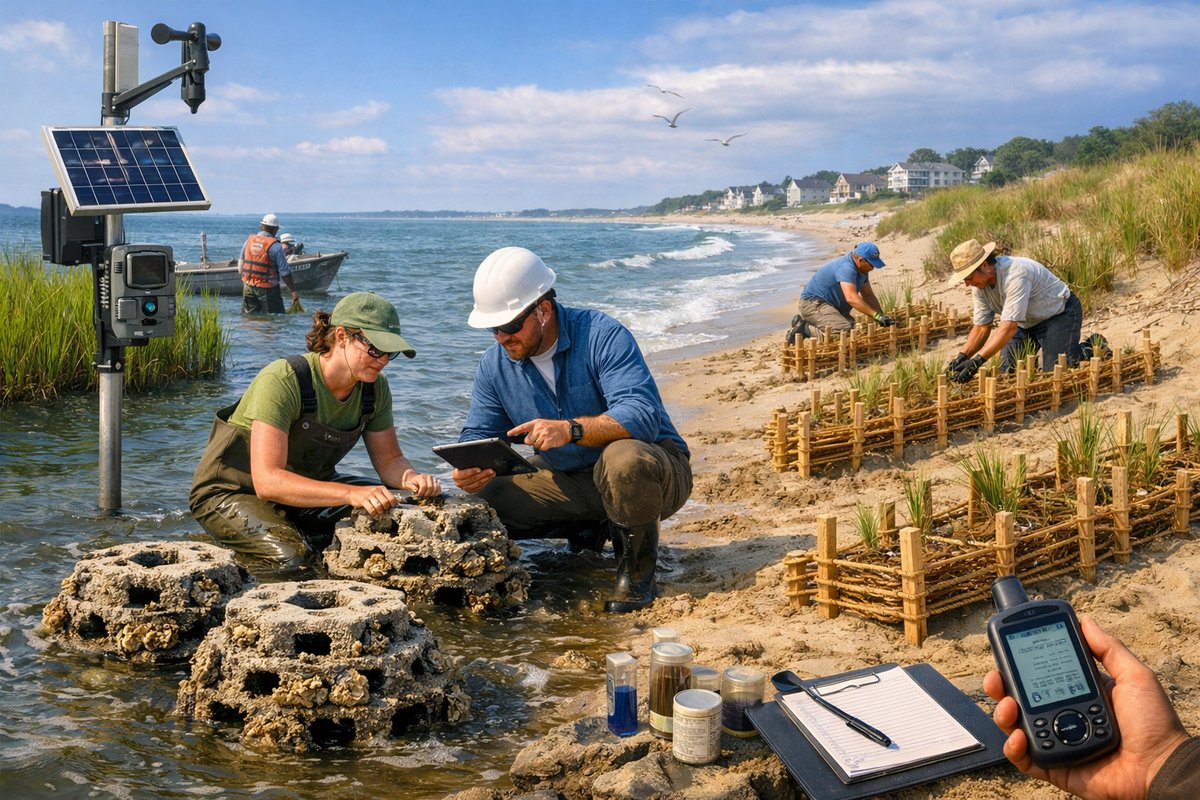
A pioneering collaboration between engineers and ecologists is deploying modular oyster reef units and biodegradable dune frames to safeguard vulnerable shorelines. Early trials show that combining living infrastructure with community science tools could transform how coastal habitats adapt to rising seas and storms.
Along a long stretch of exposed barrier island, teams of restoration specialists are sinking lightweight reef modules just below the low tide line and anchoring geo-cellular frames filled with native grasses atop adjacent dunes. This pilot experiment is part of a broader movement to replace stone breakwaters and steel seawalls with structures that grow stronger through biological processes. By marrying modular materials and living ecosystems, researchers hope to create shore defenses that not only absorb wave energy but also rebuild themselves and support local wildlife.
The project, led by an interdisciplinary group from several research institutions, launched its first test beds last spring at three estuary sites along the mid-Atlantic coast. At each location, ecologists installed a series of modular reef units seeded with juvenile oysters. These box-like segments are designed to interlock underwater, guiding oysters to colonize the surfaces and cement the modules into a continuous reef. Above them, engineers positioned lightweight geo-cellular elements made from compostable fibers that hold sand and cordgrass shoots. Together, these living dunes are expected to trap wind-blown sand, build elevation over time, and reduce the force of storm waves before they reach inland meadows and residential areas.
Early monitoring suggests the approach is already yielding benefits. Drone surveys equipped with multispectral cameras detected a 15 percent uptick in sediment deposition around the reef modules during high tide cycles, and time-lapse cameras show cordgrass stems thickening across the dune frames. In one marsh inlet, water level loggers recorded a small but measurable decrease in wave height reaching the shoreline, even after a sequence of spring storms. Researchers emphasize that these modest gains confirm a basic principle: living infrastructure can harness natural growth processes to turn passive defensive barriers into dynamic, self-healing systems.
“We’re at the cusp of a paradigm shift,” says the project coordinator, who has spent two decades studying coastal zone management. “Traditional seawalls and riprap are fixed assets that eventually degrade or need heavy maintenance. By contrast, our modular reefs and living dunes evolve. Oysters filter and accrete calcium carbonate to strengthen the reef, and marsh grasses trap sediment to build elevation. This synergy offers a pathway to shorelines that adapt alongside sea level rise.”
Yet the innovation isn’t limited to biological materials. The team incorporates a suite of community science tools and low-impact sensors to track the evolution of each testbed. At every site, volunteers deploy soil moisture meters along the dune frames to monitor vegetation health. Citizen scientists armed with waterproof field journals document seasonal changes in bird and fish populations that congregate around new reef habitats. Meanwhile, battery-powered water quality sensors measure salinity, dissolved oxygen and turbidity to confirm that reef growth is improving local water clarity and supporting a richer ecosystem.
One coastal community that partnered in the trial has a history of chronic flooding and saltwater intrusion. Local residents helped install a network of handheld GPS units to record the precise placement of modules and frames. As a result, repair crews and volunteers can revisit exact coordinates when inspecting the living infrastructure or planting additional plugs of marsh grass. This precision mapping is critical in areas where extreme tides and shifting currents can quickly alter baseline surveys.
Beyond hard data, the project places a premium on emotional intelligence and community agency. Neighborhood workshops invited shoreline property owners, fishers and schoolteachers to witness reef module fabrication, grass planting and data-logging demonstrations. These events aimed to demystify coastal engineering and give residents a stake in long-term stewardship. As one participant observed in her field notes, “I’ve spent my whole life looking at maps of flood zones. Now I see how a handful of oysters can transform the way waves break.”
The broader context for this experiment is the accelerating pace of sea level rise and intensifying storms linked to a changing climate. Coastal communities worldwide face mounting pressure to upgrade or replace aging infrastructure. Conventional approaches often come with high costs, ecological trade-offs and social controversies. By contrast, the modular reef-living dune model seeks to deliver more resilient shorelines at a fraction of the material footprint, while generating positive ecological side effects such as improved habitat for fish, seabirds and invertebrates.
To validate the approach at scale, the team plans to expand monitoring beyond the initial test sites. Long-term experiments will track carbon sequestration rates in marsh sediments, oyster biomass accumulation and changes in coastal land elevation. Early calculations indicate that a fully matured living dune reef system could trap several thousand metric tons of sediment per kilometer of shoreline each year, potentially offsetting some local land subsidence. If confirmed, these rates would rival the sediment capture capacities of larger engineered estuary gates, without the disruption of hard infrastructure.
That potential has drawn attention from regional planners and policymakers. A coastal resilience task force evaluating grant proposals has flagged the living infrastructure concept as a priority investment, citing its dual benefits for hazard reduction and habitat restoration. An upcoming feasibility study will assess cost-effectiveness compared to conventional seawalls over a 30-year horizon, accounting for maintenance schedules, ecosystem services and greenhouse gas savings tied to carbon burial in marsh soils.
Behind the scenes, material science teams are refining the composition of reef modules and dune frames. Researchers are testing bio-polymer blends that retain structural strength long enough for oysters and plants to establish, then break down harmlessly as natural calcium carbonate and organic matter accumulate. Advances in biodegradable binder chemistry and textile engineering are enabling modules that match the growth rates of target species, so that by the time fiber elements dissolve, a living reef or dune has fully taken shape.
As the project moves forward, its backers emphasize adaptability. Modules can be scaled in size, arranged in different patterns, or combined with submerged breakwaters in more exposed settings. Dune frames could be adapted to support not only cordgrass but also saltmeadow hay or seaside goldenrod. Under certain wave climates, reef units might be sited offshore at shallow depths to pre-condition breaking waves before they reach nearshore dunes.
Above all, the initiative demonstrates a core tenet: nature’s own repair mechanisms, when guided by thoughtful design, can outperform purely artificial substitutes. In an era when resource constraints and environmental pressures intensify, solutions that amplify natural resilience while fostering community involvement offer a powerful new path. Rather than building ever-taller walls against the sea, we stand to gain more by collaborating with the creatures and plants that have co-shaped coastlines for millennia.
This pilot program’s next milestones include a two-year assessment report, a community-driven reef expansion event, and a regional symposium where scientists, engineers and residents will share lessons learned. If the early promise holds, modular reefs and living dunes could become standard tools in the coastal resilience toolbox, redefining how we steward the thin, dynamic strip that lies between land and sea.