Location
Mount Vernon, WA 98274

Location
Mount Vernon, WA 98274
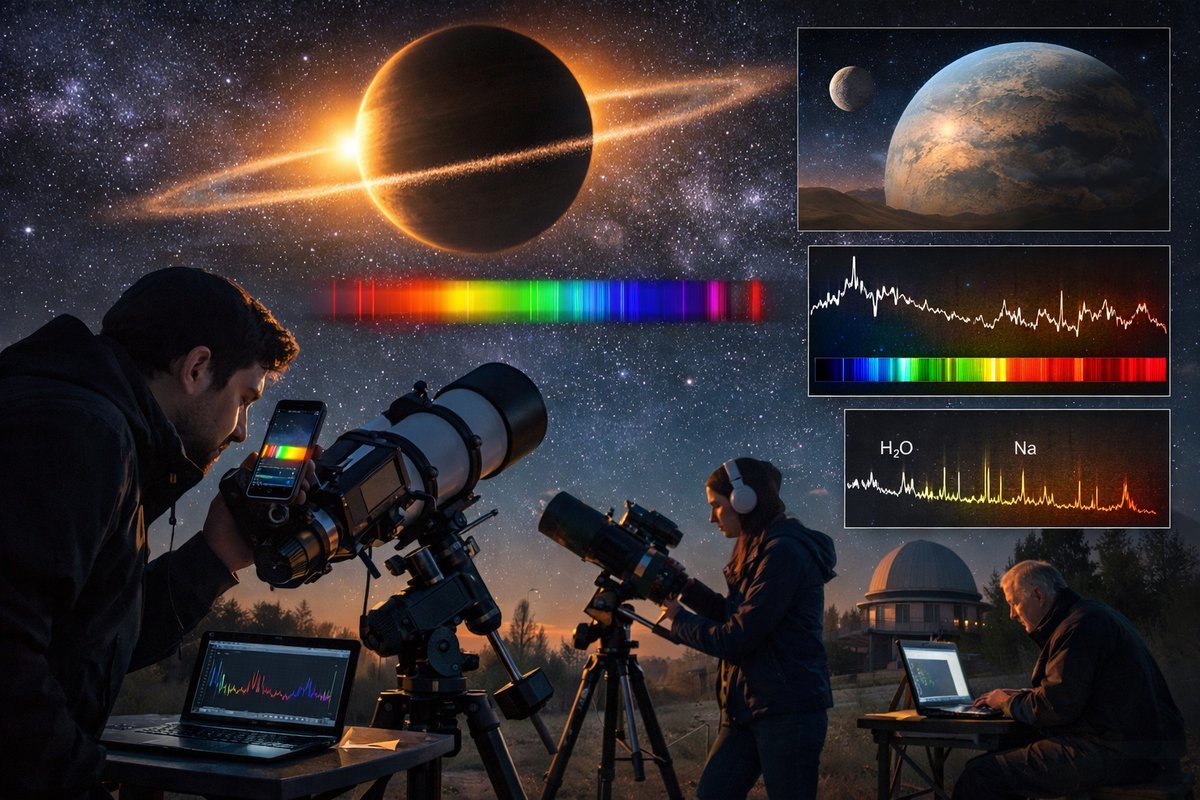
An emerging network of amateur and university astronomers is using handheld spectrographs attached to backyard telescopes to capture the fingerprints of water vapor and other molecules in distant exoplanet atmospheres. Their open-source data pipeline and smartphone-linked telescopes are broadening access to cutting-edge transit spectroscopy.
Amid a surge of public fascination with worlds beyond our solar system, a growing community of citizen astronomers has begun using portable spectroscopy equipment to probe the thin layers of gases enveloping distant exoplanets. By retrofitting mid-sized telescopes with handheld near-infrared spectrographs, these volunteers are collecting transit spectra during planetary eclipses and uploading calibrated data to a shared cloud platform.
Until recently, detailed analysis of exoplanet atmospheres required large, professional observatories or space telescopes. But advances in optical design and sensor miniaturization have driven down the size and cost of dispersive elements. In the past year, several teams operating from suburban rooftops and rural fields have detected features corresponding to water vapor, sodium, and titanium oxide in hot Jupiter-class planets, while tighter collaborations have even probed smaller Neptune-like worlds.
Key to this grassroots effort is a portable echelle spectrograph that weighs under two kilograms and attaches to off-the-shelf 10-inch telescopes. These spectrographs split incoming starlight into hundreds of narrow bands, producing a detailed intensity map as each exoplanet transits its host star. A typical observing run demands a stable mount, a precision focus mechanism, and active temperature control to reduce drift in the sensor array.
Teams also rely on custom microcontroller boards loaded with open-source firmware to synchronize data capture. Paired with LoRaWAN modules, these development boards coordinate multiple telescopes spread across several kilometers, ensuring that observations occur simultaneously under varying atmospheric conditions. The resulting differential spectra are then cross-checked in real time to filter out local weather effects and instrumental noise.
Data collected by citizen astronomers feed into a central repository, where a cloud-based pipeline performs wavelength calibration, flat-field correction, and telluric removal. The pipeline applies machine-learning models trained on professional observatory datasets to distinguish genuine molecular absorption lines from spurious artifacts. Once the cleaned spectra are validated, contributors receive automated reports that estimate species abundance and suggest follow-up targets.
So far, the network has confirmed water vapor signals in two hot Jupiters orbiting sunlike stars beyond 200 light-years. Observers have also noted tentative hints of metal oxides in one ultra-hot gas giant, though additional transits will be required to solidify that detection. The open nature of the project means that any skilled amateur with the right equipment can join in, broadening the geographical footprint of observations.
Beyond hardware, educational outreach has played a crucial role. Workshops led by university researchers teach volunteers how to build temperature-stabilized spectrographs, solder circuit boards, and write Python scripts for real-time data analysis. Outreach teams have even developed downloadable 3D printer files for spectrograph mounts and transmitter casings, allowing participants to fabricate custom parts locally.
The initiative underscores a larger trend toward democratizing access to scientific instrumentation. Just as open-source biology enabled backyard genomics, open-hardware astronomy is empowering citizen scientists to peer into planetary atmospheres. This model fosters collaborative discovery, as professional astronomers can request targeted follow-ups from the network when space telescope windows are limited.
The social dimension of this effort is equally compelling. Observers in Europe, Asia, and the Americas can contribute to the same transit event by aligning their schedules and equipment. A dedicated smartphone app sends real-time alerts when a chosen exoplanet is about to transit, instructing users to start data collection and track local weather forecasts. Once the observations are complete, the app guides them through a quality-check questionnaire before uploading the raw files.
Looking ahead, developers aim to extend the wavelength range of portable spectrographs into the mid-infrared, opening the door to detecting molecules like methane and carbon dioxide. Achieving that will require new sensor materials and cryogenic cooling systems-challenges that a close-knit maker community may be uniquely positioned to tackle.
This grassroots transit spectroscopy network is already reshaping how exoplanet science is conducted. By harnessing affordable technology, open-source software, and global collaboration, citizen astronomers are stepping into a domain once reserved for flagship space missions. Their work not only accelerates discoveries but also deepens public engagement with the search for other worlds.
In an era where big science often seems distant, this project reminds us that curiosity and creativity can flourish anywhere-from a suburban backyard to a community observatory-if the tools are within reach. As more volunteers build their own spectrographs and join the nightly vigil, the map of alien skies will become richer, and our understanding of planetary diversity will continue to expand.