Location
Mount Vernon, WA 98274

Location
Mount Vernon, WA 98274
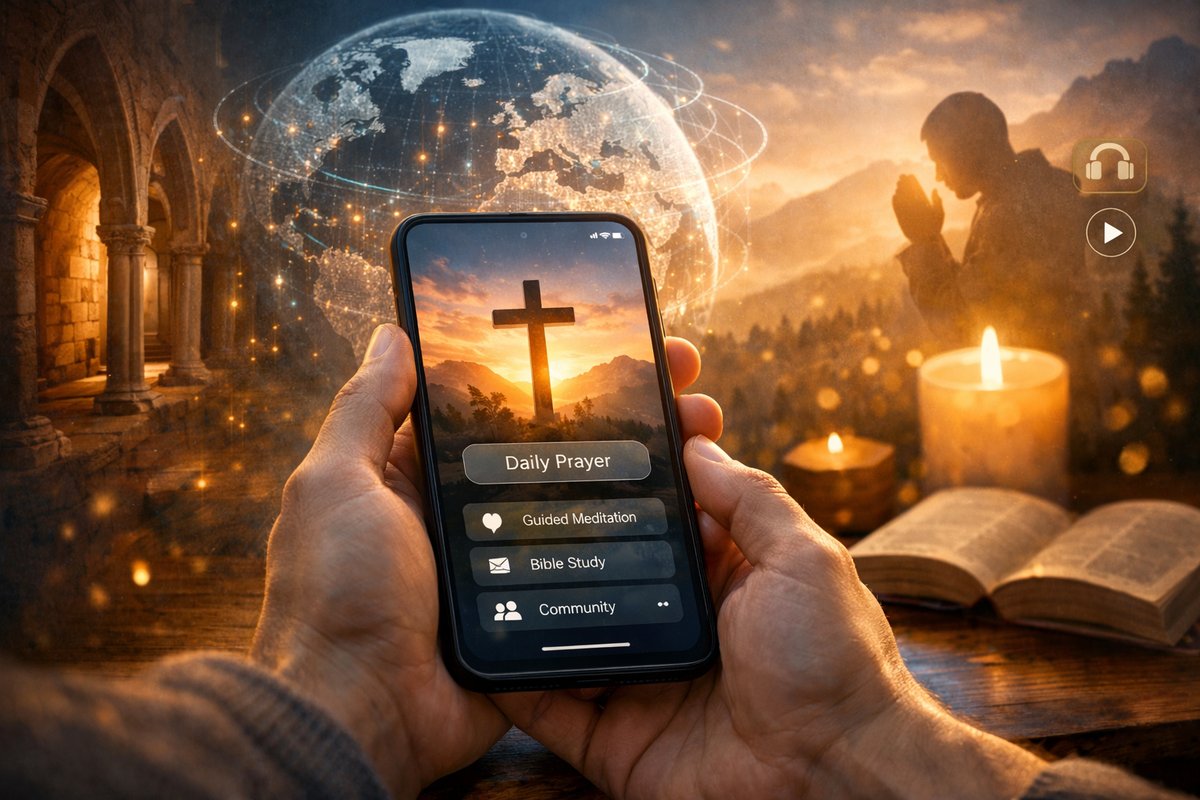
Across the globe, Christians are turning to smartphone-based retreat and prayer applications as new sanctuaries for reflection, community and spiritual growth. This digital monastic movement blends ancient disciplines with modern privacy tools and immersive features, offering fresh pathways to deeper faith beyond traditional walls.
In a quiet room half a world away, a young mother straps on a pair of noise-cancelling headphones, opens a retreat app and settles in for a forty-minute guided lectio divina session. Meanwhile, on a rural farm in southern Africa, a small group of believers gathers around a single tablet to stream a nightly prayer circle hosted by an overseas monastic community. What began as a handful of niche devotional tools a decade ago has blossomed into a thriving ecosystem of Christian retreat applications that promise moments of solitude, structured guidance and collective prayer on demand.
Recent data from a global digital-health analytics firm shows that downloads of faith-focused meditation and retreat apps grew by nearly 80 percent over the past two years. An independent survey of seven thousand respondents from four continents found that more than 40 percent of practicing Christians have used a guided prayer application at least once a week. Many report that these tools fill a gap between Sunday services and the demands of daily life, offering brief spiritual respites amid schedules packed with work, caregiving and social media noise.
At the heart of this movement is a desire for accessible, personalized spiritual practice. Traditional retreats-weekend workshops, overnight stays in hermitages or multi-day pilgrimages-often require time commitments and travel budgets that are out of reach for many families, students or urban professionals. Mobile apps, by contrast, can be used in five-minute increments on a lunch break, during a commute or before bedtime. They feature daily devotionals, scripture reflections, breathing exercises and guided imagery exercises that mirror long-standing monastic practices such as lectio divina (sacred reading), visio divina (contemplative vision) and examen prayer.
Privacy and security feature prominently in app design. As Christians who share personal struggles, doubts or confession prompts, users often prefer encrypted channels over public comment threads. Several leading applications now integrate end-to-end messaging so that small prayer groups can exchange requests and encouragement in a locked digital space. Some faith communities have even adopted open-source decentralized platforms, hosting their own servers to ensure member data remains under congregational control. This combination of spiritual depth and robust privacy is drawing interest from families dealing with sensitive issues, support networks for addiction recovery and believers in regions where religious expression carries social or legal risk.
Pastor L, who leads a mid-sized urban congregation, launched his own branded retreat app last year after seeing dramatic engagement drops in online worship services. “People crave intimacy with God, but they also crave confidentiality,” he says. His app offers a daily audio devotion, a private prayer journal function and a rotating menu of contemplative music tracks recorded by local musicians. Downloads tripled in the first three months, and nearly two-thirds of users opt in to weekly reminders designed to break screen fatigue by suggesting a digital sabbath: a twenty-four-hour period without other apps or social media.
Theological scholars caution that a full shift into digital spirituality may risk reducing deep practice to a series of notifications. “When silence and stillness become just another checkbox, we lose sight of the embodied dimensions of prayer,” notes a professor of Christian spirituality at a leading divinity school. Critics argue that the very screens meant to foster focus can become portals for distraction. In response, several applications now offer minimal interfaces devoid of colored icons or newsfeeds, and some even lock the device into a dedicated “prayer mode” that blocks incoming alerts from other apps.
Innovative features are also emerging at the intersection of faith and technology. Guided imagery segments use 360-degree soundscapes recorded in historic cathedrals, desert retreats and mountain monasteries, creating an immersive atmosphere that transports users beyond their surroundings. One pilot project pairs smartphone haptics with gentle pulse vibrations, designed to mimic the rhythm of contemplative breathing patterns found in Eastern and Western Christian traditions alike. Meanwhile, artificial-intelligence-driven devotion generators curate scripture passages and prayers tailored to individual spiritual seasons-grief, gratitude or discernment-based on brief self-assessments.
Community remains central to the digital monastery ethos. Some applications host live prayer rooms where believers join by audio or video, lighting virtual candles and offering intercessions in real time. Others foster small-group discipleship through asynchronous voice messages, linking people across time zones in shared study of a weekly Gospel passage. These digital cells often mirror the structure of ancient cenobitic communities, complete with designated prayer partners, accountability check-ins and seasonal liturgical calendars.
In parts of Latin America and East Asia, where rural congregations face long journeys to the nearest parish, low-bandwidth audio apps have become essential. Instead of video-heavy streams, users access nightly homilies and sung vespers as downloadable MP3 files. These bite-sized recordings take advantage of local FM radio networks and portable solar chargers-combining traditional airwaves with app-based libraries to overcome infrastructure challenges.
The rise of digital retreats has also sparked creative partnerships between tech developers and monastic orders. A Benedictine abbey in Europe recently opened its virtual doors, offering weekly mindfulness workshops via a dedicated app that integrates Gregorian chant playlists and guided tours of the abbey’s chapel through 3D-scanned models. Proceeds help fund restoration projects, bridging ancient stewardship of sacred spaces with contemporary tools for community outreach.
For many, the appeal lies not in flashy features but in the promise of a disciplined rhythm. In an age of constant connectivity, the digital monastery invites believers to reclaim moments of unhurried silence, Scripture immersion and intentional listening. As one longtime user puts it, “I never imagined pressing a button could lead me into such deep stillness. My phone has become a lantern in the dark.”
Questions linger about the ultimate shape of Christian practice in a digital age. Will screens supplant stained glass? Can code replicate the embodied wisdom of centuries-old rituals? Or will these apps become virtual stairways complementing-not replacing-our visits to church buildings, retreat centers and pilgrimage routes?
Whatever the answers, the swift adoption of retreat applications underscores a hunger for spiritual depth adapted to modern rhythms. In a world marked by rapid change, the digital monastery offers both shelter and pathway-inviting each user to explore, in solitude and community, the age-old invitation to seek God’s presence in every moment.
Quiet revolutions in worship and prayer often begin in unassuming ways: a gentle tap to start a meditation, the hush of a recorded chant, the shared echo of an online prayer group. As Christian communities continue to weave ancient practices into new digital fabrics, the contours of faith itself may be reimagined-one pixel at a time.