Location
Mount Vernon, WA 98274

Location
Mount Vernon, WA 98274
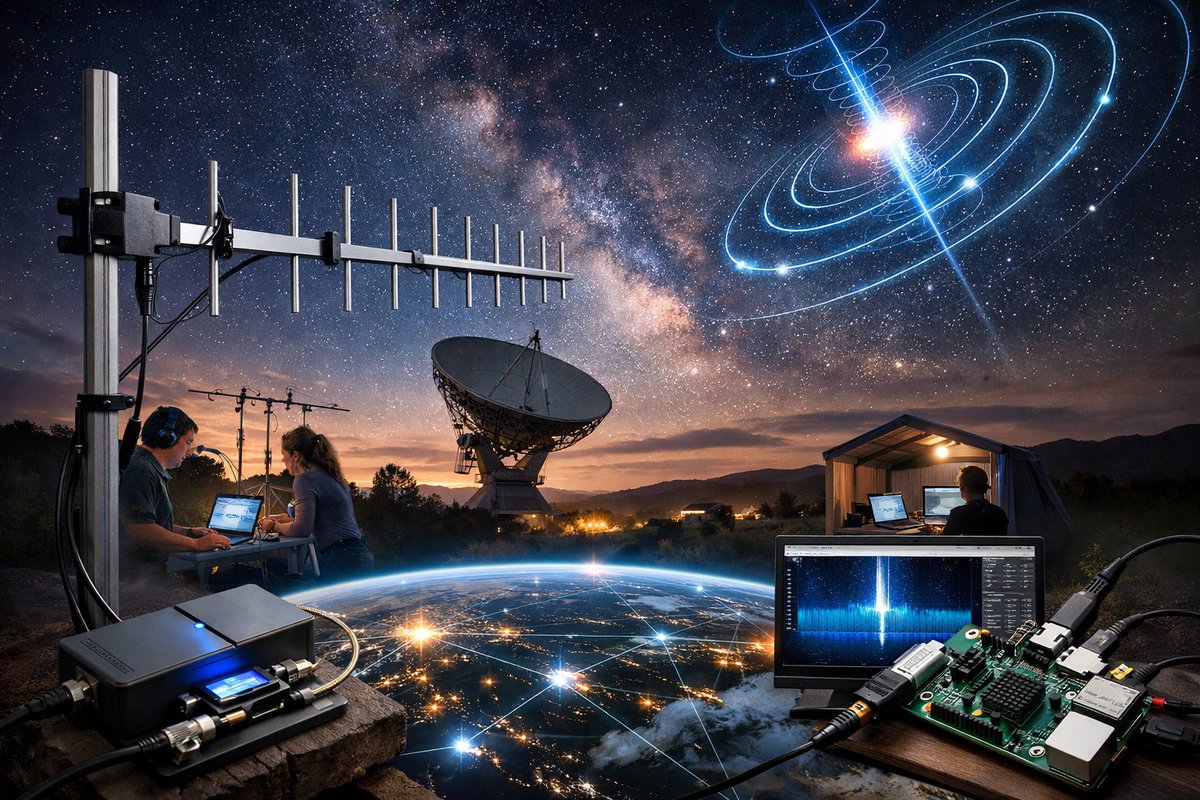
An international collaboration of amateur and professional astronomers has deployed a distributed network of low-cost radio telescopes to track and analyze fast radio bursts (FRBs). Using software-defined radio dongles, home-built Yagi-Uda antennas, and single-board computers, volunteers have helped pinpoint a repeating FRB source, shedding light on one of astronomy's greatest mysteries.
Fast radio bursts (FRBs) are intense, millisecond-long pulses of radio waves originating from galaxies billions of light-years away. First discovered a decade ago, FRBs have remained one of modern astronomy’s most tantalizing puzzles. Recent developments in signal processing and hardware miniaturization have made it possible for citizen scientists to join the hunt. A newly launched global network harnesses low-cost software-defined radio (SDR) receivers, single-board computers, and custom antennas to capture these fleeting cosmic whispers. This crowdsourced array is already contributing key observations, including the detection of a repeating burst pattern that may rewrite our understanding of the processes driving these enigmatic signals.
The brainchild of a consortium of university researchers and radio enthusiasts, the network invites volunteers to install compact radio receivers in backyards, observatory rooftops, or even on sailing vessels. Each node consists of a software-defined radio dongle connected to a single-board computer housed in a weatherproof enclosure. A lightweight Yagi-Uda antenna mounted on a simple mast supplies the necessary gain to capture signals from the 1.2 to 1.5 GHz band, where many FRBs have been recorded. Participants register their station’s location and calibration data through an online portal, which automatically schedules observing sessions and distributes real-time updates on candidate events.
Data acquisition at each site is orchestrated by custom open-source software. When the receiver picks up bursts of radio power exceeding a threshold, a short time-stamped snippet of raw spectral data is buffered and automatically uploaded to central servers. There, machine learning algorithms sift through thousands of recordings each night, distinguishing genuine cosmic signals from local radio interference-from household Wi-Fi routers, microwave ovens, and passing vehicles. Suspicious detections are flagged for human review, with volunteers granted access to an interactive dashboard where they can inspect time-frequency plots, adjust detection thresholds, and vote on the veracity of each candidate.
Within months of going live, the network achieved its first major success: a repeating FRB source located in a distant spiral galaxy. While professional observatories had previously cataloged dozens of one-off bursts, this is the first time a grassroots array has documented recurring pulses from the same sky coordinates. By correlating time stamps across multiple stations, the team was able to triangulate the burst’s position with an accuracy of under one arcminute. Follow-up observations with larger dishes confirmed the discovery, revealing subtle variations in the burst spectrum that hint at complex plasma interactions between the source and intervening intergalactic medium.
Scientific analysis of the repeating bursts suggests a connection to highly magnetized neutron stars known as magnetars. These exotic remnants of supernova explosions can produce enormous magnetic flares capable of accelerating charged particles to near-light speeds, potentially triggering radio bursts when interacting with surrounding material. Yet many questions remain unresolved. Do all FRBs originate from magnetars, or is there a diverse population of progenitors? Why do some sources repeat while others remain silent? The crowd-sourced network is uniquely positioned to address these puzzles by providing continuous, long-term monitoring at a fraction of the cost of major observatories.
Beyond the astrophysical insights, the initiative exemplifies a new model for distributed science. Volunteers report high levels of engagement, drawn by the thrill of discovery and the chance to contribute to frontline research. Regular webinars and online tutorials cover topics ranging from antenna assembly and radio interference mitigation to data analysis techniques and the astrophysics of neutron stars. A dedicated online forum allows participants to share calibration tips, troubleshoot hardware issues, and propose software enhancements. The project’s leaders emphasize that the transparency of methods and open availability of code are crucial to maintaining scientific rigor and replicability.
Field deployments are not without challenges. Urban participants must contend with dense networks of radio-frequency interference, requiring careful filtering and frequent recalibration. In remote or coastal locations, high winds and salt spray can degrade antenna performance, making weatherproof housings and corrosion-resistant mast fittings essential. Some citizen scientists have improvised solutions, such as protective mesh screens and lightweight fiberglass poles, demonstrating the innovation that thrives in a community-driven environment.
Power management is another critical consideration. Single-board computers and SDR dongles draw tens of watts during observing sessions, and continuous operation can strain residential electrical circuits. Many sites employ portable power banks or dedicated solar panels paired with battery controllers to ensure uninterrupted data collection. Remote volunteers on sailboats or in off-grid communities appreciate the project’s guidance on energy-efficient configurations and power budgeting. The ability to run a station entirely on renewable energy sources underscores the initiative’s commitment to sustainability.
Looking ahead, the network plans to expand into the southern hemisphere by collaborating with astronomy clubs in Australia, South Africa, and Chile. This geographic diversity will improve sky coverage and enable simultaneous multi-latitude observations, critical for disentangling atmospheric effects from true astrophysical signals. By integrating optical and high-energy follow-up observations, the team hopes to capture multiwavelength counterparts to FRBs, offering a more complete picture of these cataclysmic events.
Beyond fast radio bursts, the same infrastructure can be repurposed for other scientific applications. Researchers are exploring the network’s potential to monitor solar radio bursts, track ionospheric disturbances caused by geomagnetic storms, and even detect airborne space debris re-entry events through their radio signatures. The flexible, modular design of the hardware and software stacks makes rapid adaptation to new use cases straightforward, encouraging creativity among participants and maximizing the impact of each station.
In an era when large scientific instruments often demand budgets measured in hundreds of millions, this citizen-driven approach provides a compelling counterpoint. By leveraging advances in digital signal processing, affordable electronics, and community engagement, the project has democratized access to radio astronomy. Enthusiasts contribute not only data but also fresh ideas, fueling an iterative cycle of innovation that professional institutions can tap into. The result is a vibrant ecosystem where curiosity, precision, and collaboration converge to advance our understanding of the cosmos.
As the network grows, so does its scientific reach. The discovery of a repeating fast radio burst from a remote galaxy stands as proof of concept, demonstrating that distributed sensing networks can achieve high-impact results. With new stations coming online, enhanced data pipelines, and an ever-expanding volunteer base, the project is poised to unlock further secrets of the universe-one fleeting radio flash at a time.