Location
Mount Vernon, WA 98274

Location
Mount Vernon, WA 98274
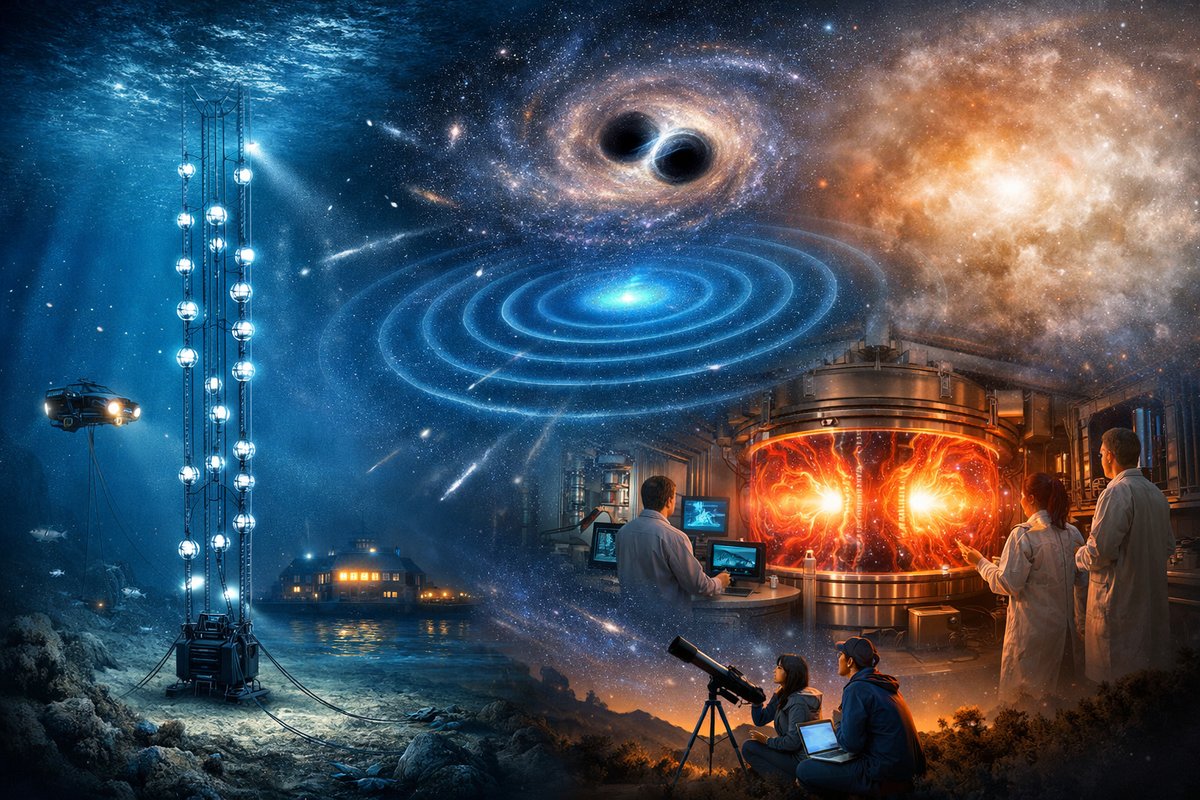
A new international initiative is deploying deep-sea neutrino detectors, lab-scale plasma experiments, and citizen-science projects to capture the universe's oldest particles-ghostly messengers that predate the first photons. By combining underwater observatories with gravitational-wave networks and hypersensitive lab setups, researchers aim to reconstruct the cosmos before light could escape its primordial fog.
Cosmologists are embarking on a bold effort to detect the faintest remnants of the universe’s earliest epochs-ancient neutrinos that streamed freely moments after the Big Bang. Unlike the well-studied cosmic microwave background, which traces light from 380,000 years post-expansion, these “relic neutrinos” were dispatched less than a second after the initial inflation. Capturing them would rewrite our understanding of fundamental physics and offer a glimpse into a realm uncharted by photons.
At the heart of this campaign lies a network of deep-sea neutrino detectors anchored in the darkest ocean trenches. Hundreds of pressure-hardened photomultipliers will line vertical strings, listening for the telltale flashes produced when a neutrino collides with a seawater nucleus. By situating these sensors two kilometers below the surface, researchers minimize background noise from cosmic rays and terrestrial radioactivity. The Pacific deployment, alongside planned sites in the Mediterranean and the Indian Ocean, will create a nearly global neutrino array.
But underwater observatories alone cannot capture relic neutrinos, whose energies fall well below the threshold of conventional detectors. To reach these ghostly particles, scientists are developing superconducting bolometers capable of sensing minute temperature spikes from neutrino absorption. Prototypes cooled to millikelvin temperatures are undergoing environmental tests in laboratory cryostats. These devices must distinguish genuine neutrino events from vibrations, thermal fluctuations, and electromagnetic interference-no small feat when the signal can be a thousand times weaker than the lab’s own thermal noise.
Complementing the sea-floor rigs and cryogenic bolometers, high-energy particle accelerators are recreating conditions akin to the infant universe. By colliding heavy ions at near-light speed, experiments generate a fleeting quark-gluon plasma, a soup of subatomic particles that pervaded the cosmos microseconds after the Big Bang. Detectors surrounding the collision chamber map the flow of particles as the plasma cools and condenses. These data refine theoretical models of neutrino decoupling and the behavior of dark matter candidates under extreme conditions.
Meanwhile, the gravitational-wave observatory network has found a new role as a time-stamp for cosmic events. Ripples in spacetime from early phase transitions could coincide with neutrino emissions, offering cross-correlation opportunities. By synchronizing triggers from interferometers on three continents with neutrino detectors-both undersea and underground-researchers hope to converge on simultaneous signals that mark the same primordial process.
Dark matter filaments, too, may be illuminated by this multidetector strategy. As relic neutrinos traverse large-scale structures, their trajectories should be subtly deflected by concentrations of unseen mass. Mapping slight anisotropies in neutrino arrival directions could sketch the web of dark matter that binds galaxies. This approach complements ongoing lensing surveys and X-ray mapping of hot gas, promising an independent probe of the universe’s invisible scaffolding.
In parallel, a suite of tabletop experiments invites citizen scientists to build their own cloud chambers and cosmic-ray detectors. DIY kits are already in circulation at schools and science fairs, demonstrating how charged particles carve ion trails in supersaturated alcohol vapor. While these chambers detect high-energy muons rather than low-energy neutrinos, they foster public engagement and sharpen skills in data logging and pattern recognition. Enthusiasts are encouraged to submit visual tracks to online platforms, where machine-learning tools classify event types and flag anomalies.
To support this ground-up movement, an open-source data portal will host neutrino candidate events, gravitational-wave triggers, and lab accelerator logs. Participants can access simplified analysis pipelines, plot arrival times, and explore correlations across data streams. In teaching modules, students learn the physics behind neutrino oscillations, the role of gauge bosons in weak interactions, and the influence of cosmic inflation on particle densities. Educators praise the initiative for blending theory, coding skills, and hands-on experimentation.
The collaboration’s scientific advisory board emphasizes stringent calibration standards. Every detector’s timing must be synchronized to better than a few nanoseconds, and sensor gains are cross-checked with known neutrino sources such as the Sun and supernova remnants. Blind injection tests-where artificial signals are inserted without analysts’ knowledge-ensure that spurious artifacts don’t masquerade as groundbreaking detections.
Early results from pilot detectors have already demonstrated sub-milli-electronvolt sensitivity in cryogenic bolometers, surpassing previous records. Meanwhile, the Mediterranean prototype site has logged tens of thousands of muon tracks, refining background rejection algorithms. As acoustic positioning beacons and pressure sensors maintain the geometry of the undersea array, researchers adjust the vertical spacing of sensor modules to optimize coverage of different neutrino energy bands.
Looking ahead, the group envisions satellite missions that host neutrino detectors in a low-background environment above Earth’s atmosphere. Concepts include inflatable Cherenkov detectors that deploy around small spacecraft or piggyback instruments aboard cosmic microwave background survey satellites. In deep space, far from terrestrial noise, such sensors might directly intercept relic neutrinos with sufficient exposure.
Theoretical physicists are meanwhile exploring the implications of a successful measurement. Confirming the predicted relic neutrino density and temperature would validate key aspects of the Standard Model of cosmology and particle physics. Deviations could hint at sterile neutrinos, asymmetries in matter-antimatter production, or evidence for extra dimensions. A precise neutrino map from the universe’s infancy might even constrain models of cyclic cosmologies or pre-Big Bang physics.
Ultimately, the quest for ancient neutrinos represents more than a technical challenge-it is a journey into our cosmic origins. By uniting oceanographers, particle physicists, data scientists, and amateur astronomers, the initiative embodies a spirit of global inquiry. Every neutrino captured is a fragment of a story that began before light ever shone, a whisper from a time when the universe was at once simpler and more mysterious than we can fully imagine.