Location
Mount Vernon, WA 98274

Location
Mount Vernon, WA 98274
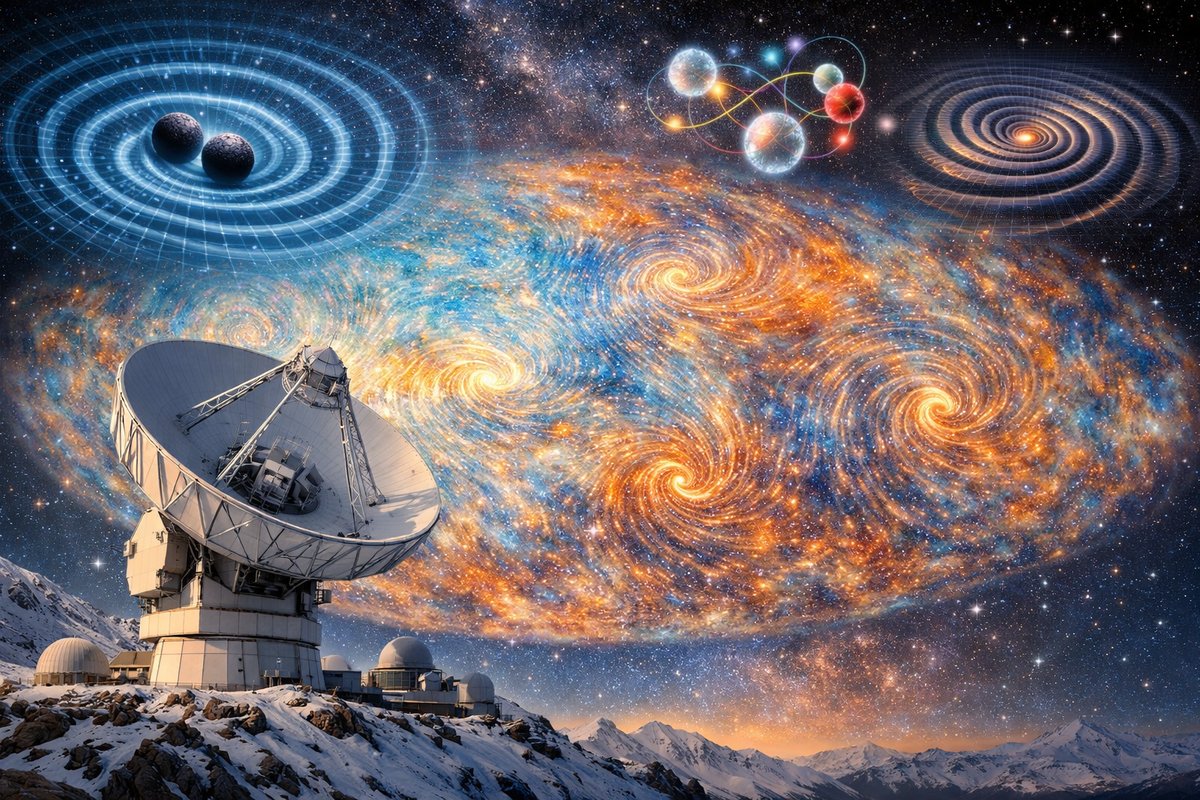
A recent release of high-resolution polarization data from a major ground-based microwave telescope reveals subtle patterns in the cosmic microwave background. These swirling signatures offer fresh clues about primordial gravitational waves, neutrino relics, and the fundamental forces that shaped the universe's first instants.
Scientists operating a high-altitude telescope in the Atacama Desert have unveiled the most detailed polarization map of the cosmic microwave background (CMB) to date. By measuring the orientation of faint microwave fluctuations across the sky, researchers can tease out subtle signals imprinted by rapid expansion, known as inflation, and the gravitational waves that rippled through space-time in the universe’s first trillionth of a second.
The new data set, covering nearly a third of the sky, captures two types of polarization patterns-so-called E-modes and B-modes. While E-modes arise largely from density variations in the primordial plasma, B-modes can result from gravitational lensing of those E-modes or directly from primordial gravitational waves. Distinguishing between these sources has long been a challenge, but advanced statistical methods combined with multi-frequency observations are now peeling back layers of cosmic fog.
On the ground, the Atacama telescope’s ultra-sensitive detectors, cooled to fractions of a degree above absolute zero, collect microwave photons passing through our galaxy’s dusty foregrounds. By comparing observations at different frequencies, scientists subtract out galactic emission to isolate the pure cosmological signal. Early results hint at a tiny B-mode excess on large angular scales-just enough to rekindle hopes of a direct window into inflationary physics.
Gravitational wave observatories like LIGO, Virgo, and KAGRA complement these findings by listening for the stochastic gravitational-wave background generated throughout cosmic history. Although direct detection of a primordial background remains out of reach for ground-based interferometers, ongoing upgrades in sensitivity and new data analysis pipelines are shrinking the gap. A combined approach-pairing microwave polarization with gravitational-wave searches-promises a multi-messenger portrait of the early universe.
Beyond photons and gravitons, the universe’s first seconds also produced a sea of neutrinos that has long evaded direct detection. Known as the cosmic neutrino background, these relic particles stream through us by the trillion every second. Laboratory experiments such as KATRIN have placed ever-tighter bounds on the neutrino mass, while ambitious proposals like the PTOLEMY project aim to capture low-energy cosmic neutrinos directly, using advanced tritium-based detectors parked deep underground.
Dark matter candidates, including axions and dark photons, could also leave fingerprints in the polarization map or in tiny distortions of the CMB spectrum. Microwave cavities in experiments like ADMX and resonant detectors searching for dark photons are probing the parameter space where these particles might dwell. A detection of a dark sector signal would rewrite our understanding of how the universe’s mass and energy budget evolved.
A surprising twist comes from hints of cosmic birefringence-a subtle rotation of polarization angles over vast distances. If confirmed, this effect could signal new physics that violates classical parity symmetry, such as coupling between photons and ultralight axion fields. Multiple teams are racing to cross-check results using independent telescopes and analysis codes, mindful that systematic errors in instrumentation or foreground subtraction can mimic genuine cosmic signals.
Despite these advances, foundational puzzles remain. The horizon problem asks how regions separated by billions of light-years share identical temperature to a part in a hundred thousand. The flatness problem questions why spatial curvature appears so nearly zero. Both find elegant resolution in inflationary theory, yet the driving mechanism-whether a simple scalar field, a high-energy phase transition, or something more exotic-remains uncertain.
At the intersection of cosmology and quantum mechanics, theorists wrestle with the information paradox and the nature of space-time itself. Does the universe emerge from a pre-existing quantum foam? Could our Big Bang be one bounce in an eternal cosmic cycle? Loop quantum gravity and string theory provide candidate frameworks, but testable predictions have been scarce-until now, perhaps, as observational cosmology presses into previously unreachable regimes.
New observatories on the horizon include the Simons Observatory and the CMB-S4 network, which will deploy thousands of detectors for even finer angular resolution and sensitivity. In space, the LiteBIRD satellite is slated to map polarization across the whole sky at multiple frequencies, free from atmospheric interference. Together, these instruments could definitively confirm or rule out primordial B-mode signals down to tensor-to-scalar ratios near 10-3.
Meanwhile, next-generation gravitational wave facilities such as the Cosmic Explorer and the Einstein Telescope aim to push detection bands toward lower frequencies, opening a direct channel to the primordial gravitational wave background. By combining cosmic microwave, gravitational wave, and neutrino signals, researchers envision a richly layered narrative of the universe’s earliest heartbeat.
On the laboratory front, quantum simulators-arrays of ultracold atoms manipulated with laser fields-are being designed to mimic the dynamics of inflationary phase transitions. Though far removed from cosmological scales, these tabletop experiments can test key features of scalar field dynamics, symmetry breaking, and particle production in controlled settings, providing invaluable guidance to theoretical models.
For curious minds, these breakthroughs illuminate humankind’s quest to trace its origins back to the first flickers of creation. From the precise alignment of microwave detectors in the high desert to the deep underground laboratories hunting ghostly neutrinos, a tapestry of ingenuity spans continents and disciplines. Every new data release not only challenges our understanding but also inspires fresh questions about the nature of reality.
As polarization maps sharpen and new observatories come online, the cosmic dawn is poised to yield its deepest secrets. Whether it be a faint B-mode swirl, a neutrino whisper, or a gravitational tremor, each signal carries the imprint of forces and particles that shaped everything we know-and everything we have yet to imagine.