Location
Mount Vernon, WA 98274

Location
Mount Vernon, WA 98274
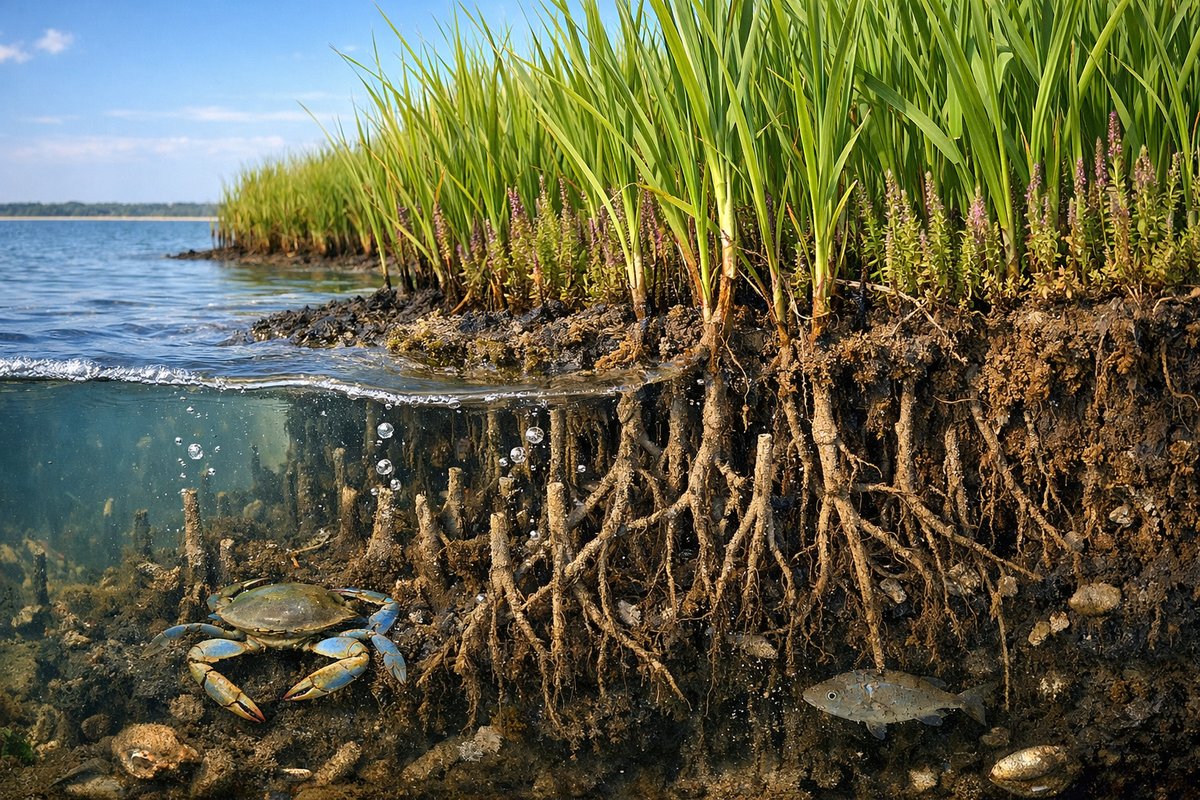
A new international study reveals that salt marsh vegetation uses oxygen‐releasing roots to forge natural seawalls, stabilizing sediment and boosting carbon storage. These 'breathing roots' could redefine coastal resilience strategies amid accelerating sea level rise.
Along many temperate coastlines, salt marshes serve as the unassuming frontline against storm surges and erosion. In a recent study published in a leading ecology journal, researchers have uncovered a hidden mechanism by which marsh plants actively engineer their own defense systems. By channeling oxygen from shoot to root tips, these plants foster mineral coatings that lock sediment in place-effectively building living breakwaters that grow stronger with each tidal flush.
The research team deployed drone‐based LiDAR scans across several North American and European marshes, mapping elevations before and after high‐tide events. They discovered that patches dominated by smooth cordgrass (Spartina alterniflora) gained up to three centimeters of elevation each year, even as regional sea levels rose by nearly three millimeters annually. To probe the microscopic processes, scientists carried out sediment core sampling down to half a meter, combining oxygen microelectrodes with iron isotope analysis.
Their findings show that oxygen expelled by roots oxidizes dissolved iron in the waterlogged soil, precipitating rust‐colored iron hydroxides around root channels. These mineral deposits bond clay and silt particles together, creating stiffer, more erosion‐resistant structures. Over time, the aggregated sediment forms ridges that diffuse wave energy before it reaches upland areas.
“We used to think marsh plants were purely passive victims of inundation,” said one marine ecologist involved in the study. “But here we see a dynamic, self‐reinforcing system: the more salt marsh thrives, the more it fortifies the shore.” This biological mineralization also slows organic matter decay, effectively locking away carbon that would otherwise escape as carbon dioxide.
Salt marshes already rank among the most efficient coastal carbon sinks, sequestering roughly 0.15 gigatons of CO₂ each year-equivalent to taking more than 30 million cars off the road. This newly described oxygenation process could raise sequestration rates even further by stabilizing peat deposits, ensuring they remain buried rather than oxidized.
But the benefits extend beyond carbon. By reducing sediment loss, breathing roots support habitat complexity that attracts juvenile fish, migratory shorebirds, and invertebrates. Laboratory trials demonstrated that sediment aggregates around root zones contain up to 40 percent more microfauna diversity compared to bare flocculent mudflats. In turn, this boosts nutrient cycling and overall marsh productivity.
Despite these advantages, salt marshes face mounting threats. Coastal development, shoreline armoring, and upstream damming have already reduced global marsh area by nearly a third in the last half-century. As sea levels accelerate, many marshes lack the space or sediment supply to migrate inland. The study’s coauthors urge that conservation plans incorporate the breathing‐root phenomenon when evaluating restoration success.
In practice, this means selecting plant species with the highest oxygen‐release capacity and ensuring sufficient sediment delivery during restoration. It may also involve creating shallow tidal channels to disperse sediment-laden water across marsh plains. By aligning engineering designs with these natural mineralization pathways, coastal managers can foster self‐maintaining ecosystems that adapt to changing conditions.
The implications reach far beyond salt marsh fringes. Similar geochemical feedbacks could occur in mangrove forests, seagrass beds, and freshwater wetlands-habitats that collectively shield our shorelines and store vast carbon stocks. Ongoing research is now testing whether root oxygenation can be enhanced by breeding strains with higher root porosity or by applying biodegradable amendments that stimulate iron cycling.
For communities vulnerable to hurricanes and king tides, the breathing root model offers a blueprint for low‐impact shoreline defense. Field trials are already underway in several European estuaries, where pilot marsh restorations incorporate gentle slope gradients and sediment infusion strategies. Preliminary results suggest that combining engineered sediment pumps with cordgrass plantings accelerates natural ridge formation by up to 50 percent compared to standard methods.
Ultimately, this discovery underscores a larger lesson: effective climate adaptation solutions often lie within nature’s own toolkits. By observing and harnessing the subtle chemistry of marsh plant roots, scientists have opened a new chapter in eco-engineering. In an era of rising seas and tightening budgets, living infrastructures like salt marshes may prove our best-and most resilient-allies.
As policymakers, engineers, and conservationists embrace these insights, they’ll be tasked with striking a balance between technological intervention and ecological stewardship. But the message is clear: when given the right conditions, salt marshes don’t just withstand change-they actively shape their own survival.
With breathing roots at work beneath every tide, the coastlines of tomorrow may be stronger, greener, and more stable than ever before.